How Duluth custom home builders charge what their work is actually worth.
I’ll tell you what most marketing agencies won’t admit. Most Duluth custom home builders price their projects based on what competitors charge. The ones billing $2.4M for the same square footage priced based on what their portfolio justifies.
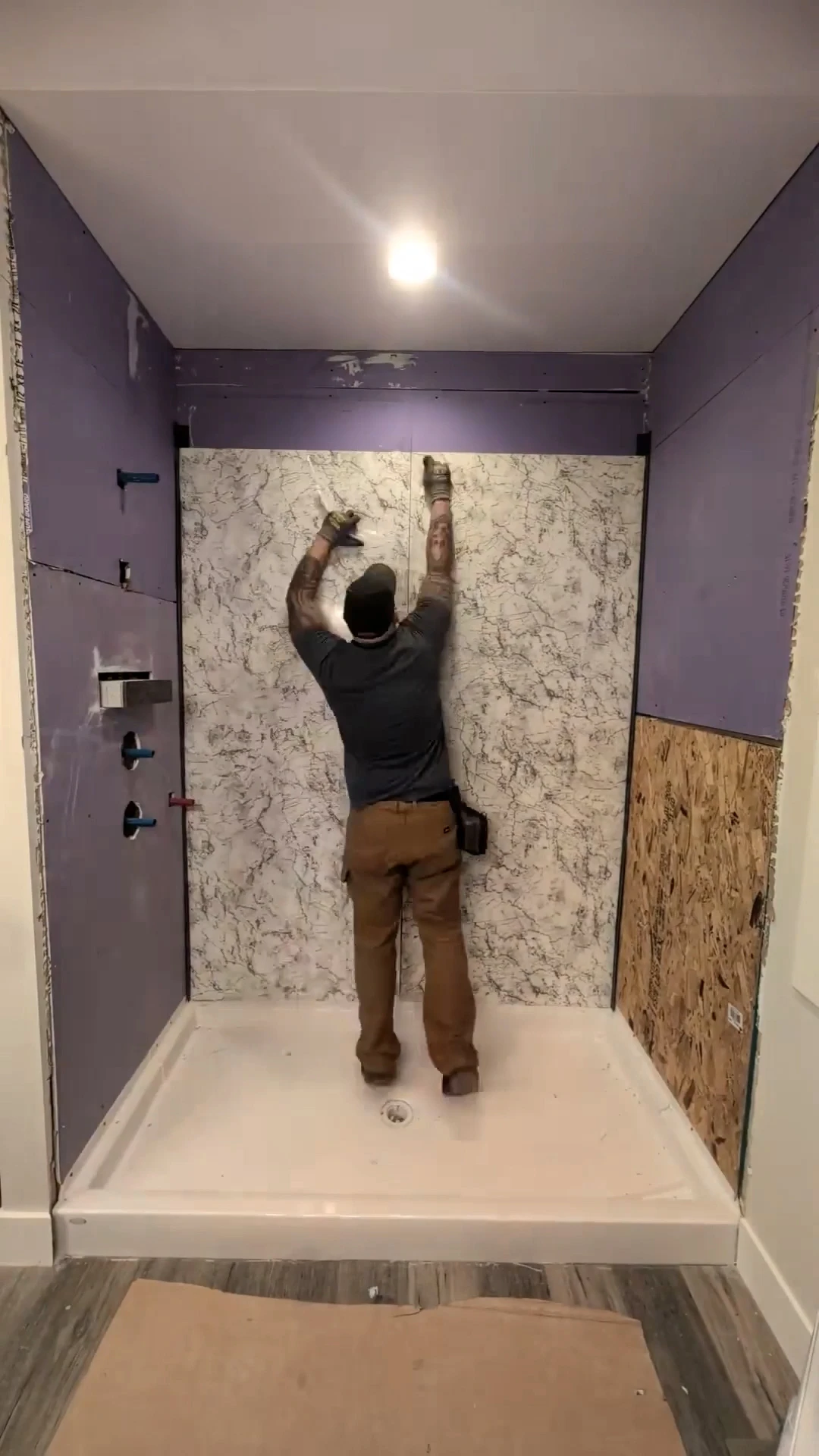
You’re a $1.6M builder priced like a $1.1M builder.
Here’s the thing. Most Duluth custom home builders pull their pricing from one place: what the contractor down the street charges. He’s at $1.1M average on a 5,500 sq ft Sugarloaf build, so you’re at $1.1M too — give or take a few percent based on finish selections. That’s not pricing. That’s flinching.
Real talk: the Sugarloaf Country Club and Chattahoochee Run lot buyers have already decided to spend $1.5M to $2.4M before they ever call a builder. The number was set when they signed the lot purchase. The only question they’re answering on the calls that follow is — which builder’s brand, portfolio, and presentation feels worth that number. And if your website, proposal book, and intake conversation look identical to a production builder charging $900K, you’ll get the $900K offer. Not because they’re cheap. Because you signaled $900K.
If you’ve built four Sugarloaf homes a year for the last six years at an average of $1.1M, here’s the math you don’t want to look at: that’s $1.3M a year in revenue you’re handing to the competing builder whose presentation feels more like the home itself. Same trade base. Same craftsmanship. Different brand altitude.
Duluth’s luxury buyers aren’t shopping price — they’re shopping fit with the home they’ve already pictured. The builder whose brand mirrors that home’s tone wins the contract at the number the buyer was always going to pay. You either look like that number, or you become the comp they use against the builder who does.
The good news? Premium repositioning a Duluth custom builder takes about 90 days. You don’t need new crews, a new shop, or new architectural relationships. You need the brand to finally match the work.
Mid-market positioning vs. luxury-tier positioning
Same builder. Same trades. Same finish quality. Completely different annual revenue.
| The brand experience | Mid-market builder | Luxury-tier builder |
|---|---|---|
| Website hero | “Quality custom homes in Gwinnett — affordable, on time” | Twilight estate exterior, no headline, just a name |
| Portfolio lead-in | 14 homes, mixed tier, $480K to $1.3M shown | 6 homes, $1.6M minimum, photographed at golden hour |
| Average project value | $1,100,000 | $1,640,000 |
| Annual revenue (4 builds) | $4.4M | $6.56M |
| Lead source | Lot referrals, basic Google search | Architect referrals, Sugarloaf word-of-mouth, country club intros |
| Inquiry-to-contract | 17% close rate, 3 estimates per close | 52% close rate, 1.4 estimates per close |
The single hero image on a luxury-positioned builder’s homepage — twilight, no caption, no claim. The image is the claim.
Stop showing 14 homes. Start showing 6. Stop quoting first. Present first.
You’ve probably noticed that every Duluth custom builder’s portfolio page works the same way. A grid of every home they’ve ever built — from the $480K spec house in Berkeley Lake to the $2.1M Sugarloaf estate. The thinking: “show range, show capability.” The result: every $1.6M+ prospect sees the $480K spec house and immediately categorizes you as mid-market. Your most expensive project just got dragged down by your least expensive one sharing the same page.
The Duluth builders winning Chattahoochee Run and Sugarloaf contracts do the opposite. Six homes on the portfolio. Minimum project value $1.6M. Every photo shot at golden hour or twilight by a luxury real estate photographer. No square footage badges. No “starting at” pricing. No client testimonials with first-name-last-initial. Just the work, presented like it’s in Veranda magazine. Because that’s the magazine your prospect is comparing it to.
Same logic on the proposal side. The mid-market builder sends a 4-page Word doc with line-item pricing on day one. The luxury-tier builder sends a leather-bound portfolio book and schedules a 90-minute design presentation at the prospect’s existing home. By the time price is discussed — week three — the prospect has already mentally signed. They’re not comparing your number to a competitor’s. They’re comparing your number to the experience of living in the home you’ve already shown them.
Your portfolio is your price tag. A Duluth builder showing $480K specs and $2.1M estates on the same page is telling the $1.8M buyer he’s negotiable. The builder showing only six $1.6M+ homes is telling him the number is the number.— What 18 Sugarloaf-area builder repositioning projects have taught us
This isn’t about pretending. If your work genuinely justifies $1.6M+ — your trim package, your foundation specs, your project management cadence — then leading with anything less actively costs you. The buyer who wants premium needs you to look premium. Everything else is leakage.
Four shifts. Premium project tier, locked in.
Every luxury-repositioned Duluth builder we’ve worked with rebuilt around the same four shifts. None require changing what you build. All change who shows up at the first meeting — and what they’re willing to pay.
What changes when you reposition from mid-market to luxury-tier.
None of these work alone. A luxury website with a mid-market intake call fails the second touchpoint. A great proposal book with no architect relationships never gets opened. The whole presentation has to align — from search result to signature.
A portfolio-led website that presents like a luxury monograph, not a contractor brochure.
Six homes maximum. $1.6M minimum project value. Twilight and golden-hour photography only. No square footage tickers, no service-area chips, no “starting at” pricing — none of the mid-market noise. The site behaves like a Veranda feature, because that’s the visual language the Sugarloaf buyer is fluent in. Our premium builder web design work strips out everything that signals “contractor” and rebuilds the site to signal “atelier.” That single change usually moves average project value $300K–$500K within two build cycles.
A leather proposal book — and a design presentation, not a quote.
The first meeting is a 90-minute design presentation at the buyer’s existing home. Price is week three, not day one. That single sequencing change doubles close rate on Sugarloaf prospects.
Architect and country club relationships, not Google Ads.
Luxury Duluth contracts route through architects, designers, and the Sugarloaf member network. Show up there. Spend zero on lead gen ads. The lead source itself signals tier.
Patience pricing — and the willingness to walk away from a $900K bid.
Premium positioning only works if you actually hold the line. Quote the $1.6M number. Let the $900K buyer walk. Two refusals and a luxury photo set will reset what your inbound traffic looks like inside one quarter — and the next four Sugarloaf prospects will arrive expecting your number, not arguing against it.
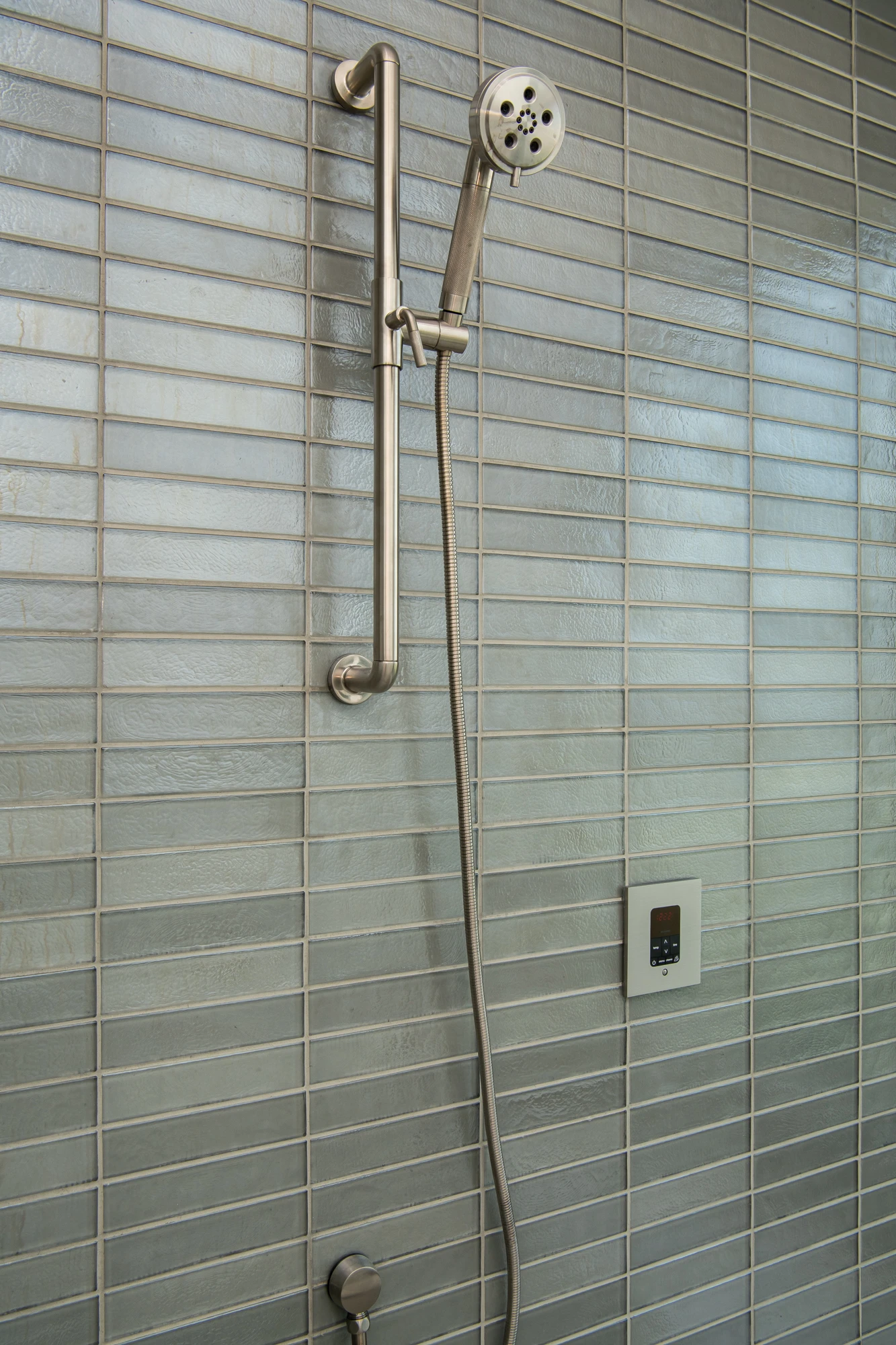
A Chattahoochee Run interior the way luxury-tier builders present it — wide-angle, natural light, no signage, no badge.
How we reposition a Duluth custom builder from mid-market to Sugarloaf-tier.
Audit and edit the portfolio
We review every build of the last 5 years, identify the 6 strongest projects above $1.6M, and commission luxury real-estate photography of each at golden hour. Everything below that tier comes off the public site. We rewrite project descriptions in monograph voice — architect, finish materials, design intent. No square footage. No price.
Rebuild the brand stack
New website, new leather proposal book, new intake script, new design-presentation framework. We script the 90-minute first meeting end-to-end. We build the architect and Sugarloaf member outreach list. We retire every mid-market lead source you have and replace it with two referral channels — design firm partnerships and Chattahoochee Run word-of-mouth seeding.
Hold the line and compound
By month 9 your average project value is $1.6M+, your close rate on premium inquiries is past 50%, and your inbound mix is architect-referred and country-club-introduced rather than Google-form-filled. Annual revenue rises $1.3M+ at identical build volume — and once you’re the named builder in two Sugarloaf cul-de-sacs, that position compounds for a decade.
The Sugarloaf builder who pulled 9 homes off his portfolio and added $1.4M in annual revenue.
A custom home builder working the Sugarloaf and Chattahoochee Run corridor was averaging four builds annually at $1.1M with a portfolio page showing 15 projects — ranging from a $520K spec in Berkeley Lake to a $2M Club Drive estate. We edited the portfolio to six homes, all $1.6M+, reshot every exterior at twilight with a luxury real estate photographer, rebuilt the website to a portfolio-led monograph format, and introduced a leather proposal book paired with a 90-minute on-site design presentation as the new intake standard. Inside 9 months his average project value was $1.64M and his close rate on Sugarloaf inquiries had moved from 18% to 53%. Annual revenue jumped $2.16M to $6.56M at exactly four builds — same crews, same trades, same calendar.
Average signed project value, quarter over quarter after premium repositioning.
Luxury positioning compounds. Each Sugarloaf build becomes the social proof that pre-sells the next two — and the architect and country-club referral chain reaches further than any ad spend ever could.
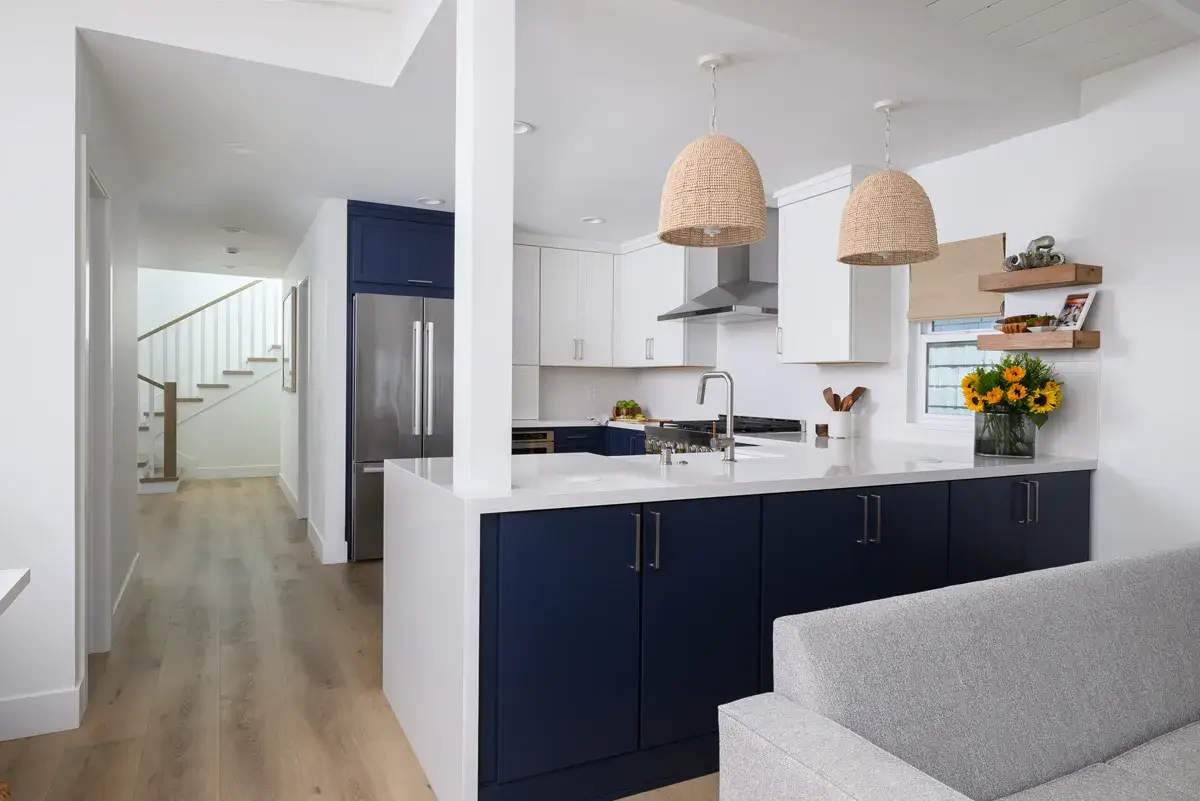
The kind of finish-level detail that justifies the $1.6M+ project tier — but only if your portfolio presentation lets the buyer see it before price.
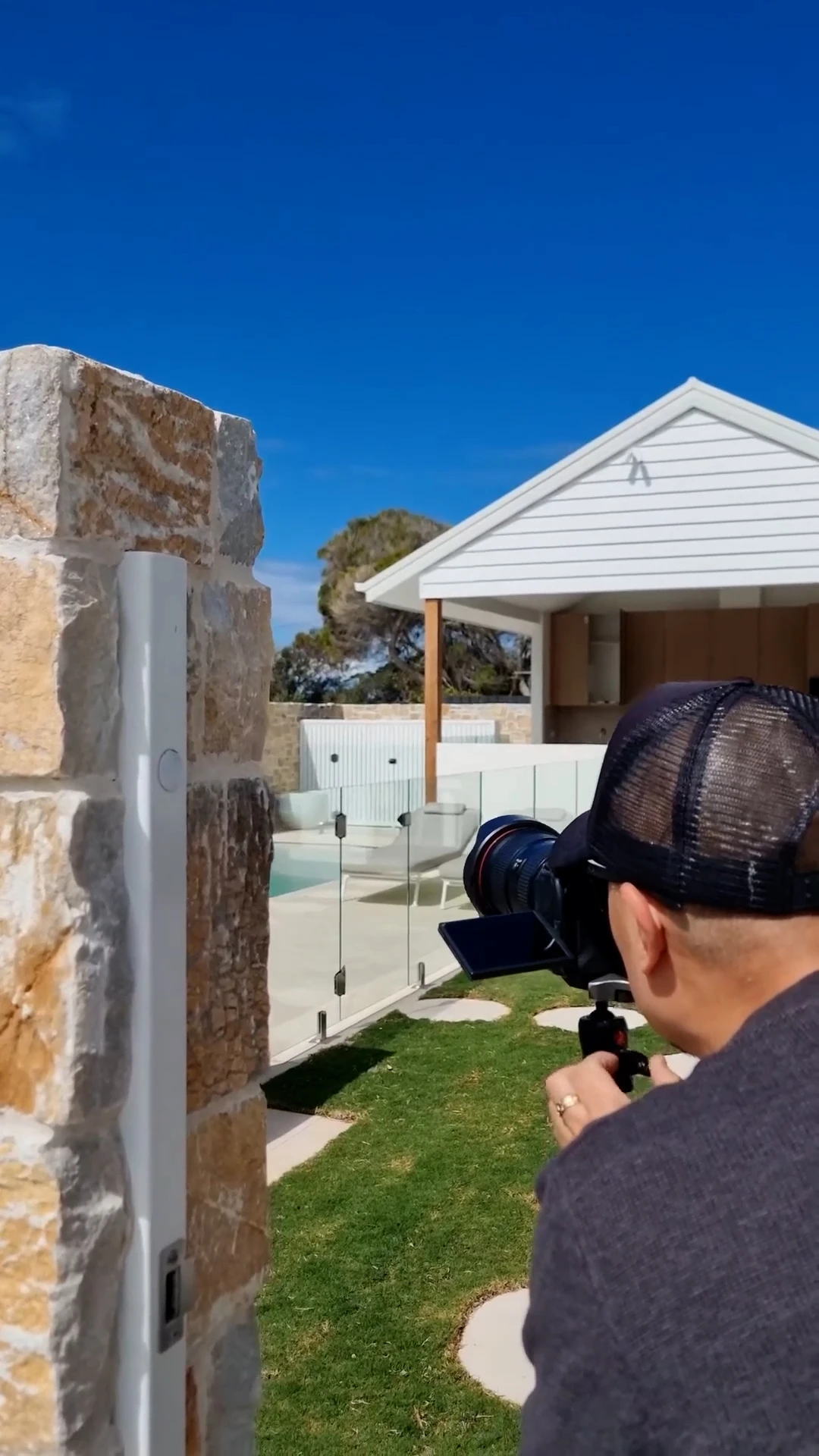
Behind the scenes of a builder content shoot — the assets that make a $1.6M brand look like a $1.6M brand online.
Six questions every Duluth custom home builder should ask before the next proposal.
Run your firm through these six questions honestly. The answers tell you exactly where premium project value is leaking out of your business — and how fast you can close the gap.
What’s the minimum project value on your public portfolio?
If you’re showing builds under $1.4M alongside $2M+ estates, you’re capping yourself at the lower number. Edit the portfolio. Lead luxury-only.
Who shot the exteriors on your site?
iPhone photos at noon won’t sell a Sugarloaf build. Luxury real estate photographers at golden hour or twilight are non-negotiable.
How quickly do you mention price in the first meeting?
If price comes up in week one, you’re a contractor. If it’s introduced in week three after a design presentation, you’re an architect’s peer.
How many active architect referral relationships do you have?
If it’s fewer than three, you’re missing the highest-quality channel in Duluth. Architects deliver pre-qualified, pre-budgeted prospects.
When did you last refuse a project under your minimum?
If “never,” your minimum isn’t real. Premium pricing only works if you’ll actually walk from the $900K bid. The walk-aways teach the market.
Does your proposal arrive in PDF or in leather?
The presentation format is part of the product at luxury tier. A leather portfolio book at a design meeting closes 3x what a PDF emailed at midnight does.
The kind of presentation Duluth’s premium-tier custom home builders use to make $1.6M feel like the obvious number.
What Duluth custom builders keep asking us about premium positioning.
No. Search engines reward depth, not project count. Six richly written project pages with luxury photography, architect credits, and finish detail will outrank 15 thin portfolio entries — and you’ll attract the high-intent searcher specifically looking for that tier of work.
Finish the work that’s already under contract. The repositioning applies to new inquiries only. Most Duluth builders we work with run their old pipeline alongside the new positioning for 4–6 months while the luxury lead flow builds, so there’s no revenue gap during transition.
Our typical Duluth custom builder repositioning runs $24,000–$42,000 over 90 days — new website, luxury photography of 6 builds, leather proposal book, intake scripting, and architect outreach strategy. Most clients recoup the full investment from the first repositioned contract — usually $300K–$500K higher than they’d have priced before.
Yes — architects pre-qualify projects in ways homeowner referrals can’t. A homeowner referral arrives knowing only your name. An architect referral arrives with a defined design vision, a confirmed budget, and the expectation of your tier. Close rates on architect-routed leads run 60–70% versus 25–35% on cold homeowner inquiries.
No. One luxury custom builder per Duluth submarket — and the geographic boundaries are explicit in the contract. Sugarloaf, Chattahoochee Run, Berkeley Lake, and Club Drive are treated as separate territories so a single repositioned client owns their corridor without internal competition.
Imagine your next Sugarloaf contract closing at $1.64M instead of $1.1M.
If you want a 30-minute call where we audit your portfolio, your proposal flow, and the specific Duluth lead channels you should own at the luxury tier — that’s free. We do a few each week with builders across the wider North Atlanta luxury market.
Ready to turn searches into booked jobs?
Viral Spark is a custom builder lead generation partner built for North Atlanta contractors. We pair high-converting contractor websites with local SEO that ranks so the right customers find you first — no lead-buying. Get a free game plan →