

In Milton, where premium outdoor living meets Georgia’s 52-inch annual rainfall, the surface you choose for your walkways, steps, and pool deck is a safety specification — not just an aesthetic one. The numbers that govern whether a surface is safe when wet exist. Most contractors don’t discuss them. Here’s what they mean and how they apply to your project.
The measurement that governs outdoor hardscape safety is the Dynamic Coefficient of Friction, or DCOF. It measures how much resistance a surface generates against a shoe sole in motion on a wet surface — essentially, how hard it is to slip on that surface when it’s wet. The minimum DCOF for wet outdoor horizontal surfaces is 0.42. Below that threshold, a surface is considered below specification for safe outdoor use under wet conditions. Above it, the surface provides adequate resistance for normal pedestrian traffic. The practical range for premium outdoor hardscape runs from 0.42 at the minimum to 0.70+ for highly textured surfaces.
The Material Rankings
Not all outdoor materials perform equally when wet. The starting texture of a material determines its DCOF rating, but that starting texture is also subject to change over time through wear, algae growth, and polishing from foot traffic. A material that exceeds the 0.42 threshold on day one may fall below it after ten years of foot traffic and Georgia humidity if it hasn’t been properly selected and maintained. Here’s how the most common Milton outdoor surface materials compare:
“The material that looks best in the showroom is not always the material that performs best when it’s wet, shaded, and covered in a thin layer of Georgia pollen. DCOF is the number that separates a beautiful outdoor surface from a safe one.”
A brushed concrete walkway installed with a DCOF of 0.58 does not maintain that rating indefinitely without maintenance. Foot traffic gradually polishes the peaks of surface texture over time, reducing effective grip — particularly on high-traffic areas like step treads, pool deck edges, and main entry paths. In Milton’s climate, algae and mineral deposits can further reduce effective grip on shaded surfaces. The implication is that material selection must account for the starting texture relative to its degradation rate — a material starting at 0.52 that degrades slowly is preferable to a material starting at 0.55 that polishes to 0.38 under ten years of foot traffic.
Tumbled pavers and natural cleft stone surfaces are preferred for long-term grip performance precisely because their texture is three-dimensional rather than surface-applied. A tumbled paver’s grip comes from its physical shape — the rounded, irregular surface that results from the tumbling process. That shape doesn’t polish away in the same way that a brushed finish on a flat stone surface does. For Milton homeowners building for 20-year performance, the starting material selection is also the maintenance-cost decision.

Step nosing treatment and surface texture selection for a Milton property — meeting DCOF safety standards while maintaining premium aesthetics.
The step nosing — the leading edge of each step tread — is the single point of highest slip risk on any outdoor hardscape. It is where a foot first contacts the step during descent, where weight transfer happens under momentum, and where wet surface area is fully exposed during rain. Step nosing treatment is not an optional aesthetic detail. It is a safety specification. A step tread that meets DCOF standards on its flat surface may still have a nosing edge that has been cut smooth for visual crispness — and that smooth edge, at the exact point of foot contact during descent, is below specification.
The treatment options that maintain grip at the nosing: a carborundum strip embedded in the tread surface provides the highest wet-grip performance and is standard in commercial applications. A profiled or bullnose edge treatment on natural stone provides a tactile boundary without the visual austerity of a carborundum strip. A consistent surface texture running all the way to the nosing edge — without any polished or cut finish at the leading edge — is the minimum standard for any residential step in a premium Milton outdoor project.
For Milton’s higher-value properties, the goal is premium aesthetics and required safety ratings simultaneously — not a compromise between the two. Natural cleft bluestone or sandblasted granite step treads deliver DCOF ratings in the 0.55–0.68 range with a visual quality that matches the caliber of these properties. Premium materials can achieve both outcomes when specified correctly. They fail when the specification prioritizes the photograph over the physics.
Kaizen Scapes proudly serves homeowners across Canton, GA, Woodstock, GA, and the surrounding North Georgia communities including Holly Springs, Ball Ground, Acworth, Kennesaw, Marietta, Alpharetta, Milton, Roswell, Cumming, Johns Creek, and East Cobb. If you’re looking for hardscaping and landscaping craftsmanship within 35 miles of Canton or Woodstock, our team is ready to transform your outdoor space.
Whether you’re in Canton, Woodstock, Alpharetta, Milton, or anywhere across Cherokee County and the greater North Atlanta suburbs, Kaizen Scapes brings the same relentless standard to every project. We don’t do cookie-cutter. We do custom — built to last.
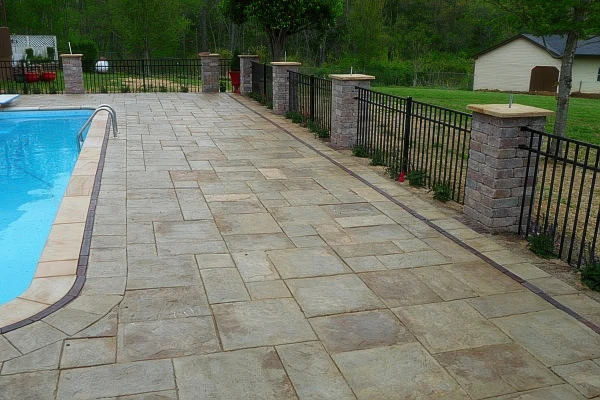
A completed outdoor hardscape project in Milton — surface materials specified to DCOF wet standards across walkways, steps, and pool deck.
Free material consultations across Milton, Alpharetta, Canton, and North Atlanta. We specify to DCOF standard on every project. Call (470) 535-0252 or request an estimate online.
Kaizen Scapes is based in Canton, Georgia and serves the greater North Atlanta region within 35 miles: