

Lake Lanier properties in Gainesville and Hall County come with a terrain profile that no suburban contractor is properly prepared for. The slopes are steep, the drop to the water is often dramatic, and the erosion forces at play — wave action, storm runoff, and seasonal lake level fluctuations — are fundamentally different from the grade management challenges on a typical residential lot. For homeowners on or near Lake Lanier trying to create usable waterfront space while stopping the hillside from sliding toward the water, a retaining wall isn’t optional. It’s the project that protects everything else.
The challenge isn’t just structural — it’s regulatory. Work near Lake Lanier shoreline falls under Georgia Environmental Protection Division oversight, and waterfront retaining wall projects require permits, setback compliance, and material specifications that aren’t relevant on a typical inland lot. A contractor who doesn’t understand the Georgia EPD permitting framework for shoreline work — or who hasn’t navigated the Army Corps of Engineers jurisdiction that governs Lake Lanier specifically — is not the right contractor for this project, regardless of how competitive the quote looks.
Lake Lanier Terrain
Inland slopes in Hall County fail primarily from rainfall and hydrostatic pressure. Waterfront slopes fail from all of that plus wave action, boat wake erosion, and the constant fluctuation of moisture content as lake levels rise and fall seasonally. A shoreline slope that looks stable during a dry summer can be actively undermining itself all winter as lake levels fluctuate and freeze-thaw cycles work on saturated soil. By the time erosion is visible at the surface, the structural failure is already well underway below it.
The physical drop from yard to water on Lake Lanier properties also tends to be severe. Many Gainesville-area lots have 20 to 50 feet of vertical relief between the house pad and the water’s edge, often packed into a relatively short horizontal distance. That creates wall height and tiering requirements that exceed what a standard residential contractor is designed to build — and what a standard segmental block system is rated to hold without engineered reinforcement specifications.
“Waterfront retaining walls aren’t just holding back soil. They’re holding back soil that’s being worked on by water from two directions simultaneously — and they’re doing it under state permit requirements that most contractors have never navigated.”
Lake Lanier is federally managed by the Army Corps of Engineers, and any work within the project boundary — which extends above the normal pool elevation — requires Corps permit coordination in addition to standard local permits. Georgia EPD has additional jurisdiction over shoreline grading, vegetation disturbance, and fill activity near the water. Retaining wall projects at or near the shoreline typically require a Section 404 permit from the Corps and may require a state water quality certification from EPD depending on scope and proximity to the water’s edge.
This is not bureaucratic paperwork to minimize — it’s the framework that protects your investment. Unpermitted shoreline work on Lake Lanier can result in removal orders and restoration requirements from the Corps. Getting the permitting right before construction starts is part of how a waterfront retaining wall project gets done properly, and it’s part of what a qualified contractor in this region is responsible for managing on your behalf.
Tiered Wall Design
The right answer for most steep Lake Lanier area properties isn’t a single wall at the bottom of the slope — it’s a tiered terrace system that creates multiple usable flat zones at different elevations while managing the grade in structurally sound increments. A wall at the top of the slope holds the lawn area. A mid-slope wall creates a seating or fire pit terrace with unobstructed lake views. A lower wall at or near the shoreline stops active erosion and creates a stable transition to the dock or beach area.
Natural stone and boulder wall systems are particularly well-suited to Lake Lanier area properties — not only because their aesthetic fits the North Georgia mountain lake character, but because the natural permeability of dry-stack stone construction handles waterfront moisture conditions better than mortared or block systems that can build pressure behind them. The material choice is a structural decision first and an aesthetic decision second, but on Lake Lanier properties the two often point in the same direction.
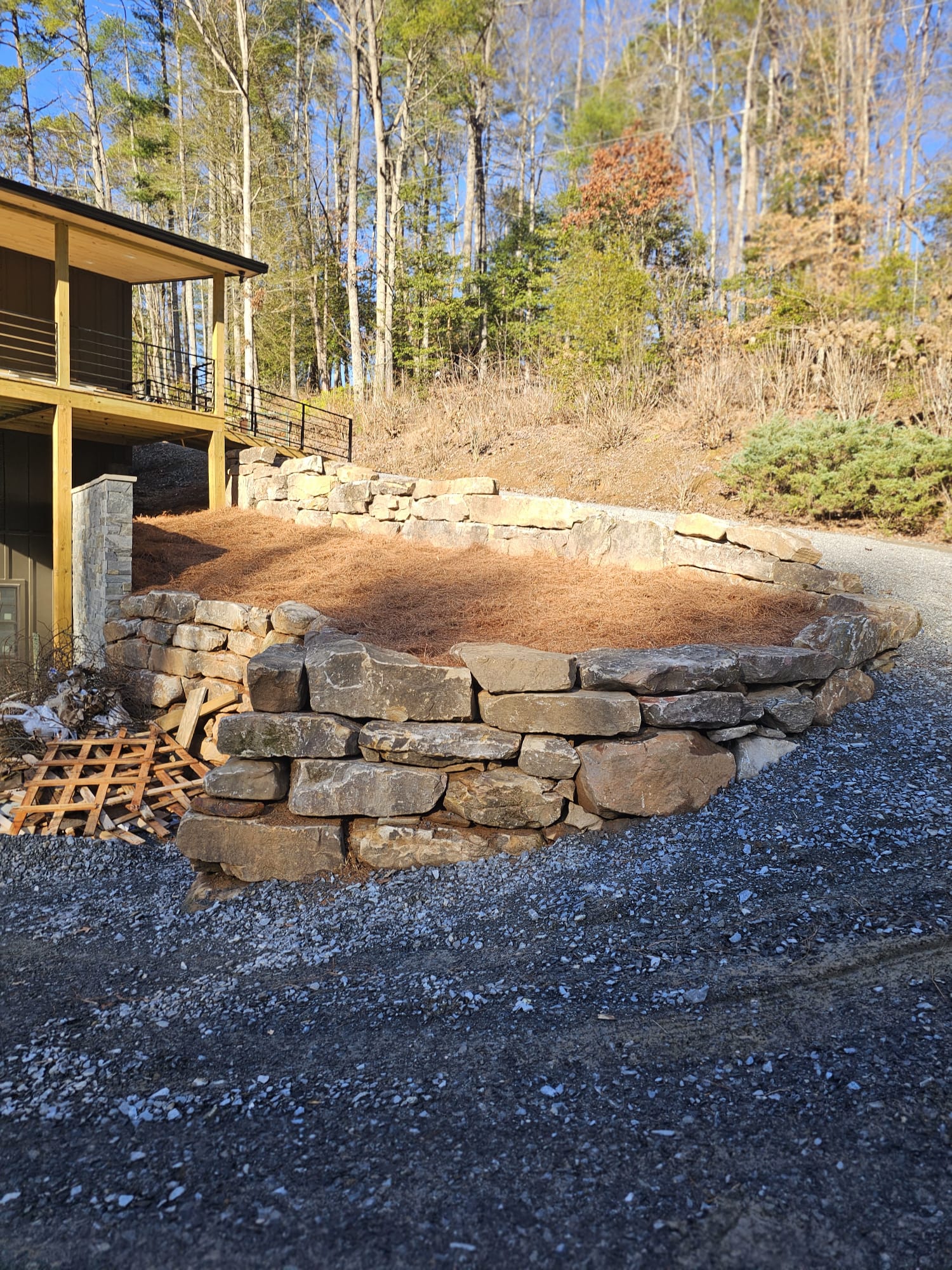
A tiered retaining wall system on a Lake Lanier area slope in Hall County — natural stone selected for both structural performance and waterfront aesthetic compatibility.
Waterfront retaining wall projects in the Gainesville and Lake Lanier area carry a cost premium over inland work, and there are three legitimate reasons for it. First, material costs for natural stone or boulder systems appropriate to waterfront conditions are higher than segmental block. Second, site access on steep Lake Lanier lots often requires specialized equipment or manual staging that increases labor time significantly. Third, the permitting process — Army Corps coordination, Georgia EPD review — adds professional time that inland projects don’t require.
For a meaningful waterfront slope management project on a Lake Lanier area property — a tiered system managing a 20 to 40-foot grade change from yard to water’s edge — the realistic budget range is $30,000 to $75,000. Smaller applications on less severe grades, or single-tier erosion control at the water’s edge, can start closer to $12,000 to $22,000 for properly engineered work. Any quote well below these ranges on a waterfront project should prompt questions about what isn’t included — because on Lake Lanier, what gets left out of a retaining wall spec is what fails first.
Waterfront erosion is not a problem that pauses while you decide what to do. Every wet season that passes without slope protection on a steep Lake Lanier lot accelerates the failure — undermining trees, destabilizing the soil profile above the water line, and making the eventual project more expensive because more material and more structural intervention is required to rebuild what erosion has already removed. The homeowners who spend the most on waterfront retaining walls are usually the ones who waited longest to address it.
Why Kaizen Scapes
We work in North Georgia’s complex terrain regularly — including the waterfront and near-waterfront slope conditions that are common across Hall County’s Lake Lanier corridor. Our approach to waterfront retaining wall projects starts with understanding the regulatory environment, confirming permit requirements, and designing a system that meets both the structural demands of the site and the Corps and EPD specifications that govern what can be built there.
Kaizen Scapes proudly serves homeowners across Canton, GA, Woodstock, GA, and the surrounding North Georgia communities including Holly Springs, Ball Ground, Acworth, Kennesaw, Marietta, Alpharetta, Milton, Roswell, Cumming, Johns Creek, and East Cobb. If you’re looking for hardscaping and landscaping craftsmanship within 35 miles of Canton or Woodstock, our team is ready to transform your outdoor space.
Whether you’re in Canton, Woodstock, Alpharetta, Milton, or anywhere across Cherokee County and the greater North Atlanta suburbs, Kaizen Scapes brings the same relentless standard to every project. We don’t do cookie-cutter. We do custom — built to last.
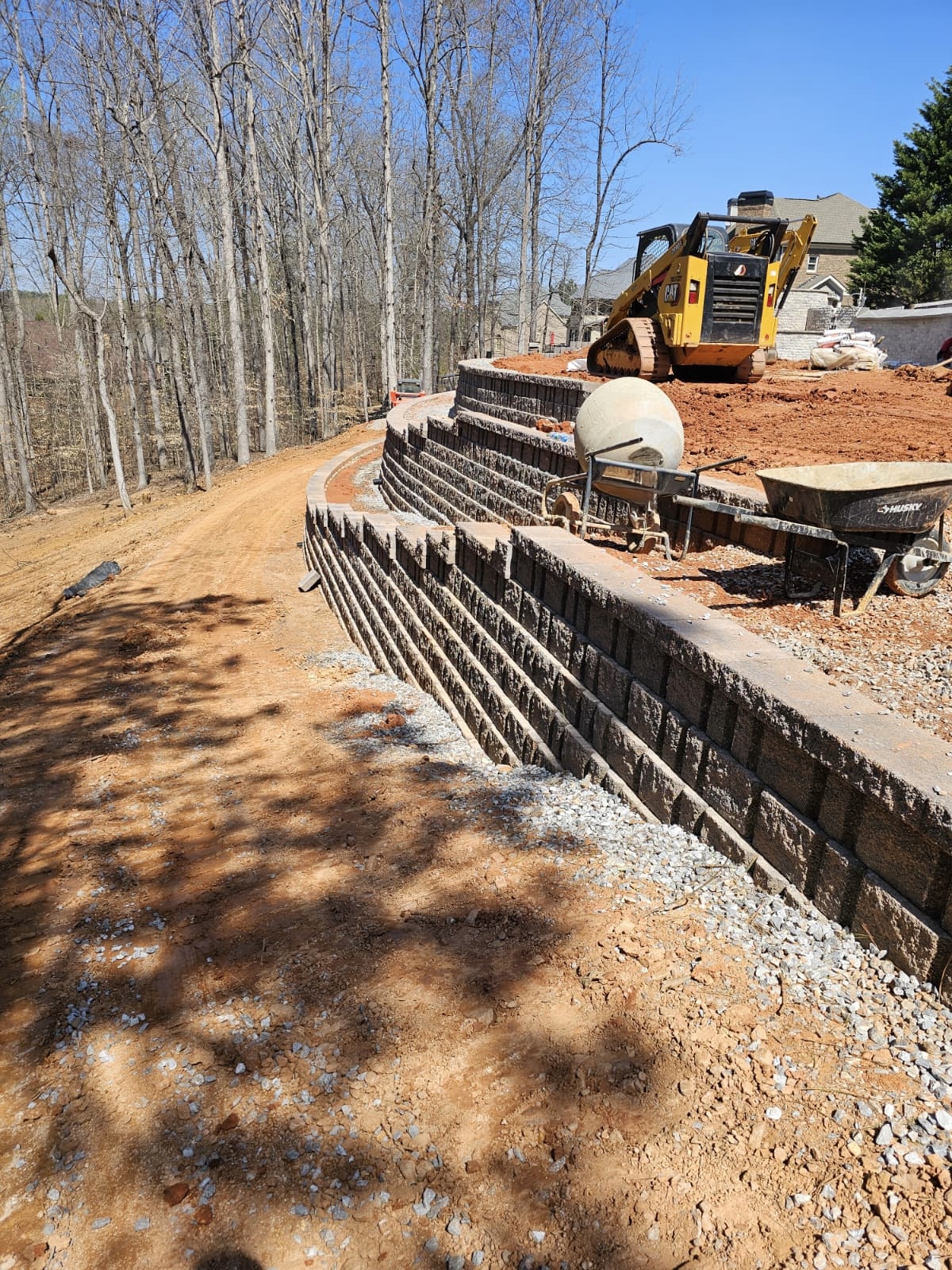
A completed retaining wall project near the Lake Lanier corridor — tiered system engineered for waterfront slope conditions and Hall County permit requirements.
We assess terrain, navigate permits, and engineer systems built for waterfront conditions. Free evaluations across Gainesville, Hall County, and the Lake Lanier region.
Kaizen Scapes is based in Canton, Georgia and serves the greater North Atlanta region within 35 miles: