

Dawsonville sits at the edge of the North Georgia mountains, and the terrain shows it. Dawson County properties carry grade changes that suburban lots in Woodstock or Kennesaw rarely see — steep drops across wide acreage, rocky subsoil below shallow topsoil, and slopes that turn every heavy rain into an erosion event if they’re left unmanaged. For homeowners in Dawsonville trying to create usable outdoor space from land that fights back, a retaining wall isn’t a landscaping detail. It’s the project that makes everything else possible.
The problem is that most retaining wall contractors aren’t thinking at Dawson County scale. They’re calibrated for a four-foot suburban wall on a flat-ish lot with predictable clay soil. When a Dawsonville homeowner needs to manage a fifteen-foot grade change across a two-acre yard — or anchor a wall into rocky mountain foothill subsoil — the suburban playbook breaks down. The material selection, the drainage engineering, and the structural design all have to be rethought for what North Georgia mountain foothills terrain actually demands.
Dawson County Terrain
The Canton-Woodstock corridor sits on Piedmont red clay — dense, consistent, and frustrating for drainage, but at least predictable. Dawsonville and the greater Dawson County region are different. As you move north toward the foothills, the soil profile shifts from uniform clay to a rockier, more variable subsoil where you might hit rock shelf at eighteen inches in one corner of a yard and have four feet of loose topsoil in another. That variability changes how a wall is footed, what excavation looks like, and whether standard segmental block is even the right system for the application.
The grade changes are also larger. Dawsonville properties — particularly those on the western and northern edges of the county toward Amicalola Falls and the foothills corridor — frequently have 20 to 40 feet of total elevation change across what a homeowner wants to use as functional yard. Managing that kind of grade doesn’t mean one wall. It means a tiered system: multiple walls at different elevations, connected by steps or graded transitions, each holding a flat zone that would otherwise be unusable slope.
“A single retaining wall holds back a slope. A tiered system transforms a hillside into a property. In Dawson County, most projects worth doing are tiered systems.”
In Cherokee County’s clay soils, segmental interlocking block with geogrid reinforcement is usually the cost-effective choice. But in Dawsonville’s rockier terrain, boulder walls often become the more practical option — not because they look better (though they do blend naturally with the North Georgia landscape), but because the site conditions actually favor them. When you’re working with rocky subsoil, boulder walls require less deep excavation for footings. Large boulders can be set against the existing rock profile in ways that would be impossible with engineered block systems requiring uniform base preparation.
Boulder walls also perform differently in freeze-thaw conditions, which Dawsonville experiences more acutely than South Cherokee County. The mass and natural irregularity of dry-stacked boulders handles frost heave better than a mortared or highly engineered segmental system in some site contexts. That’s not a universal rule — it’s a site-specific judgment that should be made after a proper assessment, not before it.
Creating Usable Space
The typical Dawsonville homeowner conversation starts the same way: “We have all this land but we can’t actually use any of it.” A sloped property in Dawson County might have two or three acres but less than a quarter-acre of genuinely flat, usable ground without intervention. Retaining walls change that math. A properly engineered tiered wall system can carve out a level area for a patio or outdoor kitchen at one elevation, a flat lawn zone at another, and a garden terrace at a third — all connected, all functional, all held in place by walls designed for Dawson County’s specific soil and grade conditions.
This is the investment that makes everything else possible. You can’t install a patio on a slope. You can’t put a fire pit area on terrain that drains into your neighbor’s yard. The retaining wall system isn’t the feature — it’s the foundation that every other outdoor living feature gets built on top of. Homeowners who skip this step and try to work around their terrain end up with outdoor spaces that feel awkward, drain poorly, and erode within a few seasons.
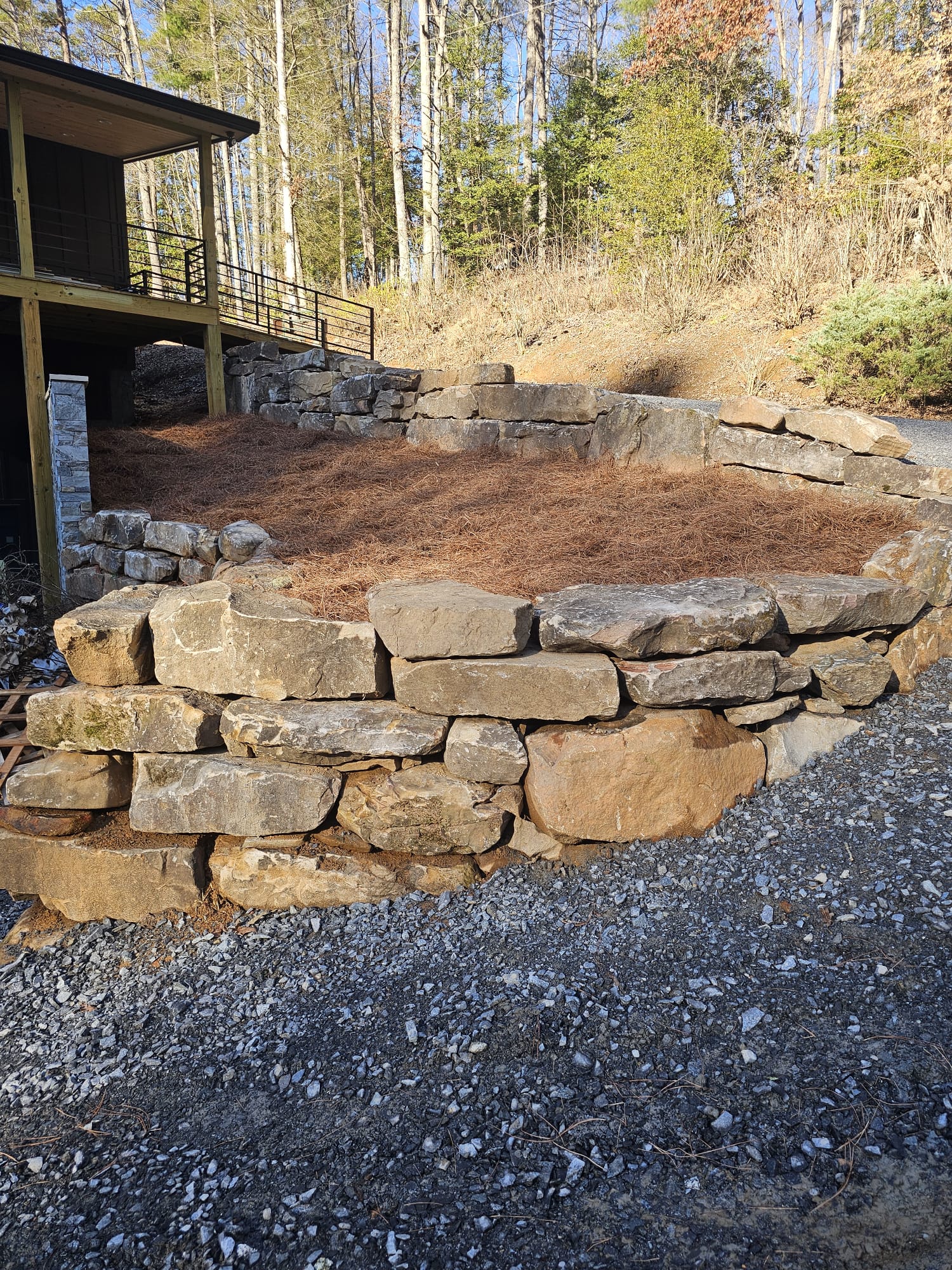
A tiered retaining wall system transforming steep Dawson County terrain — multiple flat zones created from an unusable hillside grade.
Retaining wall projects in Dawsonville and Dawson County run a wider range than suburban Cherokee County work because the conditions are more varied and the grade changes are larger. For a significant grade management project on a rural Dawson County property — think 15 to 30 feet of total elevation change managed across a tiered system — the honest budget range is $25,000 to $65,000. Smaller single-tier applications on more modest slopes start closer to $8,000 to $18,000 for a properly engineered system with drainage.
The cost variables that drive Dawsonville projects above the suburban baseline include: rocky subsoil that requires different footing preparation, larger boulder or stone material requirements for rural-scale grade management, site access challenges on larger wooded lots that affect equipment mobilization, and the engineering complexity of multi-tier systems that need to work together structurally rather than as independent walls.
The drainage system behind a retaining wall is the single most important cost item on a Dawsonville project — and the one most commonly underspecified by contractors who haven’t worked in foothill terrain. In Dawson County, where rainfall events can be intense and rocky subsoil creates unpredictable drainage patterns, the perforated drain pipe, drainage aggregate, and filter fabric behind your wall aren’t optional. A wall built without proper drainage in this terrain will develop hydrostatic pressure behind it within a few wet seasons. That pressure either bows the wall or blows it out entirely — and either outcome costs more to fix than the drainage package would have cost to install properly the first time.
Why Kaizen Scapes
We work in North Georgia terrain regularly. The mountain foothill profile that makes Dawson County properties challenging — rocky subsoil, steep grade changes, variable drainage — is terrain we assess and engineer for, not terrain we’re trying to adapt a suburban wall spec to fit. Every Kaizen Scapes project starts with a site evaluation that tells us what the soil is actually doing, where the water is moving, and what structural system fits the specific conditions of your Dawsonville property.
Kaizen Scapes proudly serves homeowners across Canton, GA, Woodstock, GA, and the surrounding North Georgia communities including Holly Springs, Ball Ground, Acworth, Kennesaw, Marietta, Alpharetta, Milton, Roswell, Cumming, Johns Creek, and East Cobb. If you’re looking for hardscaping and landscaping craftsmanship within 35 miles of Canton or Woodstock, our team is ready to transform your outdoor space.
Whether you’re in Canton, Woodstock, Alpharetta, Milton, or anywhere across Cherokee County and the greater North Atlanta suburbs, Kaizen Scapes brings the same relentless standard to every project. We don’t do cookie-cutter. We do custom — built to last.
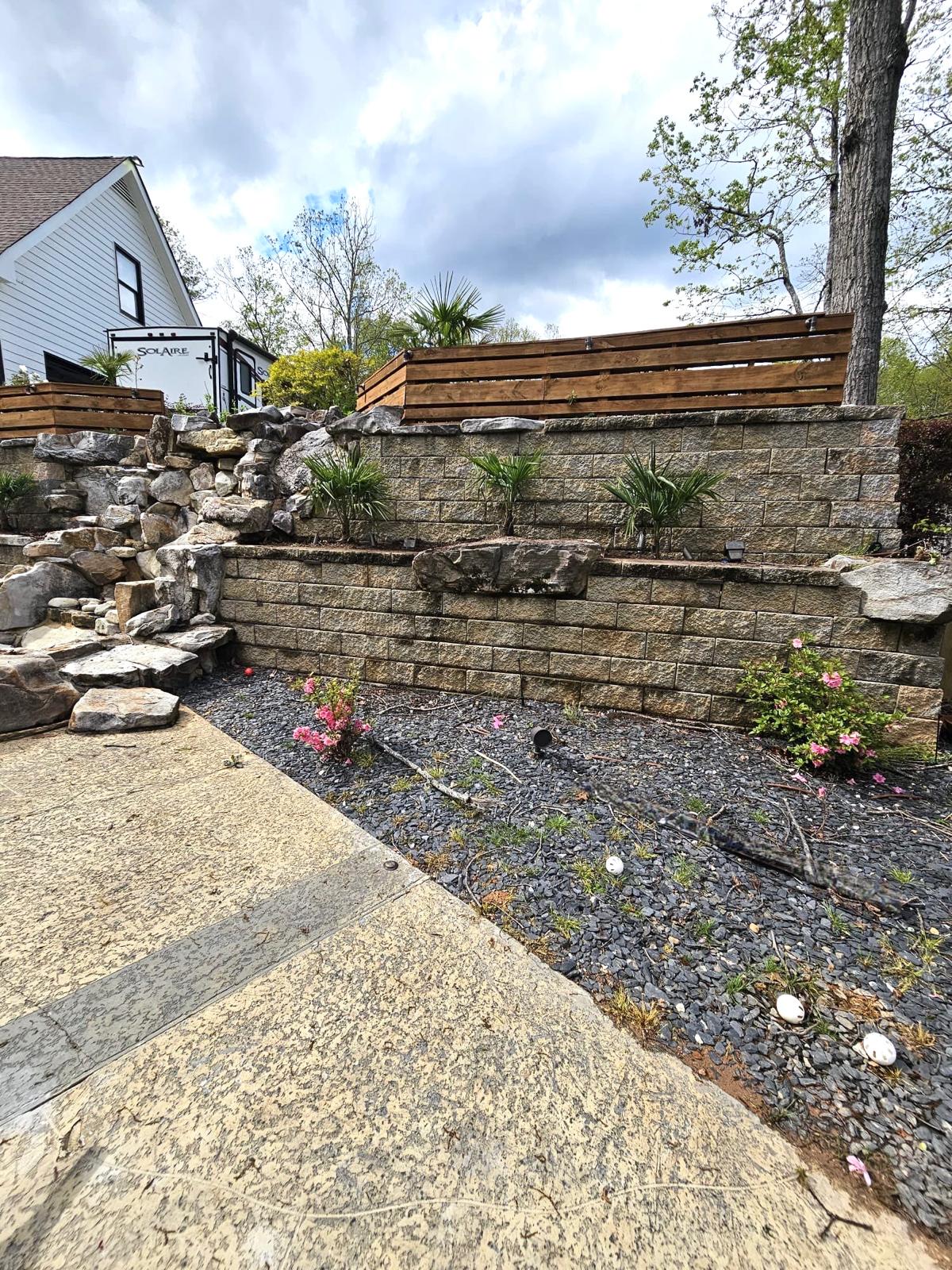
A completed retaining wall project in the Dawsonville area — boulder system selected to match rocky Dawson County subsoil conditions, tiered for maximum usable outdoor space.
We assess the terrain before recommending anything. Free retaining wall evaluations across Dawsonville, Dawson County, and all of North Georgia.
Kaizen Scapes is based in Canton, Georgia and serves the greater North Atlanta region within 35 miles: