

Mulch is the most universally misapplied landscape product in Woodstock. Every spring, landscapers and homeowners pile it on — sometimes six, eight, even ten inches deep against tree trunks and around shrubs — with the best intentions. The result, over time, is the slow death of the very plants the mulch was supposed to protect. The good news is that correct mulch application is simple. The bad news is that most of what gets done in Cherokee County is wrong.
This is not a minor issue. Volcano mulching — mulch piled in a cone against a tree trunk — is one of the most common causes of tree decline in residential landscapes across Woodstock and the greater Cherokee County area. It traps moisture against the bark, creates habitat for insects and fungal pathogens that attack the cambium layer, and causes the tree to produce adventitious roots that circle and eventually girdle the trunk. The tree doesn’t die immediately. It declines over three to ten years while the homeowner looks for other explanations — disease, drought, poor soil — never realizing the mulch volcano installed during a spring cleanup is the primary cause.
The Volcano Mulch Problem
The correct application leaves a two-to-four-inch gap between the mulch surface and the tree’s root flare — the point where the trunk widens at ground level. The root flare must be visible above the mulch. If you cannot see where the trunk transitions to root, the mulch is too deep or too close. This applies to every tree on your Woodstock property regardless of species, age, or size. A mature oak and a newly planted dogwood are equally vulnerable to prolonged bark moisture retention.
Georgia’s combination of heat and humidity accelerates the fungal damage that bark moisture exposure creates. In Cherokee County’s climate, a mulch volcano that might take eight years to kill a tree in a northern state can produce visible crown dieback within three to five years. Walk your property and look at every tree trunk where mulch has been applied. If the mulch is touching the bark, pull it back now — today — and create that gap. This is the single highest-return maintenance action most Woodstock homeowners can take.
“Two to three inches of mulch, kept away from the trunk. That’s the entire prescription. Most of the damage we see on Woodstock trees was done by people who were trying to take care of them — and applied too much, too close.”
Correct Depth & Decomposition Rate
The correct mulch depth for planting beds in Woodstock is two to three inches. Not four. Not six. At depths over three inches, mulch impedes water penetration to the root zone — rainfall hits the surface, runs off laterally, and the soil beneath stays dry even after a rain event. It also creates anaerobic conditions at depth that suppress the beneficial soil biology mulch is supposed to support. More mulch is not better mulch. It is the opposite of better mulch.
Georgia’s climate decomposes organic mulch significantly faster than most national guides account for. A two-inch layer of hardwood bark mulch in Woodstock’s summer heat and humidity will reduce to under one inch within a single growing season. This means most Cherokee County properties benefit from annual mulch replenishment — not to pile on new material, but to refresh the depth back to two to three inches as the previous layer breaks down. Before adding new mulch each spring, assess what’s there. If there’s still two inches of intact material from last year, you may need only a light refresh rather than a full installation.
Mulch decomposition is not just aesthetic fade — it is the mechanism by which mulch feeds your soil biology. As organic mulch breaks down, it introduces carbon, nitrogen, and complex organic compounds that feed the bacterial and fungal communities in Cherokee County’s soil. This soil biology is what converts nutrients into forms plant roots can absorb, suppresses pathogenic organisms, and builds the aggregate structure that helps clay soil drain and aerate. The mulch that looks “used up” in September is actually at its most beneficial stage for soil biology. The key is not to remove it — turn it lightly into the soil surface or simply top-dress over it with fresh material.

Planting bed maintenance in Woodstock — correct mulch depth and material selection matched to Georgia’s decomposition rate and plant root zone requirements.
Pine straw is the dominant mulch in Cherokee County for good reason. It is the most widely available, lowest cost per cubic yard, and performs well in Georgia’s conditions — it interknits to resist displacement during heavy rain events, decomposes slowly enough to provide multi-season coverage, and its slight acidity benefits acid-loving plants like azaleas, camellias, and blueberries that are common in Woodstock landscapes. It does not compact into an impermeable layer the way dense hardwood bark can. Annual cost for pine straw installation by a Woodstock landscaping company runs $45 to $75 per cubic yard installed, with a typical residential bed installation of 3–4 cubic yards.
Double-shredded hardwood bark is the superior choice for formal landscape beds where appearance at installation matters most — it has a consistent, rich brown color and a finer texture than pine straw. The trade-off is that it compacts more readily than pine straw in heavy rain, which can reduce water penetration if the layer becomes dense. It decomposes faster than pine straw in Georgia’s heat, adding more organic matter to the soil quickly — which is beneficial, but means more frequent replenishment. Cost runs $55 to $85 per cubic yard installed.
Cypress mulch is marketed heavily on its slow decomposition rate and natural pest-repellent properties. The reality in 2026 is that most “cypress mulch” sold commercially is a blend of whole-tree cypress and other species — it does not perform as distinctively as pure old-growth cypress, which is no longer harvested sustainably. Its decomposition advantage over hardwood bark in Georgia conditions is minimal. We don’t recommend it specifically.
Dyed mulch — red, black, or brown-dyed wood products — is the option we most actively advise against for Woodstock planting beds. The dye fades within a single season in Georgia sun, leaving a gray, washed-out appearance that looks worse than natural mulch at the same age. More significantly, the wood fiber used in many dyed mulch products comes from pallets, construction debris, and pressure-treated lumber — not clean forest material. These products can leach compounds into the soil biology that native mulch materials don’t. The initial color pop is real. Everything after that is a liability.
A typical Woodstock property with 400–600 linear feet of planting beds needs roughly 6–10 cubic yards of mulch annually. DIY material cost at a landscape supply yard runs $35 to $55 per cubic yard for pine straw or hardwood bark — roughly $300 to $550 in material plus delivery, plus a full Saturday of labor. Professional installation through Kaizen Scapes includes material, delivery, labor, and the guarantee that mulch depth and trunk clearance are correct — at a total cost that is often comparable to or only slightly above DIY when you account for your time honestly. Learn more about our full landscaping services including annual mulch programs.
Kaizen Scapes proudly serves homeowners across Canton, GA, Woodstock, GA, and the surrounding North Georgia communities including Holly Springs, Ball Ground, Acworth, Kennesaw, Marietta, Alpharetta, Milton, Roswell, Cumming, Johns Creek, and East Cobb. If you’re looking for hardscaping and landscaping craftsmanship within 35 miles of Canton or Woodstock, our team is ready to transform your outdoor space.
Whether you’re in Canton, Woodstock, Alpharetta, Milton, or anywhere across Cherokee County and the greater North Atlanta suburbs, Kaizen Scapes brings the same relentless standard to every project. We don’t do cookie-cutter. We do custom — built to last.
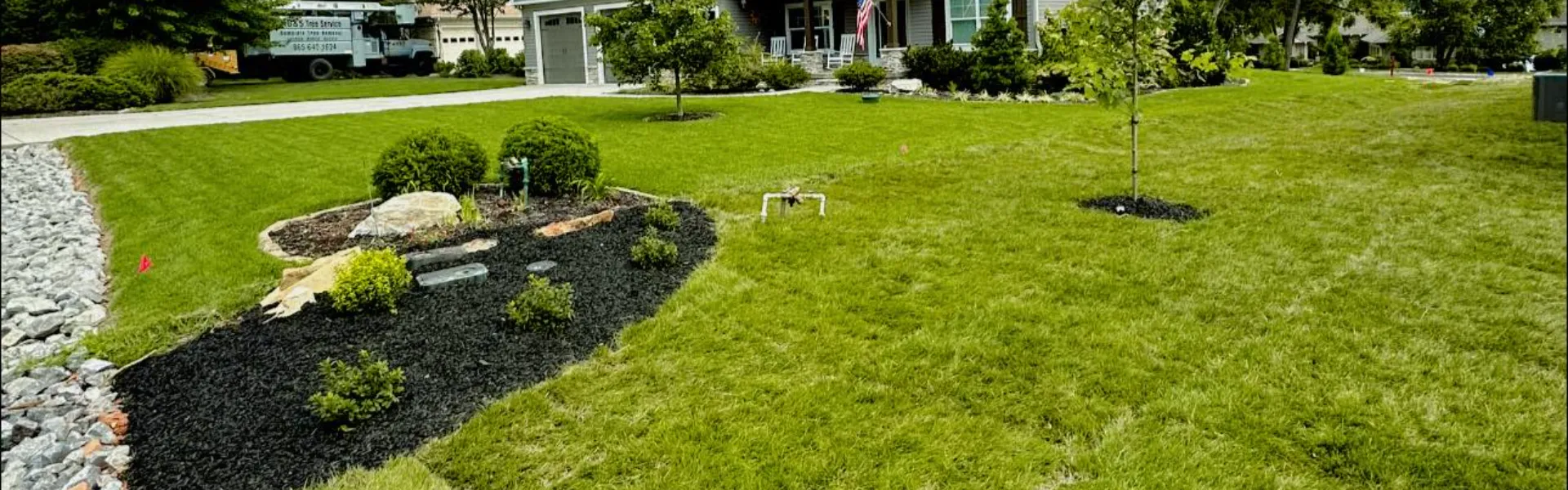
Landscape maintenance in Woodstock — mulch depth and material selection that feeds soil biology and actually protects plants, not just one that looks fresh for a month.
Correct depth, correct clearance, correct material for your beds and trees. Annual mulch programs across Woodstock, Canton, and all of Cherokee County.
Kaizen Scapes is based in Canton, Georgia and serves the greater North Atlanta region within 35 miles: