

Clean planting bed edges are one of those landscape details that most homeowners don’t notice when they’re done right — but immediately notice when they’re not. In Alpharetta, where properties trend toward manicured and the expectations for finished landscape appearance are high, edge maintenance is a constant expense. The material choice you make at installation determines whether that maintenance is an occasional touch-up or a monthly battle against Georgia’s clay soil.
The most common complaint we hear from Alpharetta homeowners is metal edging that has risen out of the ground. It looked clean at installation. Three seasons later, the aluminum benderboard is sitting two inches above grade, the mulch has migrated across it, and grass has grown over it in three spots. This is not an installation error — it is what Georgia’s expansive clay soil does to thin metal edging. Understanding why that happens is the starting point for choosing a material that doesn’t.
The Soil Heaving Problem
Alpharetta sits on Piedmont clay soils that absorb water, expand significantly when wet, and contract as they dry. This expansion-contraction cycle — which happens repeatedly every year through Georgia’s wet springs, dry summers, and wet falls — exerts consistent upward and lateral pressure on anything installed in the soil. Thin-gauge aluminum edging (the most common residential product, sold at every big-box store) has insufficient mass to resist this pressure. The soil swells around it, the freeze-thaw differential in occasional North Georgia cold snaps adds minor frost heave, and within two to three seasons the edging has worked its way up and out of the soil plane.
Heavier-gauge steel benderboard (14-gauge or thicker) resists this process significantly better than aluminum, but it is still a flexible material held in place by stakes — and stakes can be pushed upward by the same clay movement. The permanent solution to clay heaving is mass and rigidity: a material that the soil cannot move because it is too heavy, too deep, or too bonded to the substrate to be displaced.
“Metal edging fails in Georgia clay not because it was installed incorrectly — but because it was the wrong material for this soil type. Concrete curbing and natural stone borders hold permanently for exactly the same reason: the soil can’t move them.”
Material Comparison
Aluminum edging (16-gauge or lighter) is the least expensive option — materials around $1.50 to $2.50 per linear foot — and has the shortest effective lifespan in Alpharetta’s clay soil conditions. It installs quickly, holds a clean line initially, and is appropriate for low-budget projects where the homeowner is comfortable re-staking and resetting every two to three years. It is not a permanent solution in expansive clay soil — period.
Steel benderboard at 14-gauge or heavier is meaningfully more durable — materials run $3 to $6 per linear foot — and resists heaving better than aluminum due to its greater mass. It is the right metal choice for Alpharetta when permanent edging is not in the budget. Even heavy-gauge steel benderboard will require occasional re-staking in Georgia clay after three to five years, but it will not fail as quickly or as visibly as aluminum.
Poured-in-place concrete curbing is the edging system that holds in Alpharetta’s clay conditions without ongoing maintenance. Installed cost runs $5 to $8 per linear foot, significantly more than metal edging at initial installation — but the comparison changes when you account for the re-installation and maintenance costs of metal edging over a ten-year period. Concrete curbing is poured continuously, anchoring itself to the soil at depth and hardening into a monolithic unit that the surrounding clay cannot heave. It can be stamped, brushed, or colored to match the property’s hardscape, and it creates a definitive edge that eliminates mulch migration into the lawn. Once poured and cured, it requires nothing. The maintenance schedule goes to zero.
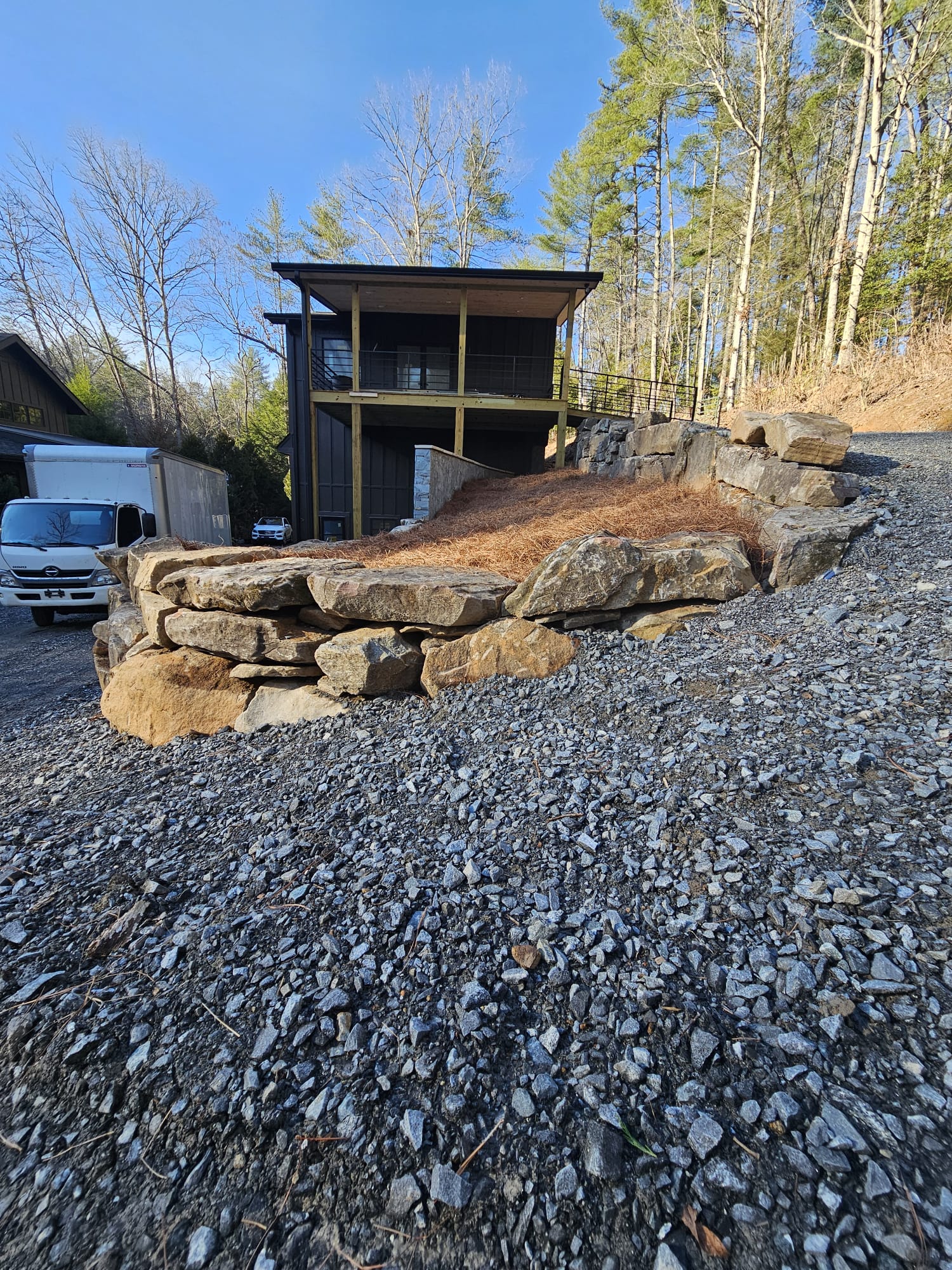
Hardscape and planting bed integration in the greater Alpharetta area — edging material selected for long-term performance in Georgia clay, not just initial appearance.
Natural stone border edging — fieldstone, granite cobble, or cut stone set in a continuous border — performs as well as concrete curbing in clay conditions for the same reason: mass. A properly set natural stone border laid on a compacted gravel base resists heaving, creates a visual separation that reads as a design element rather than a maintenance detail, and can last for decades without intervention. Material and installation costs vary widely by stone type, but expect $12 to $24 per linear foot installed for granite or fieldstone borders set correctly with a proper base. On high-visibility Alpharetta properties with premium landscaping, this investment is frequently the right one.
Brick soldier courses — a single course of bricks set vertically or at a slight angle along the bed edge — offer a traditional, formal aesthetic that suits many of Alpharetta’s older subdivisions and estate-style homes. Like stone, brick has the mass to resist clay heaving when set properly on a compacted base. Installed cost runs $8 to $16 per linear foot depending on brick selection and base requirements. The long-term maintenance advantage is the same as stone and concrete: once set, they hold.
The edging material decision also affects how frequently you need to reapply mulch. A low metal edge allows mulch to migrate into the lawn during heavy rain — you’re not just re-edging, you’re also re-mulching more frequently. A concrete curb or raised stone border physically contains the mulch layer and keeps it where it belongs through Georgia’s summer storms. For a 200-linear-foot bed perimeter, that mulch containment alone can reduce annual mulch costs meaningfully over a five-year period. Pair that with professional hardscaping services and your landscape maintenance overhead drops significantly.
Kaizen Scapes proudly serves homeowners across Canton, GA, Woodstock, GA, and the surrounding North Georgia communities including Holly Springs, Ball Ground, Acworth, Kennesaw, Marietta, Alpharetta, Milton, Roswell, Cumming, Johns Creek, and East Cobb. If you’re looking for hardscaping and landscaping craftsmanship within 35 miles of Canton or Woodstock, our team is ready to transform your outdoor space.
Whether you’re in Canton, Woodstock, Alpharetta, Milton, or anywhere across Cherokee County and the greater North Atlanta suburbs, Kaizen Scapes brings the same relentless standard to every project. We don’t do cookie-cutter. We do custom — built to last.

Planting bed edging in Alpharetta — material selected for the soil conditions and long-term maintenance profile of each specific property.
We assess your soil, existing landscape, and long-term goals before recommending any edging system. Free landscape design consultations across Alpharetta, Milton, and greater North Atlanta.
Kaizen Scapes is based in Canton, Georgia and serves the greater North Atlanta region within 35 miles: