

There is a measurable difference between a patio that you use and a room that you live in. Most Woodstock homeowners have the first one. The ones who invest in the design principles that create genuine enclosure — ceiling, walls, floor, focal point, ambiance — end up with the second. The gap between a poured concrete slab with patio furniture and an outdoor room you’d describe to a guest as “our favorite room in the house” is not a budget gap. It’s a design gap. And it’s a gap that closes entirely once you understand the system behind it.
An outdoor room is not a metaphor. It is a literal application of the same spatial principles that make an interior room feel contained, comfortable, and purposeful — translated into materials that exist in the landscape. Every outdoor room that works is built on the same five-element framework: a defined ceiling plane, defined wall edges, a deliberate floor surface, a focal point, and lighting that activates the space at night. Remove any one of those five elements and the room becomes a patio again. Keep all five and you have something that Woodstock homeowners consistently describe as the best investment they’ve made in their property.
Element One
The single design move that converts a patio into a room is the addition of an overhead plane. A pergola doesn’t enclose the space — it defines it. The psychological shift is immediate and measurable: when you sit under a pergola, your eye tracks to the structure overhead before it wanders to the yard, the neighbors’ roofline, or the open sky. That visual boundary is what creates the sensation of being “in” something rather than “outside” something. Interior designers call this compression of the vertical field. In outdoor room design, it’s the difference between furniture floating in open air and furniture anchored in a space.
For Woodstock homes, cedar pergola construction in the 12×16 to 16×20 foot range covers a primary seating and dining area without overwhelming the scale of the home. The proportion matters: an outdoor room that is significantly larger than the interior rooms it relates to feels like a parking lot. One that reflects the proportions of your interior living areas — typically a ratio of 1:1 to 1.5:1 outdoor-to-indoor — feels immediately familiar. That proportion is where outdoor room design starts, not with the pergola style or material.
“It’s not the materials that make it feel like a room. It’s the decision to design it like one — ceiling first, then walls, then floor, then everything else.”
Elements Two and Three
An outdoor room needs edges. Without them, the space bleeds into the yard and the furniture arrangement looks provisional rather than permanent. In outdoor room design, the “walls” are not literal enclosures — they are low masonry seat walls, raised planting beds, or changes in paving material that signal where the room ends and the landscape begins. A 24-inch seat wall along one or two edges of a Woodstock patio does three things simultaneously: it provides additional seating for gatherings, it creates a visual boundary that reinforces the room’s perimeter, and it anchors the patio in the landscape in a way that furniture alone cannot.
The floor surface — the paver field — is the material the room sits on, and it carries more visual weight than most Woodstock homeowners expect. Large-format pavers (24×24 or larger) read as calmer and more interior-like than small-format running bond patterns, because the larger joint spacing registers as a finished floor rather than a constructed surface. Herringbone patterns in brick-sized pavers feel more traditional and cottage-like. Straight-lay large-format concrete pavers in warm limestone tones feel the most interior — the most like a room. The pattern and scale of the paver field is not a decorative decision — it’s a spatial one.
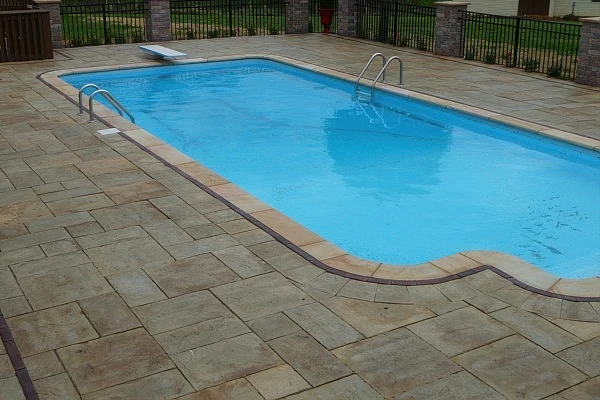
An outdoor room in Woodstock — overhead pergola, seat wall edges, and a paver floor working together to create genuine spatial enclosure.
A fire feature is not an amenity — it is a focal wall. Every successful interior room has a focal point that the seating arrangement faces: a fireplace, a television wall, a view. In outdoor room design, the fire feature serves that same function. It gives the room a “front.” Seating orients toward it. Conversation happens across it. The moment a Woodstock patio gets a fire feature, the furniture arrangement stops being arbitrary and starts having a logic that every guest intuits on arrival. That is the design function of fire — not warmth, not atmosphere, though it delivers both. The primary function is spatial.
Lighting closes the loop on the outdoor room system. A patio that disappears at dark is only usable half the year. A room with a well-designed lighting layer is usable every evening of the year in Woodstock’s climate, which carries comfortable evening temperatures from late March through November. The lighting approach that creates the most interior-like atmosphere within a pergola is a combination of overhead string or pendant fixtures within the pergola structure and low-level path and step lighting at the room’s perimeter. The overhead glow replicates interior ceiling fixture light. The perimeter lighting replicates interior floor lamps and sconces at the room edges. Together, they create an evening environment that is genuinely difficult to distinguish from an interior room — until you look up at the stars.
The outdoor room that feels best is almost always the one that reflects the scale of the interior room it connects to. If your great room is 18×22 feet, your outdoor room should be in a similar proportion range — not a 10×12 patio off a set of French doors. The spatial discordance of stepping from a generous interior room onto a tiny patio reads as incomplete even when the patio is beautifully finished. Designing the outdoor room to match interior room proportions is the single principle that Woodstock homeowners most often wish someone had told them before they built. It is also the principle that separates projects that feel finished from those that feel like there’s still a phase missing.
Kaizen Scapes proudly serves homeowners across Canton, GA, Woodstock, GA, and the surrounding North Georgia communities including Holly Springs, Ball Ground, Acworth, Kennesaw, Marietta, Alpharetta, Milton, Roswell, Cumming, Johns Creek, and East Cobb. If you’re looking for hardscaping and landscaping craftsmanship within 35 miles of Canton or Woodstock, our team is ready to transform your outdoor space.
Whether you’re in Canton, Woodstock, Alpharetta, Milton, or anywhere across Cherokee County and the greater North Atlanta suburbs, Kaizen Scapes brings the same relentless standard to every project. We don’t do cookie-cutter. We do custom — built to last.
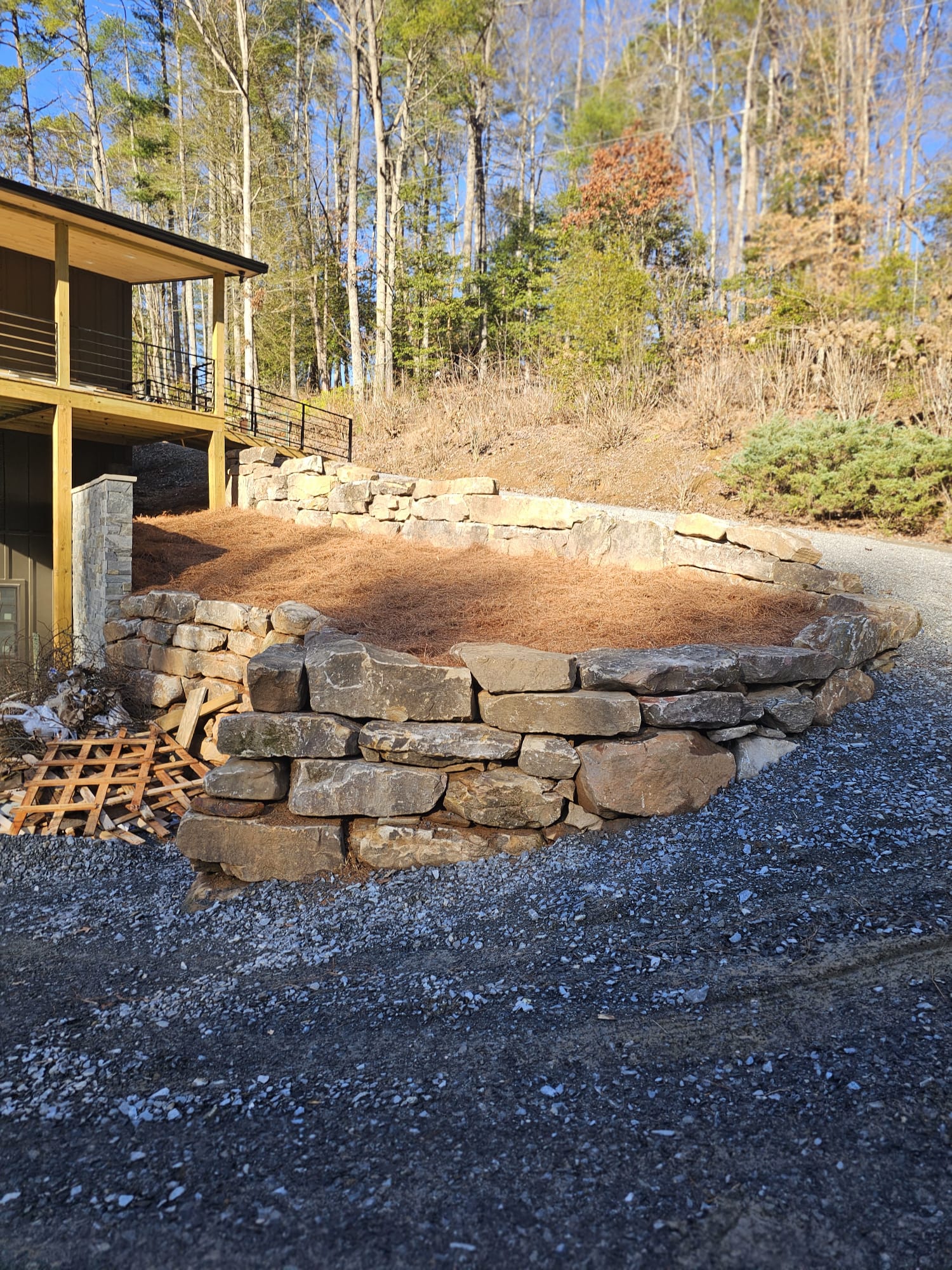
A completed outdoor room in Woodstock — all five elements present, proportioned to the house, and designed to be used every evening of the year.
We start with the spatial framework, then select materials. Free outdoor room consultations across Woodstock, Canton, and all of Cherokee County. Call (470) 535-0252.
Kaizen Scapes is based in Canton, Georgia and serves the greater North Atlanta region within 35 miles: