

Most outdoor projects that fail don’t fail during construction. They fail because of decisions made before the first shovel broke ground — design choices, sequencing shortcuts, and contractor selections that look fine on day one and cost two to three times the original budget to correct two years later.
In North Georgia’s clay-heavy, grade-variable terrain, these mistakes are especially unforgiving. What survives in the sandy flatlands of coastal Georgia often fails in Canton, Woodstock, and Cherokee County within a single rainy season. Here are the ten design mistakes we see most often — and the real-world cost each one carries when it has to be corrected.
Mistake 01
A patio that feels adequately sized in a showroom sketch feels cramped the moment a dining table, four chairs, and a grill occupy it. The rule of thumb most homeowners hear — 12×12 feet — is a minimum, not a standard. A functional outdoor dining patio for four people needs at least 16×18 feet before you account for circulation space and any adjacent seating area. Tearing out and extending a patio after the fact means recompacting base, resetting a larger portion of the existing paver field, and often regrading drainage that was designed around the original footprint. Add-on cost: typically $4,000–$9,000 for what should have cost $1,500 more at the time of original installation.
Mistake 02
Drainage is invisible until it isn’t. In Cherokee County’s clay soils, water doesn’t percolate — it migrates laterally, pools against foundations, and saturates paver bases until they shift. A patio or hardscape area installed without a positive drainage plan will move. The base settles unevenly, pavers tip, and the surface becomes a bowl that channels water toward the house. Correcting a drainage failure after pavers are installed means pulling the entire affected field, regrading, recompacting, and reinstalling. Cost to fix: $6,000–$14,000 depending on how much of the paver field is involved. Cost to design it correctly from the start: a few hundred dollars in planning and minimal additional material.
Mistake 03
You want outdoor lighting. Maybe a future outdoor kitchen. A gas line for a fireplace. Every one of those elements requires conduit or supply lines that run under the hardscape. If you don’t rough in those lines before the patio is installed, adding them later means saw-cutting through finished pavers, trenching, and patching — and paver patches are always visible. The cost of rough-in conduit at time of installation is typically $400–$900. The cost of adding it through a completed paver patio is $2,500–$6,000, and the finished result will never look as clean.
Mistake 04
Sod and plantings go in last — always. Heavy equipment required for hardscape installation damages root systems, compacts soil around plants, and destroys sod fields that cost real money to install. Homeowners who sequence landscaping before hardscape face the double expense of replanting everything that was damaged during construction. Beyond the direct cost, disrupted drainage from hardscape installation can stress plants that were established assuming a different water flow pattern. The correct sequence: hardscape first, grading and drainage second, planting and sod last.
“Sequence and planning are not overhead — they are the difference between a project that works and one that looks right for eighteen months before it doesn’t.”
Mistake 05
Poured concrete and Georgia clay are a bad long-term pairing. Clay’s shrink-swell cycle — expanding when wet, contracting when dry — exerts lateral and vertical pressure on concrete slabs that causes cracking within three to seven years, depending on the drainage conditions of the site. Paver systems, by contrast, are designed to flex slightly with ground movement — individual units can be reset if the base shifts. A cracked concrete patio can be patched, but patchwork is always visible and eventually the whole slab needs to be removed and replaced. Replacement cost in North Georgia: $8,000–$22,000 for a mid-size patio versus the original $5,000–$14,000 paver alternative.
Mistake 06
Standard residential pavers are 2.375 inches thick. Driveway applications — anything that carries vehicle weight — require a minimum 3.125-inch paver, and the base specification is entirely different from a foot-traffic patio. Contractors who install driveway pavers at pedestrian paver specs will see cracking and displacement within two to four years under regular vehicle loads. Replacing a failed driveway paver system costs $15,000–$35,000 and involves full base removal and recompaction. Getting the spec right at the start is not a premium — it’s a standard for the application.
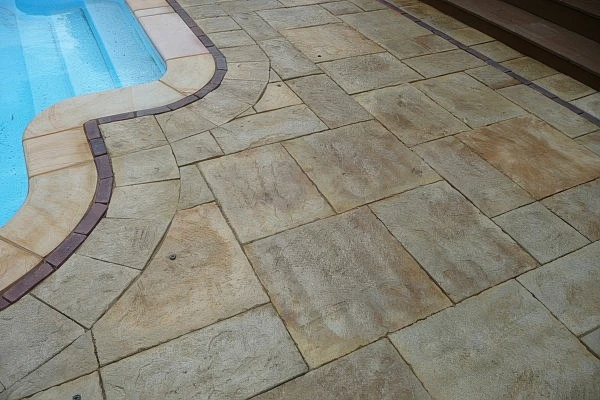
Properly sequenced outdoor living build in Canton — hardscape and drainage first, lighting rough-in before pavers, landscaping last.
An outdoor fireplace or fire pit placed in the wrong location on a North Georgia property becomes unusable — not because it doesn’t function, but because prevailing wind patterns in Cherokee County’s rolling terrain direct smoke directly toward the seating area or into the house. Wind analysis is not a complex engineering exercise. It requires understanding the site’s topography and the prevailing wind direction in the afternoon and evening hours when the fire feature will actually be used. Relocating a masonry fireplace after construction is effectively a demolition and rebuild — $12,000 to $28,000. The conversation takes twenty minutes during the design phase.
Mistake 08
A 10-foot pergola with a 12-foot post height in North Georgia is a sail in a thunderstorm. The taller the structure, the greater the wind load on the footing — and standard 24-inch footings are not adequate for structures above 10 feet in Georgia’s storm-prone weather. Pergolas that shift, lean, or detach from their footings during storm events are a liability issue, not just a structural nuisance. Engineered footings at the right depth for the actual structure height add $800–$2,000 to a pergola installation. A pergola that shifts off its footings and requires structural correction costs $6,000–$15,000 to fix — and that doesn’t include any damage it caused to the hardscape below.
Mistake 09
Outdoor lighting is not an afterthought. Step lights, in-paver accent lights, and low-voltage path lighting all require wire runs that should be stubbed under the hardscape before the surface is installed. When lighting is added as a retrofit, wire runs are exposed along the edge of the patio, buried shallowly in landscape beds where they get damaged during routine maintenance, or routed in ways that limit fixture placement options. A well-designed lighting plan roughed in during construction adds $600–$1,200 to the project. Adding the same system as a retrofit adds $2,500–$5,500 and compromises the final result.
Mistake 10
The lowest bid on an outdoor living project in Canton almost always reflects one of two realities: either the scope is genuinely different from the other bids (which means you’re not comparing the same project), or the contractor is compressing cost by skipping base depth, geogrid, drainage infrastructure, or engineering that the site actually requires. In North Georgia’s clay-heavy terrain, the corners that can be cut invisibly are the ones that matter most — base compaction, drainage aggregate, footing depth, utility rough-in. None of these are visible on a finished project. All of them determine whether the project holds up in year three. The cost to rebuild a project installed at spec versus one installed below spec is not the difference between two bids — it’s two to three times the original project cost.
Kaizen Scapes proudly serves homeowners across Canton, GA, Woodstock, GA, and the surrounding North Georgia communities including Holly Springs, Ball Ground, Acworth, Kennesaw, Marietta, Alpharetta, Milton, Roswell, Cumming, Johns Creek, and East Cobb. If you’re looking for hardscaping and landscaping craftsmanship within 35 miles of Canton or Woodstock, our team is ready to transform your outdoor space.
Whether you’re in Canton, Woodstock, Alpharetta, Milton, or anywhere across Cherokee County and the greater North Atlanta suburbs, Kaizen Scapes brings the same relentless standard to every project. We don’t do cookie-cutter. We do custom — built to last.

Outdoor lighting roughed in during construction — no visible conduit, no patch cuts, no compromised fixture placement.
Free site evaluations across Canton, Woodstock, and all of North Georgia. We don’t skip the steps that matter.
Kaizen Scapes is based in Canton, Georgia and serves the greater North Atlanta region within 35 miles: