

If you’ve ever watched a patio crack, a retaining wall bow, or a paver field shift within a few years of installation, Georgia clay was almost certainly involved — not as an excuse, but as an unaddressed engineering variable. The soil conditions in Cherokee County and the greater North Atlanta region are fundamentally different from the conditions that most national installation standards are written around, and that difference matters at every stage of a hardscape project.
North Georgia’s dominant soil types — Cecil clay loam in the upland Piedmont areas, Lloyd clay in the heavier lowland zones — are among the most challenging soils for hardscape installation in the Southeast. Contractors who work primarily outside this region, or who apply coastal Georgia or national standard practices to Cherokee County properties, are routinely installing below the actual spec the site demands. Here’s what every North Atlanta homeowner should understand before any hardscape project begins.
Georgia Clay 101
Cecil and Lloyd clays share three characteristics that every hardscape contractor in North Georgia must design around. First, they have a high shrink-swell capacity — they expand significantly when saturated and contract as they dry. This volumetric change exerts vertical and lateral pressure on anything embedded in or bearing on the soil: footings, paver bases, retaining wall foundations. Second, they have low bearing capacity when wet. A Cecil clay subgrade that would support a loaded vehicle in dry summer conditions may not support the same load following a three-day rain event. Base compaction requirements must account for the weakest condition, not the average. Third, they drain slowly. Unlike sandy coastal soils that shed water quickly, North Georgia clay holds moisture for days after a rain event — and that sustained saturation is when the shrink-swell pressure is highest.
“Georgia clay doesn’t just affect how we build — it affects which spec we choose, how deep we go, and how many compaction passes we require before we set a single stone.”
What It Means for Your Project
Standard footing depth guidelines written for general contractor use in the United States are based on freeze-thaw cycles and average soil bearing capacity — neither of which accurately describes Cherokee County. North Georgia doesn’t have a severe freeze-thaw problem, but it does have a sustained saturation problem that drops effective bearing capacity seasonally. Pergola footings, outdoor fireplace foundations, and retaining wall base footings in Canton and Woodstock should be designed for the wet-season bearing capacity of the specific soil profile, not the national average. This typically means footings that go deeper than minimum code and are sized for the actual structural load plus a margin for seasonal soil weakness.
A paver base installed over North Georgia clay requires more compaction passes than the same paver base installed over a gravel or sandy loam subgrade. The clay’s tendency to rebound slightly after compaction means that a single pass with a plate compactor leaves residual movement that will eventually telegraph to the surface. Reputable hardscape contractors in Canton use multiple compaction passes with a geotextile fabric layer between the native soil and the aggregate base to prevent clay migration into the drainage layer over time. Without the fabric barrier, fine clay particles infiltrate the base aggregate over years, reducing drainage capacity and creating differential settlement.
This is the most consequential difference between North Georgia clay and the soils most national installation guides assume. Sandy soils shed water quickly and naturally drain away from hardscape installations. Cherokee County clay does not. Water that enters a hardscape base in a clay soil zone stays there until it either evaporates or is directed out by an engineered drain system. Every patio, walkway, and hardscape installation in Canton and Woodstock must have positive drainage designed into it — not assumed. This means deliberate slope, perimeter drainage channels or French drains, and outfall locations that direct water away from the hardscape and the foundation.
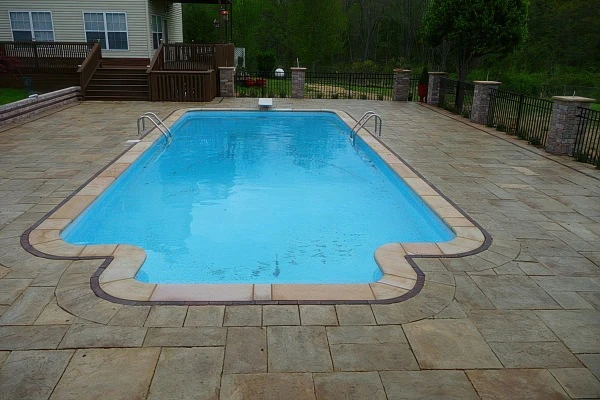
A pool deck in Canton — base engineered specifically for Cherokee County’s clay soil profile, with full perimeter drainage infrastructure.
Retaining walls in North Georgia face a loading condition that doesn’t show up on the day of or the day after a rain event. Because clay drains so slowly, the maximum water saturation — and therefore the maximum hydrostatic pressure behind a retaining wall — occurs three to five days after a significant rainfall, when the soil has fully absorbed the water and not yet begun to dry. A retaining wall that looks fine immediately after a storm may be under its peak structural load several days later. This is why drainage aggregate, perforated drain pipe, and filter fabric behind every retaining wall are not optional features in Cherokee County — they are the engineering response to a soil characteristic that will otherwise degrade every retaining wall system over time.
The ICPI standard for residential paver base calls for a minimum four-inch compacted aggregate base. In high-clay zones across Canton, Woodstock, and surrounding Cherokee County areas, that minimum is a floor, not a target. Properties with documented heavy-clay subgrade — identifiable by the characteristic dark red color and sticky texture in the excavated soil — typically require six to eight inches of compacted aggregate to achieve a stable base that won’t shift seasonally. Contractors who quote a four-inch base universally, without adjusting for site-specific soil conditions, are not designing for your soil — they are designing for an average that your property may not represent.
A hardscape contractor who primarily works in coastal Georgia, Florida, or the Carolinas is accustomed to soils that drain faster, have higher native bearing capacity when wet, and don’t require the same drainage infrastructure as North Georgia clay. When those contractors take on Cherokee County projects, they frequently apply their regional standard — and that standard is below what the site demands. The result isn’t visible in the first year. It shows up in year two or three as differential settlement, bowing walls, or patio sections that have begun to tip toward the house. By that point, the contractor may be long gone and the correction falls entirely on the homeowner.
Kaizen Scapes proudly serves homeowners across Canton, GA, Woodstock, GA, and the surrounding North Georgia communities including Holly Springs, Ball Ground, Acworth, Kennesaw, Marietta, Alpharetta, Milton, Roswell, Cumming, Johns Creek, and East Cobb. If you’re looking for hardscaping and landscaping craftsmanship within 35 miles of Canton or Woodstock, our team is ready to transform your outdoor space.
Whether you’re in Canton, Woodstock, Alpharetta, Milton, or anywhere across Cherokee County and the greater North Atlanta suburbs, Kaizen Scapes brings the same relentless standard to every project. We don’t do cookie-cutter. We do custom — built to last.

Outdoor fireplace in Canton — footing depth and design driven by the site’s actual soil bearing capacity, not a national average spec.
Free site evaluations across Canton, Woodstock, and North Georgia. We assess the soil before we quote the spec.
Kaizen Scapes is based in Canton, Georgia and serves the greater North Atlanta region within 35 miles: