

When a Cherokee County homeowner has ten feet of grade change in their backyard, the instinct is to solve it with a single tall wall. It’s the simplest picture to draw and the simplest quote to write. It’s also, in most cases, the wrong solution — structurally, aesthetically, and from a long-term maintenance standpoint. The tiered system costs more up front. It performs better in every measurable way across its lifespan.
The engineering logic is straightforward: every foot added to a wall’s height does not add proportionally to the lateral load it must resist — it adds exponentially. A four-foot wall carries a fraction of the lateral pressure that an eight-foot wall carries in the same soil conditions. Two four-foot walls carrying the same total grade change as one eight-foot wall distribute that load between two independent structural systems, each operating well within its rated capacity. The physics of this are not complicated. The contractors who quote single tall walls in Cherokee County are not unaware of tiering — they’re quoting what’s simpler to build.
The Engineering Case
A single tall retaining wall concentrates its entire structural demand at the base and footing. In Cherokee County’s clay soils, that footing is operating under constant moisture-driven volumetric change — the soil expands when saturated and contracts when dry, cycling the base of the wall through stress events across every season. A single eight-foot wall has one footing to absorb that cycling. A tiered system with two four-foot walls has two footings, each carrying half the load, each operating at a structural margin that allows for that seasonal movement without transferring it to the wall face.
Geogrid reinforcement — the tensile grid embedded in the soil behind segmental block walls to provide lateral resistance — is far more effective when the wall height it serves is lower. At four feet, geogrid extends into stable, compactable soil behind the wall face. At eight feet, it extends into deeper soil that is more likely to include variable bearing, clay pockets, or perched water. Each tier of a tiered system is its own self-contained structural unit, and each one gets the benefit of a shallower, more controllable reinforcement zone.
“Two four-foot walls carrying the same grade change as one eight-foot wall aren’t twice the work. They’re a fundamentally better structural solution — and the grade between them becomes usable space.”
The Drainage Advantage
A single tall retaining wall in Cherokee County clay must manage all upslope water in one place: behind the wall, through a single drainage system at the base. A tiered system intercepts that water at multiple points. Each tier’s drainage package catches and redirects water from the terrace above it, reducing the volume that reaches each successive lower wall. The result is a dramatically lower hydrostatic pressure profile across the entire installation compared to a single tall wall managing the same catchment area.
The terrace between retaining wall tiers is not dead space waiting to be filled with mulch. It’s a design zone. Cherokee County homeowners who build tiered systems routinely plant ornamental grasses and native flowering shrubs in the first terrace, groundcover or perennials in the second, and integrate steps between levels to make the grade change walk-through rather than walk-around. The result is a backyard that reads as intentionally designed — not like a hill that was stopped from moving. That distinction matters on resale and it matters every time you look out the back door.
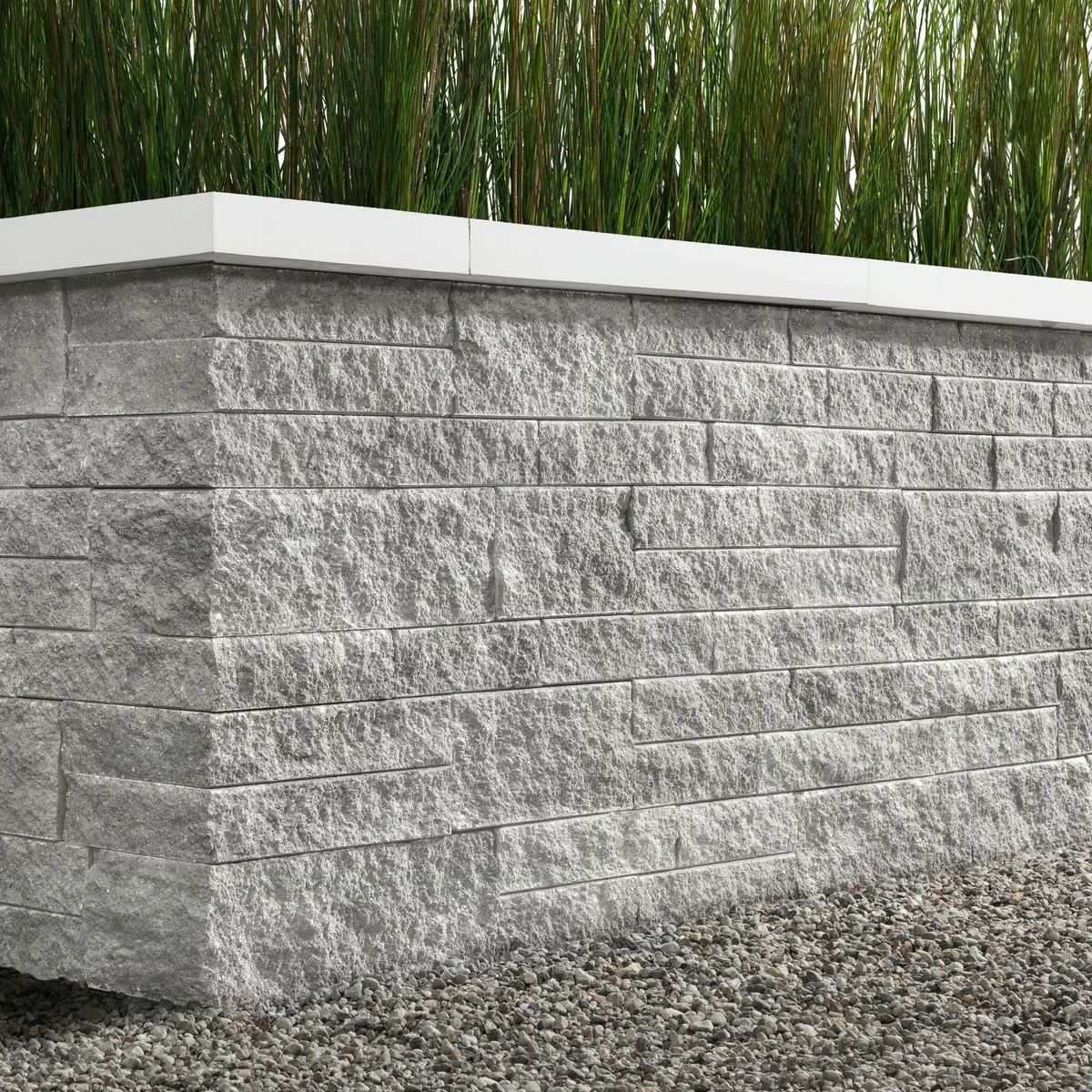
A tiered retaining wall system in Cherokee County — grade stepped into two independent structures, drainage distributed across both levels, planting zones integrated between tiers.
A tiered retaining wall system in Cherokee County handling eight to ten feet of total grade change typically ranges from $14,000 to $28,000 depending on wall length, material selection, and terrace depth. A single tall wall attempting the same grade change without tiering runs $10,000 to $20,000 — the cost premium for tiering is real, typically 20 to 35 percent. What that premium buys: better structural performance, lower long-term maintenance probability, planting zones that add landscape value, and a wall system that operates well within its rated parameters for decades rather than at the edge of them.
On a Cherokee County property where resale matters — and most do — the landscape value added by a tiered system with integrated planting and step access is measurable. A single tall wall retains the grade. A tiered system transforms it. Buyers respond to those differently, and the premium recaptures at sale in ways that a utilitarian single wall does not.
Why Kaizen Scapes
We don’t default to tiering as an upsell. We default to it when the grade, soil, and load conditions make it the more structurally sound answer. Our site assessments include a slope analysis that identifies the inflection point at which tiering becomes the better structural recommendation — and we show that calculation to homeowners as part of the proposal process. If a single wall is the right answer for your Cherokee County slope, we’ll say so and quote it that way. If tiering is the better solution, we’ll explain exactly why and let the engineering case make the argument.
Kaizen Scapes proudly serves homeowners across Canton, GA, Woodstock, GA, and the surrounding North Georgia communities including Holly Springs, Ball Ground, Acworth, Kennesaw, Marietta, Alpharetta, Milton, Roswell, Cumming, Johns Creek, and East Cobb. If you’re looking for hardscaping and landscaping craftsmanship within 35 miles of Canton or Woodstock, our team is ready to transform your outdoor space.
Whether you’re in Canton, Woodstock, Alpharetta, Milton, or anywhere across Cherokee County and the greater North Atlanta suburbs, Kaizen Scapes brings the same relentless standard to every project. We don’t do cookie-cutter. We do custom — built to last.
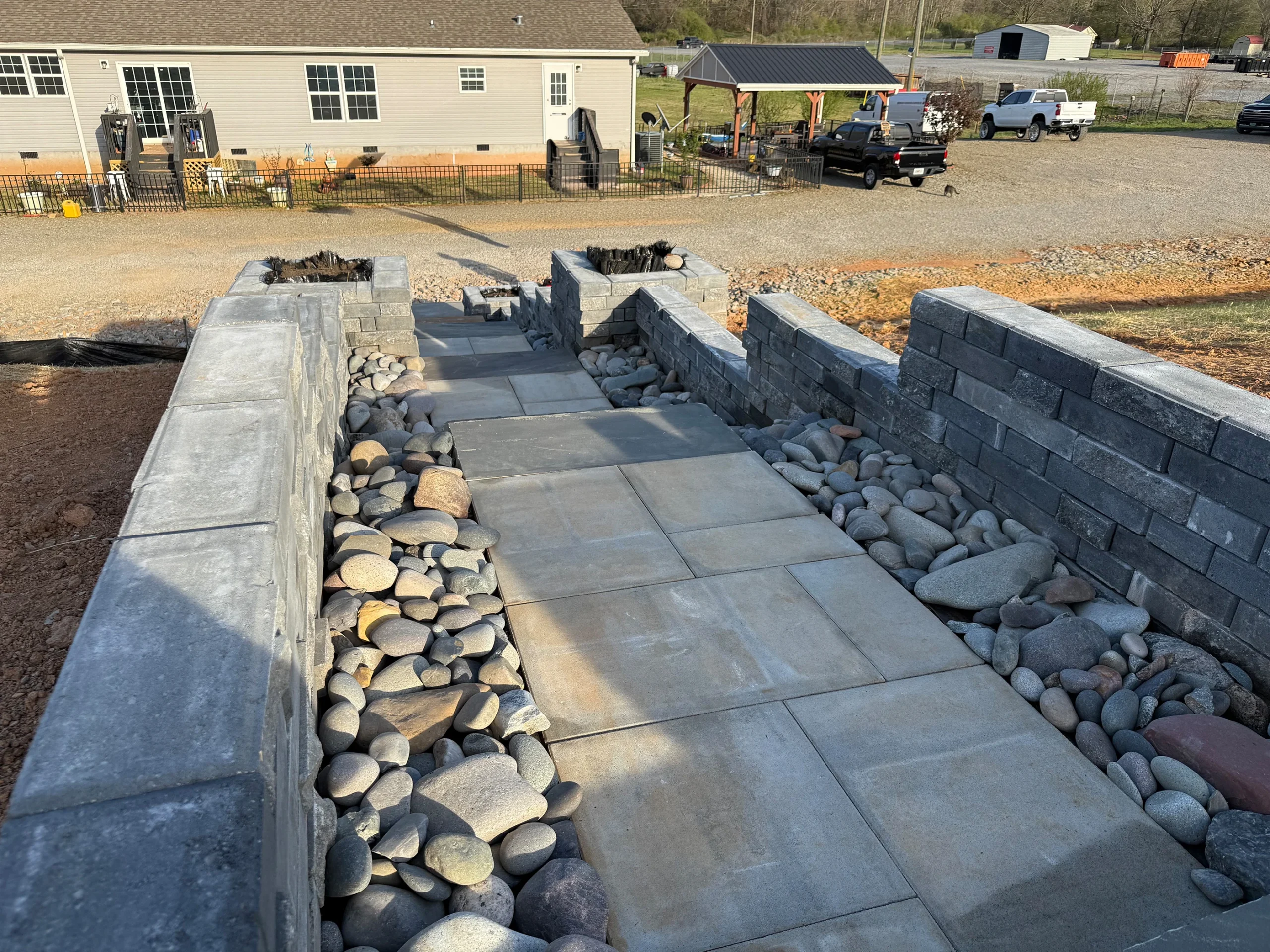
A completed tiered retaining wall in Canton — each tier operating within its structural capacity, planting zones integrated between levels, grade change transformed into usable outdoor space.
We assess your slope and show you exactly where tiering makes structural and design sense. Free evaluations across Canton, Cherokee County, and North Atlanta.
Kaizen Scapes is based in Canton, Georgia and serves the greater North Atlanta region within 35 miles: