

Getting three retaining wall quotes in Johns Creek is easy. Getting three quotes you can actually compare is not. The numbers rarely mean the same thing — because the walls being quoted are rarely the same wall. Understanding what separates a complete retaining wall proposal from an incomplete one is the difference between making a confident decision and discovering the omissions after construction has started.
Johns Creek’s planned communities were developed with engineered lots — which means the drainage patterns, grading standards, and subsurface conditions across Northpark, Nesbit Ferry, and the City of Johns Creek’s eastern corridors are more managed than what you find in older, organically developed neighborhoods. That’s not a disadvantage — it means the baseline site data is more predictable. But it also means that when a retaining wall project runs into drainage complexity or load issues in Johns Creek, it’s usually because the previous engineered solution created a condition the new contractor didn’t account for. Knowing that before quoting is the difference between a wall that performs and one that redirects drainage into a neighbor’s yard.
The other variable specific to Johns Creek is the planned community context itself. HOA-governed properties often have drainage easements, retaining wall height restrictions, and material appearance standards that affect the scope before the first quote is written. A contractor who doesn’t ask about those restrictions before quoting — or who quotes assuming they don’t apply — is setting up a conversation no homeowner wants to have after the contract is signed.
Tiered Systems Explained
A tiered retaining system — two or three shorter walls stacked back from each other rather than one tall wall — distributes lateral soil load more efficiently, manages drainage more effectively, and typically delivers better long-term structural performance than a single tall wall on the same grade. It also costs more, requires more site preparation, and in many jurisdictions above a certain height, requires engineering plans. Understanding what’s included in a tiered system quote before signing is critical to comparing proposals accurately.
The first thing to verify is whether the drainage system between tiers is specified. Water that collects in the terrace between two retaining walls and has nowhere to go will saturate the soil, increase hydrostatic pressure on the lower wall, and eventually cause movement. The drainage system behind each tier — perforated pipe, compacted aggregate, filter fabric — is not optional. It’s the component that makes a tiered system perform better than a single wall. If the quote doesn’t itemize drainage infrastructure, it’s not a complete tiered system quote.
“Three quotes for the same project in Johns Creek often describe three different walls. The homeowner who knows what to ask for gets the only apples-to-apples comparison in the group.”
The second question is geogrid reinforcement. For walls or tiered systems exceeding certain height-to-base ratios, geogrid — a high-density polyester or polypropylene mesh embedded in the backfill — extends the wall’s structural zone back into the hillside, dramatically increasing lateral resistance. Geogrid-reinforced walls perform better on sloped sites, on sites with expansive soils, and in conditions where the wall carries significant surcharge load from structures, vehicles, or heavy planting above. When geogrid is required and not included in the quote, the wall being quoted is structurally undersized for the application.
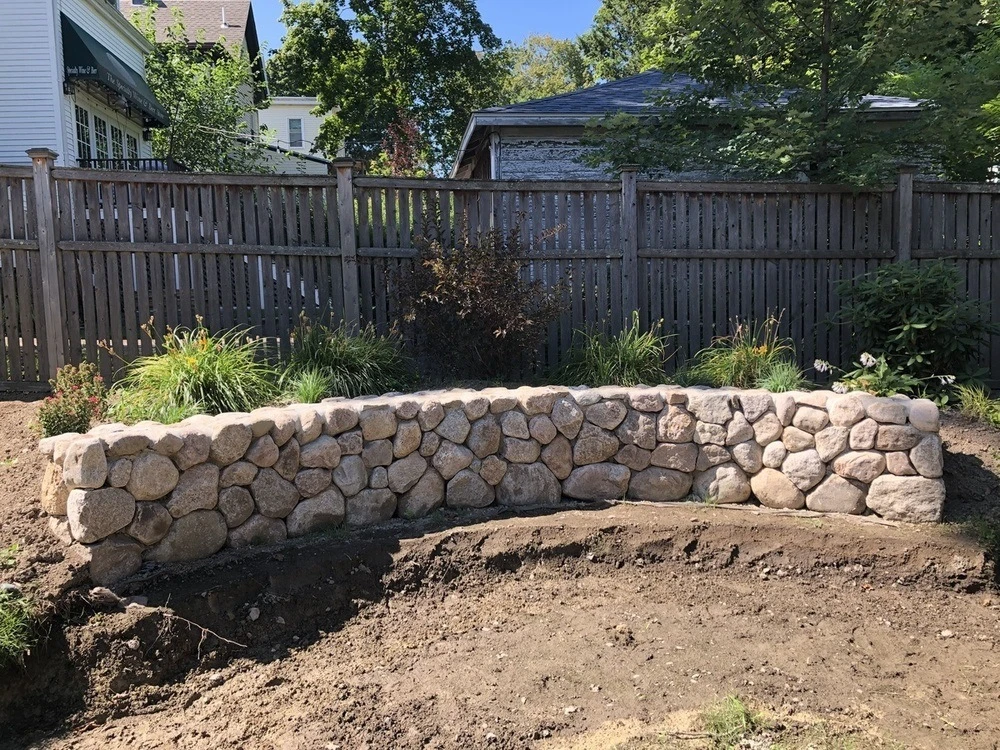
A tiered retaining system with drainage infrastructure between each level — the component that makes the system perform rather than simply look like it should.
Tiered retaining systems in Johns Creek typically range from $10,000 for a two-tier segmental block system on a modest grade to $35,000 or more for a three-tier engineered system with geogrid reinforcement, natural stone elements, and full drainage infrastructure. Engineering plan costs — where required — typically add $800–$2,500 to the project total, depending on wall complexity and the engineer’s scope. A quote that doesn’t include engineering where it’s required isn’t a lower-cost project — it’s a project with a mandatory cost that hasn’t been disclosed.
The five questions that separate a complete proposal from an incomplete one: What drainage system is included behind each tier? What is the footing depth and base aggregate specification? Is geogrid reinforcement included — and if not, why not for this wall height? Has the site been assessed for drainage easements and HOA restrictions? What block system is specified, and what height is it rated for? A contractor who answers all five with specifics is quoting a different — and more reliable — wall than a contractor who deflects, generalizes, or hasn’t visited the site before sending a number.
Why Kaizen Scapes
The site assessment comes before the quote — always. We don’t send numbers until we’ve walked the site, reviewed the drainage pattern, confirmed the HOA requirements, and determined what the wall actually needs to perform. That process takes longer than sending a square-foot price by email. It also produces a quote that you can hold us to — one where the drainage system, the footing spec, the material rating, and the geogrid decision are all documented before you sign anything. That’s the quote you want before spending $15,000 on a retaining wall in Johns Creek.
Kaizen Scapes proudly serves homeowners across Canton, GA, Woodstock, GA, and the surrounding North Georgia communities including Holly Springs, Ball Ground, Acworth, Kennesaw, Marietta, Alpharetta, Milton, Roswell, Cumming, Johns Creek, and East Cobb. If you’re looking for hardscaping and landscaping craftsmanship within 35 miles of Canton or Woodstock, our team is ready to transform your outdoor space.
Whether you’re in Canton, Woodstock, Alpharetta, Milton, or anywhere across Cherokee County and the greater North Atlanta suburbs, Kaizen Scapes brings the same relentless standard to every project. We don’t do cookie-cutter. We do custom — built to last.
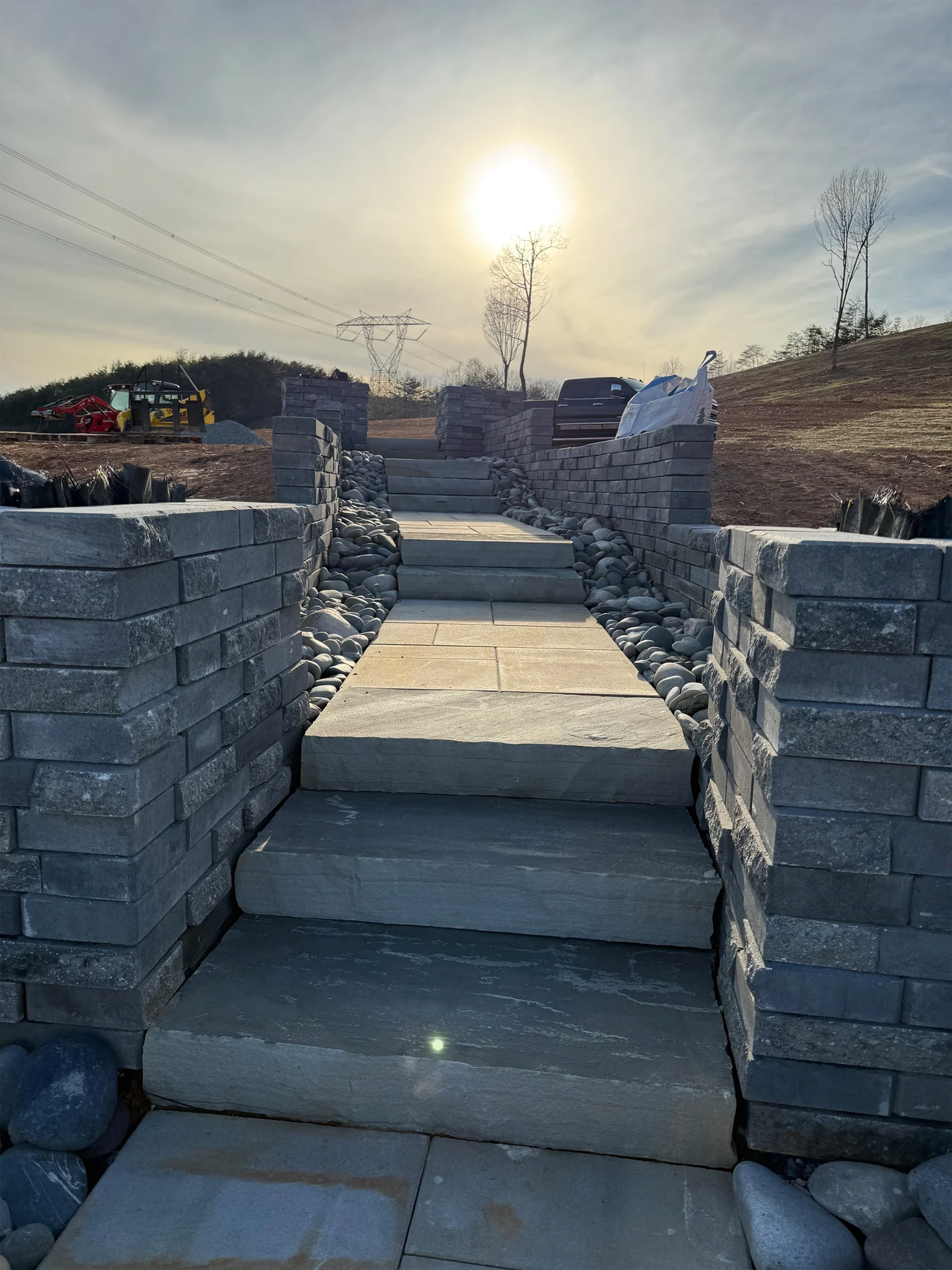
The finished tiered system — drainage between every level, geogrid reinforcement where the load required it, and a result that holds its grade without demanding maintenance.
Free site evaluations for Johns Creek and all of North Fulton County. We walk the site, review drainage, and quote the wall it actually needs — before you sign anything.
Kaizen Scapes is based in Canton, Georgia and serves the greater North Atlanta region within 35 miles: