

The stamped concrete vs. pavers debate in Marietta usually starts with install cost — which is a reasonable place to begin and a terrible place to end. The install cost is the smallest part of the comparison. The question that actually determines which material is the right investment is: what does each surface look like in five years, in ten years, and what does it cost to maintain or replace by year twenty? Marietta homeowners who have owned both surfaces have a clear answer. The numbers tell the same story.
Stamped concrete at installation is genuinely beautiful. The color, texture, and pattern — whether it mimics slate, flagstone, or cobblestone — looks crisp, intentional, and high-end. That’s not a selling point. That’s the peak. From the day of installation, Georgia’s climate begins working against it: UV exposure fades the color, thermal cycling creates micro-cracks at the surface, and Marietta’s clay soil movement does to stamped concrete exactly what it does to every other poured surface. The question is not whether these processes happen — it’s how visible they are by the time you’re five years in.
The Year-by-Year Comparison
Year 1, stamped concrete: looks as intended. Color is consistent, pattern is crisp, surface is smooth. Requires resealing within the first year to protect the color and surface finish — a cost of $500 to $1,200 for a typical Marietta patio. Most homeowners skip the first resealing. By year two, UV degradation is already measurable.
Year 5, stamped concrete: color has faded noticeably — typically 30 to 50 percent of the original intensity, depending on sun exposure. Hairline cracks are visible through the pattern in one or more locations, almost always at the points where clay soil movement has stressed the slab most. The pattern itself is still recognizable, but the surface no longer reads as the premium product it was at installation. A reseal at this point costs $600 to $1,500 and partially restores color, but cannot hide the cracking, and any crack that has opened and closed through multiple seasons will reopen through the new sealer within one to two years.
Year 10, stamped concrete: in Marietta’s conditions, this is typically the decision point. Surface cracking has progressed from hairline to visible — quarter-inch gaps in some locations, with crack edges at different elevations where the slab has shifted on either side. Color is washed out. Any crack repair that’s been done is visible as a darker line through the pattern, or as a disruption in the texture that breaks the illusion the stamped finish was meant to create. Most Marietta homeowners at year ten are getting quotes for replacement.
“Pavers at year ten look like pavers at year one. Stamped concrete at year ten looks like stamped concrete that has been through ten Georgia summers — and it shows every one of them.”
Why Pavers Age Differently
This is not a quality difference — it is an engineering difference. Stamped concrete is a monolithic surface: every part of the slab is connected to every other part. When Georgia’s clay soil moves beneath one section, that movement transmits stress through the entire slab. The slab cracks at its weakest point — which is usually a thin spot in the stamped pattern, a joint between pours, or a section near a tree root or drainage line. Once it cracks, the crack is permanent. Filling it does not restore structural integrity.
Pavers are a discontinuous surface. Each unit is independent. When the soil beneath one section moves, those specific pavers move — and the movement is contained to those units. The adjacent pavers are not stressed. The joint sand between units acts as a flexible buffer that accommodates minor differential movement without transmitting it. When a paver settles, you lift it, address the base, and reset it — and the repair is invisible because you’re using the same original paver, not filling with a material that doesn’t match.
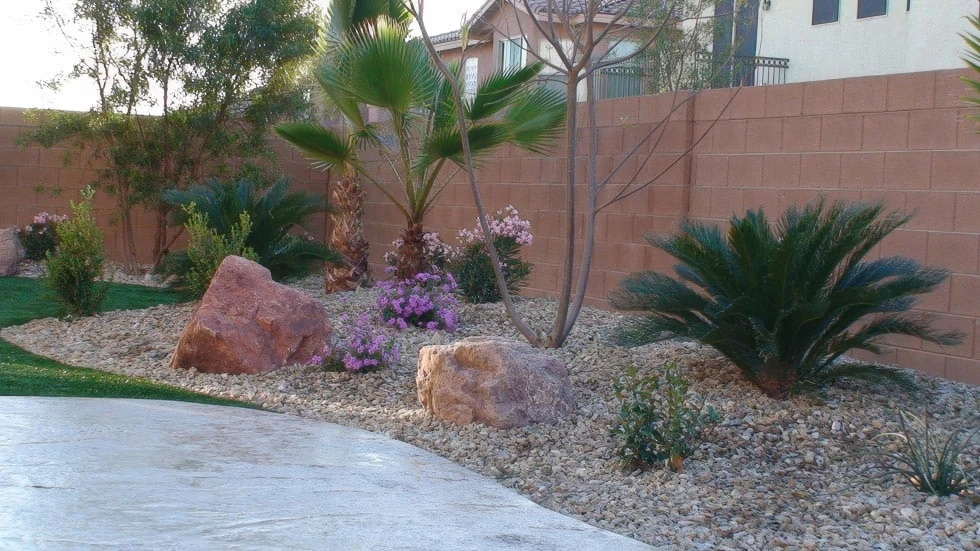
A paver installation in the Marietta area — same appearance at year ten as at installation, because individual units accommodate soil movement instead of cracking under it.
Stamped concrete on a 400-square-foot Marietta patio typically installs for $6,000 to $11,000 — less than pavers at the same size, which typically run $9,000 to $16,000. That install cost difference is real, and it’s where the stamped concrete argument tends to start and stop. Here’s what the twenty-year picture looks like when you add the maintenance and replacement cycles:
Stamped concrete over 20 years: initial install ($6,000–$11,000) + reseals every 2–3 years at $600–$1,500 per application ($3,600–$9,000 over 20 years) + likely one full replacement at year 10–12 at current labor and material costs ($8,000–$14,000 in today’s dollars, higher in ten years) = total 20-year cost: $17,600 to $34,000, and you’re back to a ten-year surface at the end.
Pavers over 20 years: initial install ($9,000–$16,000) + polymeric sand refresh every 3–5 years at $300–$600 per application ($1,200–$2,400 over 20 years) + spot repairs as needed, typically $200–$800 over the period = total 20-year cost: $10,400 to $19,200. The surface at year twenty is the same installation — not a replacement. It has another 20-plus years of useful life ahead of it.
Most Marietta homeowners intend to own their home for fifteen to twenty-plus years. At that timeframe, pavers are almost always the lower total-cost option — and the only one that delivers a surface that doesn’t require replacing mid-ownership. The install cost premium for pavers — real but often overstated in the initial quote comparison — typically pays for itself within eight to twelve years in avoided maintenance and delayed replacement costs. Beyond that point, every year of paver life is a year of stamped concrete replacement cost that doesn’t exist on your ledger.
Kaizen Scapes proudly serves homeowners across Canton, GA, Woodstock, GA, and the surrounding North Georgia communities including Holly Springs, Ball Ground, Acworth, Kennesaw, Marietta, Alpharetta, Milton, Roswell, Cumming, Johns Creek, and East Cobb. If you’re looking for hardscaping and landscaping craftsmanship within 35 miles of Canton or Woodstock, our team is ready to transform your outdoor space.
Whether you’re in Canton, Woodstock, Alpharetta, Milton, or anywhere across Cherokee County and the greater North Atlanta suburbs, Kaizen Scapes brings the same relentless standard to every project. We don’t do cookie-cutter. We do custom — built to last.

A completed paver installation in the Marietta area — the same surface that will look identical at year ten, with no resealing, no cracking, and no replacement cycle in the forecast.
We’ll walk through the honest cost comparison for your specific Marietta project — stamped concrete, pavers, flagstone. No pressure, no catalog. Call (470) 535-0252.
Kaizen Scapes is based in Canton, Georgia and serves the greater North Atlanta region within 35 miles: