

Planting beds on Milton properties fail visually for a specific set of reasons — and most of them are design decisions made before a single plant is selected. Bed edge definition, scale relative to the home, layering structure, and seasonal color continuity are the four variables that separate a bed that looks intentional from one that looks like it was filled opportunistically. Getting those four things right is a discipline, and it produces a result that holds its visual quality across all four of Georgia’s seasons.
Milton’s estate property character — larger lots, significant architectural mass, mature tree canopy on many parcels — creates both opportunity and constraint for planting bed design. The scale of a planting bed must relate to the home it borders and the site it occupies — beds that work on a 2,400 square foot suburban home look like afterthoughts against a 5,000 square foot Milton custom build. Scale is the first principle that most landscaping contractors get wrong on higher-end North Atlanta properties.
Bed Edge Definition
The edge of a planting bed is one of the most visible elements in a landscape, and it’s one of the most frequently compromised. A crisp, defined edge is what makes a planting bed look maintained rather than managed. Three primary edge systems serve different aesthetic and structural purposes on Milton properties. Concrete curbing — poured-in-place mow curb — creates a clean, permanent separation between turf and bed that never needs re-cutting and eliminates the annual labor of edging. It’s the right specification for formal bed layouts on larger properties where consistency of line is a priority, and it costs $4–$7 per linear foot installed.
Natural stone edging — dry-laid fieldstone or cut flagstone — integrates with the naturalistic character of Milton’s wooded property profiles and pairs well with beds that use organic curves and native plant masses. It requires slightly more maintenance than poured curbing as individual stones shift over time in Georgia’s freeze-thaw cycles, but its visual quality on the right property type is unmatched by any manufactured alternative. Metal edge — 1/8″ steel or aluminum landscape edging — is the professional landscaper’s clean-line solution for modern planting bed geometries: it holds a precise edge, allows for gentle curves, and is effectively invisible at ground level while performing better than plastic edging alternatives. Cost runs $2–$4 per linear foot for metal edge installed.
“The edge of a bed is the line that tells the viewer whether this landscape was designed or just planted. It’s the first thing the eye reads and the last detail most homeowners think about.”
Layer Planting
A planting bed with visual depth across all four seasons requires a three-layer structure: overstory, mid-shrub layer, and ground cover. The overstory — ornamental trees or large screening shrubs — provides the vertical structure that gives the bed height and shadow. On Milton properties with significant architecture, overstory plants anchor the bed at each end or at structural focal points and prevent the bed from reading as flat against the home’s mass. Suitable overstory choices for Milton’s mixed sun and shade conditions include Serviceberry, Oakleaf Hydrangea at its mature size, and Native Fringe Tree for partially shaded north and east-facing exposures.
The mid-shrub layer — the 2–5 foot zone that carries the primary color and texture of the bed — is where most of the plant selection decisions are made, and most of the mistakes happen. Mid-shrubs should be selected for their mature size first, bloom or texture second. A mid-shrub that maxes out at 3 feet planted 18 inches from the foundation will be at the window sill within four years unless it’s aggressively pruned — pruning that costs time and money and removes the natural form that made the plant worth specifying. Georgia natives like Itea, Loropetalum, and Dwarf Fothergilla perform well in Milton’s partially shaded conditions and reach their natural size without becoming a maintenance burden.
The ground cover layer performs two functions simultaneously: it fills the visual foreground of the bed at eye level from street view, and it suppresses weed germination structurally by covering soil surface that mulch alone can’t defend against persistent seed pressure. Liriope, Creeping Phlox, Pachysandra in deep shade zones, and native Ginger are the Milton-relevant palette — each adapted to survive Georgia summers without supplemental irrigation once established, and each maintaining enough visual presence to give the ground layer purpose year-round.
A planting bed that only performs in summer is a bed that looks neglected nine months of the year in Milton. Seasonal color planning sequences bloom times and foliage transitions so there’s always something carrying visual interest — not a simultaneous explosion of everything in June followed by six months of green. Spring color comes from Serviceberry white bloom and Loropetalum’s burgundy flush. Summer sustains through Oakleaf Hydrangea’s white panicles and Itea’s racemes. Fall brings Fothergilla’s flame color and Beautyberry’s violet fruit. Winter structure is held by the dried seed heads of ornamental grasses and the persistent bark texture of Serviceberry. That’s a bed that works across all four seasons — without a single annual replanting.
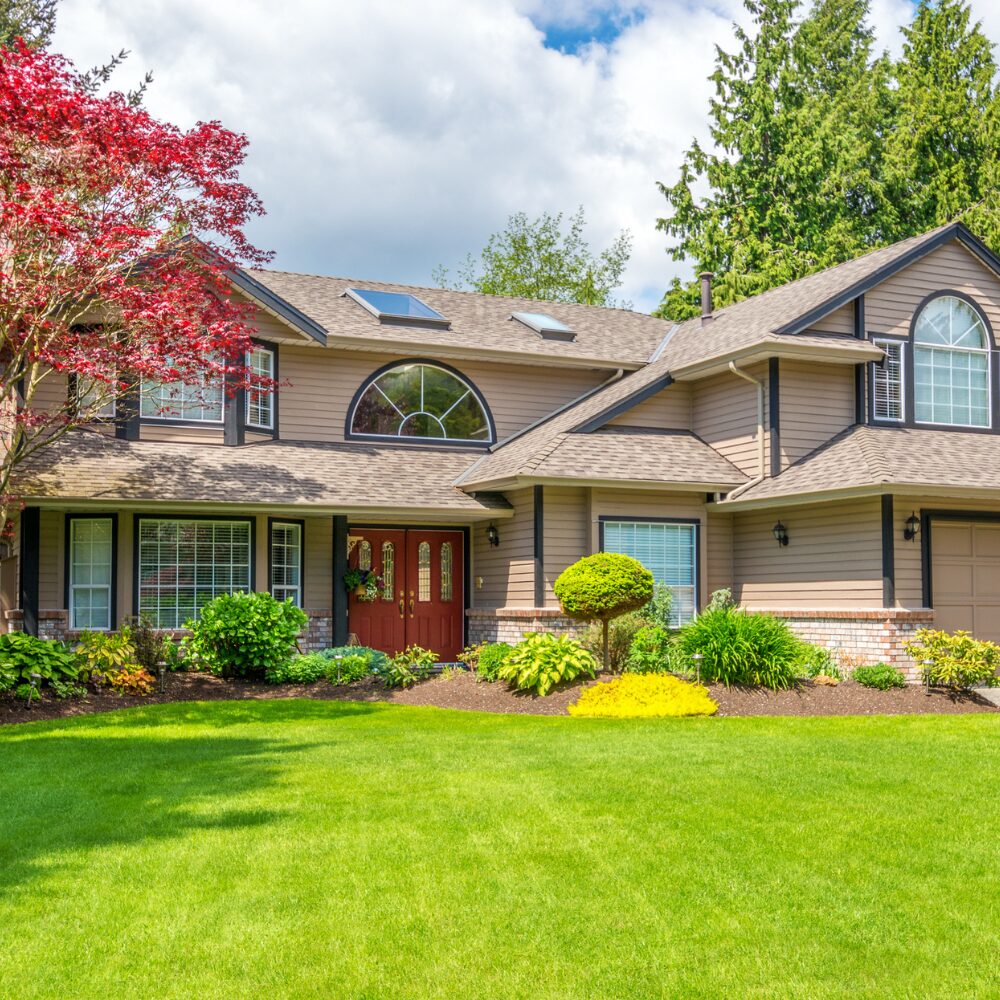
A Milton planting bed installation — three-layer structure, defined concrete curb edge, and a plant palette selected for Milton’s mixed sun and shade conditions.
The proportional relationship between a planting bed and the home it borders is one of the most common errors on larger Milton lots. A foundation bed that is 18 inches deep on a home with a 10-foot eave line reads as a thin stripe of plants against a wall of brick or board-and-batten. It doesn’t ground the architecture — it outlines it. For homes over 3,500 square feet, foundation beds typically need to be a minimum of 4–6 feet deep to read correctly from the street, and island beds in the lawn should be sized in proportion to the turf area they occupy — not the smallest size that fills a cart at the nursery.
On Milton’s larger estate lots, the transition zone between the maintained lawn and the natural tree canopy is often the highest-leverage design area on the property. A layered planting bed that softens that edge — filling the zone between manicured lawn and forest with a curated native understory — creates depth and spatial definition that no turf-only lawn achieves. That edge planting is also the lowest-maintenance zone on the property once established, because native understory plants are adapted to exactly the light, moisture, and root competition conditions that exist at the forest margin. It’s the design move that looks expensive and performs cheaply.
Kaizen Scapes proudly serves homeowners across Canton, GA, Woodstock, GA, and the surrounding North Georgia communities including Holly Springs, Ball Ground, Acworth, Kennesaw, Marietta, Alpharetta, Milton, Roswell, Cumming, Johns Creek, and East Cobb. If you’re looking for hardscaping and landscaping craftsmanship within 35 miles of Canton or Woodstock, our team is ready to transform your outdoor space.
Whether you’re in Canton, Woodstock, Alpharetta, Milton, or anywhere across Cherokee County and the greater North Atlanta suburbs, Kaizen Scapes brings the same relentless standard to every project. We don’t do cookie-cutter. We do custom — built to last.

A completed Milton landscape installation — planting beds scaled to the property, three-layer structure, and seasonal color carried across all four Georgia seasons.
We design beds scaled to your home, layered for year-round interest, and built to perform in Milton’s conditions. Free site evaluations across Milton, Alpharetta, and North Atlanta.
Kaizen Scapes is based in Canton, Georgia and serves the greater North Atlanta region within 35 miles: