

The retaining wall material decision in Cumming, GA is not the same decision it is in every market. Forsyth County’s landscape character — larger lots, wooded backdrops, natural creek corridors, proximity to Lake Lanier — gives natural stone a genuine contextual advantage on certain properties that you won’t encounter on a standard subdivision lot elsewhere in metro Atlanta. But that advantage has real limits, real cost implications, and specific conditions under which manufactured block simply performs better. This is the honest version of that comparison.
The goal here is not to steer you toward either material. It’s to give you the actual tradeoff so that when you receive quotes from retaining wall contractors in Cumming, you know what you’re comparing — aesthetically, structurally, and financially.
The Aesthetic Comparison
Natural stone — fieldstone, quarried granite, or crab orchard sandstone — presents an aesthetic advantage at installation that is genuine: the color variation, texture depth, and irregular profiles of natural stone create a visual richness that no manufactured block has yet replicated convincingly. On Cumming properties with wooded lots, creek-stone native to the Forsyth County landscape, or existing natural stone elements on the house or outbuildings, a well-built dry-stack or mortared stone retaining wall looks like it belongs. It fits the material story of the property.
Manufactured segmental block at installation presents differently: clean geometry, consistent color and texture, professional appearance — but unmistakably manufactured. The regularity that makes block easy to build with and structurally predictable is also the quality that makes it visually distinct from natural materials. High-end textured block (Versa-Lok Mosaic, Allan Block Abbey, Anchor Platinum) has improved significantly in natural stone simulation — but sophisticated eye can still distinguish manufactured from genuine at close range.
“At year ten, the gap between stone and block often narrows in stone’s favor — natural stone weathers beautifully, develops moss and patina, while block color tends to flatten. But year ten is a long way from the quote conversation.”
The ten-year aesthetic comparison favors natural stone more clearly. Granite fieldstone and dry-stack walls weather in ways that enhance their character — developing patina, moss growth in shaded areas, and a settled permanence that reads as genuinely old. Manufactured block tends to hold its original color for several years before beginning to fade and discolor in Georgia’s UV environment. Some block finishes weather attractively; others develop a bleached, institutional appearance that diverges from the original installation look. On high-visibility Cumming properties where the wall will be seen daily from the house or entertaining areas, the long-term aesthetic trajectory of each material is a legitimate factor in the decision.
The Structural Comparison
The structural comparison requires separating natural stone wall types, because they differ significantly. A dry-stack gravity wall — natural stone set without mortar, relying entirely on mass, friction, and careful stone selection for stability — is a fundamentally different structure from a mortared natural stone wall, which adds rigidity but requires weep holes and drainage management that a dry-stack wall handles inherently through its permeability.
Dry-stack natural stone walls are naturally permeable: water moves through the wall rather than building hydrostatic pressure behind it. In Forsyth County’s rainfall environment — particularly on properties with natural drainage corridors or proximity to Lake Lanier’s watershed — this permeability is a genuine structural asset. It eliminates the hydrostatic pressure failure mode that is the primary cause of retaining wall failure in Georgia clay soils. The tradeoff is that dry-stack walls require more skilled labor to achieve structural integrity at height: each stone must be set with attention to bearing surface, coursing, and tie-stones that knit the wall together. A dry-stack wall built by a contractor who learned block installation is not a dry-stack wall built by someone who learned stone masonry.
Dry-stack natural stone walls require periodic inspection and maintenance — individual stones can be displaced by frost heave, root intrusion, or surface impact and need to be reset. This is typically a minor repair when caught early and a more significant intervention if deferred for several seasons. Mortared stone walls may develop hairline cracks in mortar joints over time as the wall responds to seasonal movement; repointing is periodic maintenance rather than a structural concern if done correctly. Manufactured block walls are generally low-maintenance in the first ten years — the primary maintenance item is cap adhesive that may need reapplication and occasional weed control in the drainage aggregate. In the fifteen- to twenty-year range, block face spalling can occur on lower-grade block exposed to significant freeze-thaw cycling.
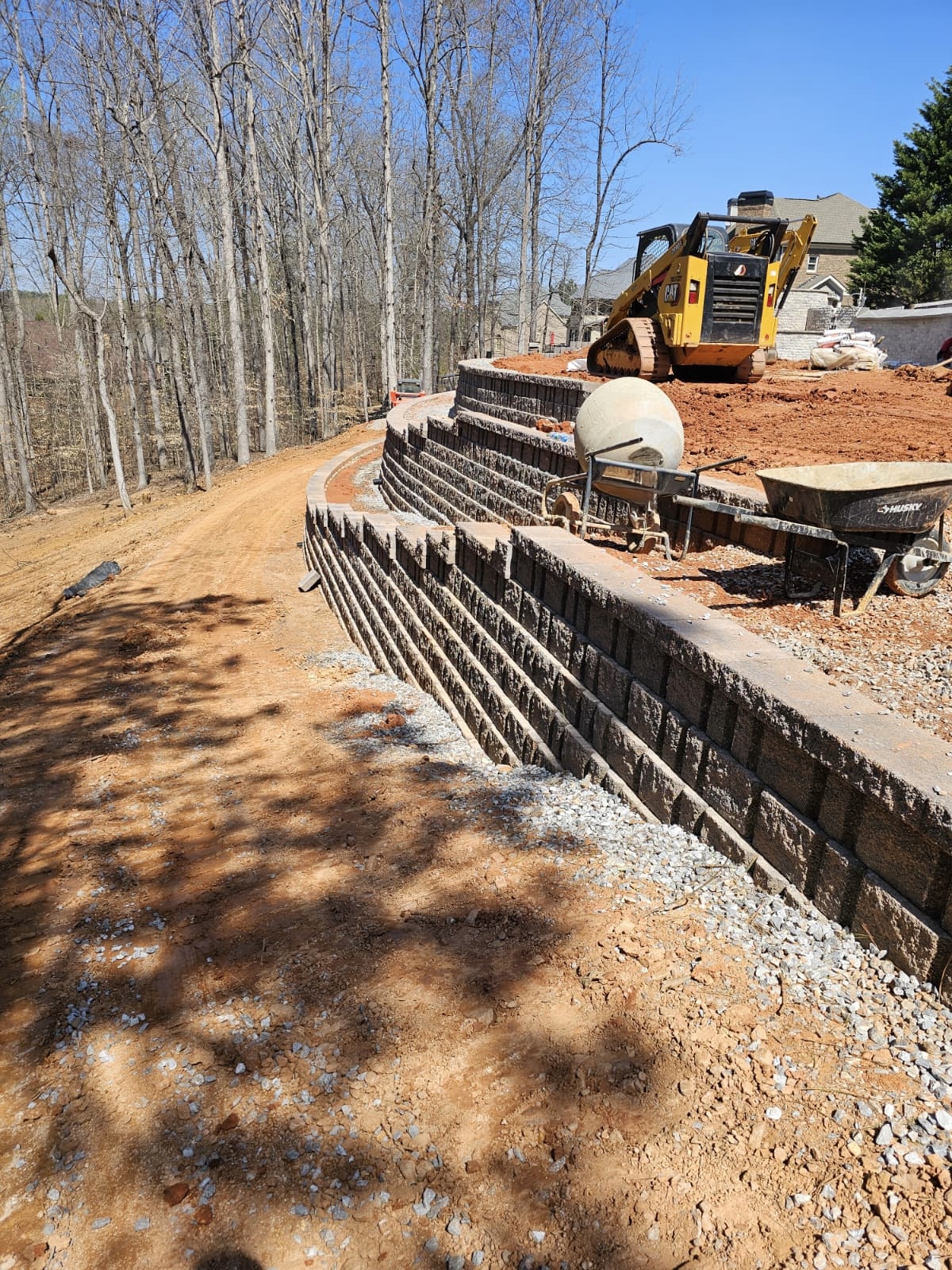
Natural stone retaining wall on a Cumming property — dry-stack granite fieldstone matched to the wooded Forsyth County landscape, permeable construction for Georgia rainfall conditions.
Manufactured segmental block retaining walls in Cumming typically run $22 to $45 per square foot of wall face, depending on block specification, geogrid requirements, drainage complexity, and site access. For a standard 40-foot wall at five feet of exposed height — 200 square feet of face — that’s roughly $4,400 to $9,000.
Natural stone retaining walls run $40 to $85 per square foot of wall face for fieldstone or quarried granite, depending on stone class, wall height, and site access conditions. The same 200-square-foot wall section runs roughly $8,000 to $17,000. The premium covers material cost (quarried or sourced stone vs. manufactured block), labor intensity (stone selection and placement requires more time and skill per square foot than block installation), and mobilization complexity (stone delivery and handling on Forsyth County lots with limited access can add significant cost). Crab orchard sandstone, which some Cumming homeowners prefer for its warm color and regional origin, typically runs at the higher end of the stone range.
Natural stone earns its premium when: the property’s landscape character is organic, wooded, or restoration-oriented — Forsyth County lots with mature hardwoods, existing creek stone, or a craftsman/farmhouse architectural character. When the wall will be a prominent visible element of the rear yard or outdoor living area — a focal wall behind an outdoor kitchen, a garden terrace wall that frames a view, a wall that will be lit and photographed. When the long-term aesthetic trajectory matters — natural stone’s weathered character at year fifteen genuinely outperforms manufactured block on premium Cumming properties.
Manufactured block is the smarter call when: the wall is a utility structure — a rear drainage slope, a side-yard grade change, a wall adjacent to a driveway or service area. When the grade change requires heights above six feet where the block’s geogrid engineering system provides structural advantages over dry-stack stone’s height limitations. When the project is a pool surround, patio terrace, or contemporary outdoor space where the block’s clean geometry complements the architectural character better than irregular stone profiles would. And straightforwardly, when the budget is fixed — a properly engineered block wall at a real budget is better than a stone wall done at reduced scope or specification.
Why Kaizen Scapes
We work with both natural stone and manufactured block systems on Forsyth County properties, and we have an honest conversation about which one fits the project before we quote. The material decision follows the site evaluation, the landscape context, the structural requirements, and the budget — not our preferred margin. Call us at (470) 535-0252 or reach us through our contact page to schedule a free site evaluation.
Kaizen Scapes proudly serves homeowners across Canton, GA, Woodstock, GA, and the surrounding North Georgia communities including Holly Springs, Ball Ground, Acworth, Kennesaw, Marietta, Alpharetta, Milton, Roswell, Cumming, Johns Creek, and East Cobb. If you’re looking for hardscaping and landscaping craftsmanship within 35 miles of Canton or Woodstock, our team is ready to transform your outdoor space.
Whether you’re in Canton, Woodstock, Alpharetta, Milton, or anywhere across Cherokee County and the greater North Atlanta suburbs, Kaizen Scapes brings the same relentless standard to every project. We don’t do cookie-cutter. We do custom — built to last.
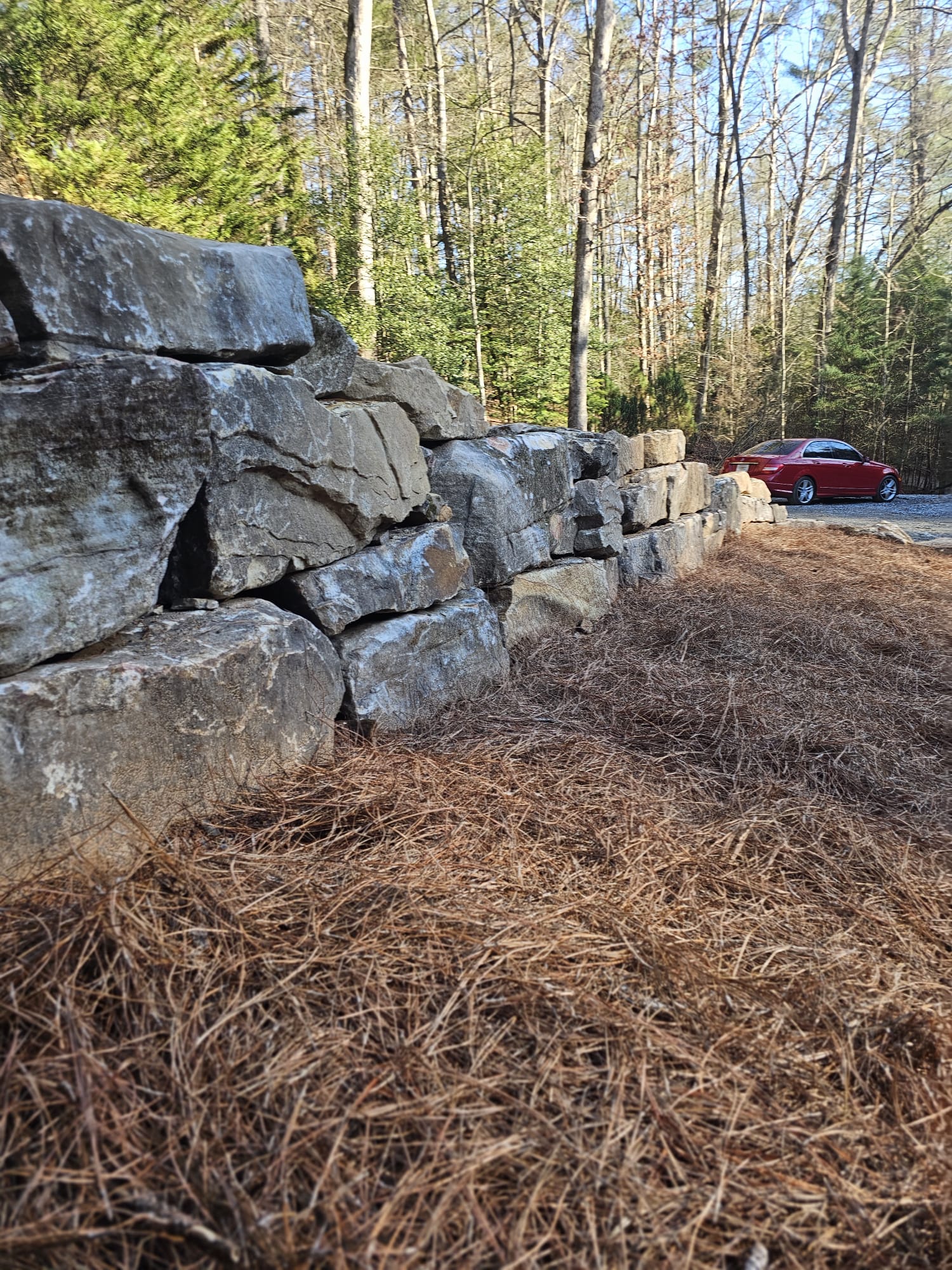
A completed retaining wall project in Cumming — material selected to match the property’s wooded Forsyth County landscape character and the structural requirements of the slope.
We assess landscape context, structural requirements, and budget before recommending any material. Free site evaluations across Cumming and all of Forsyth County.
Kaizen Scapes is based in Canton, Georgia and serves the greater North Atlanta region within 35 miles: