

At some point every Cumming homeowner who has invested in a quality patio realizes that the furniture is a recurring problem. It blows over. It corrodes. It fades. It occupies storage space every November and requires reassembly every April. A masonry seat wall solves every one of those problems permanently — and does something quality outdoor furniture never can: it defines the room.
A masonry seat wall built at the perimeter of a Cumming patio or around a fire pit isn’t just seating — it’s an architectural boundary that tells the eye where the outdoor living space begins and ends. That visual definition is what separates a patio that feels like a finished room from one that feels like a concrete pad with chairs on it. The furniture can be excellent and the patio still reads as incomplete if there’s no structural perimeter giving it form. The seat wall is that perimeter — and it seats more people, requires zero maintenance, and appreciates with the property.
The Functional Case
Quality outdoor furniture in Forsyth County — the kind that doesn’t look cheap and holds up in Georgia’s heat and humidity — runs $3,000 to $8,000 for a full patio set. That set will need cushion replacement in years three to five, frame refinishing or replacement in years seven to ten, and will represent a recurring purchase cycle that compounds over the decade. Add annual storage logistics, UV cover systems, and the wind displacement problem that every Cumming homeowner with an open lot contends with, and the ten-year cost of quality outdoor furniture approaches or exceeds what a masonry seat wall costs installed.
A masonry seat wall built correctly in Cumming costs between $4,500 and $12,000 depending on length, material, and cap selection — and has a functional lifespan that exceeds the home itself if the footing and mortar specification are correct. It doesn’t blow over in the wind events that come through Forsyth County every spring. It doesn’t corrode. It doesn’t require storage. And it doesn’t depreciate. Every dollar spent on a masonry seat wall stays in the property — and that matters in a Cumming market where landscaping and hardscape quality directly influences appraisal comps.
“A furniture set depreciates from the day it arrives. A masonry seat wall appreciates with the property. In ten years, that difference is significant.”
Cap Stone Selection
The cap stone is the most-contacted surface on any seat wall — it’s where people actually sit, where drinks are set, where the tactile experience of the masonry work lives. Getting the cap right means matching the material to both the masonry body and the climate exposure conditions of a Forsyth County property. Bluestone thermal-finish caps are the workhorse of North Atlanta seat wall projects: they’re durable, slip-resistant with a thermal finish, available in both blue-grey and buff tones, and hold up well in Georgia’s freeze-thaw cycling. Cost runs $14 to $22 per linear foot for installed bluestone caps, depending on slab thickness.
Granite caps offer a step up in hardness and longevity — granite is essentially maintenance-free in exterior applications, resists staining better than most stones, and develops a patina over years that only improves the appearance. For Cumming properties with a more contemporary or transitional design language, a grey or black granite cap on a natural stone veneer seat wall body creates a clean, high-contrast finish that photographs well and wears better than any alternative. Installed granite cap cost runs $18 to $32 per linear foot.
Travertine caps introduce warmth and texture — the characteristic travertine pitting and vein pattern adds visual complexity that flat bluestone or granite can’t replicate. The tradeoff is that travertine’s open pore structure requires sealing in exterior applications, and the sealing maintenance schedule needs to be communicated clearly upfront. For Cumming properties around a pool or in consistently wet exposure, travertine without proper sealing is not our first recommendation — but on a covered patio or under a pergola structure, it’s a beautiful cap choice.

Masonry work in the North Atlanta area — the same structural and material standards applied to every Kaizen Scapes seat wall project in Cumming and Forsyth County.
A masonry seat wall without integrated lighting is functional from 10am to 6pm. A seat wall with low-voltage LED fixtures recessed into the cap face or set under the cap overhang is a design element that works around the clock — and for Cumming families who use their outdoor spaces into the evening, that’s the difference between a feature that works for half the year and one that works year-round. The specification is straightforward: conduit sleeve embedded in the wall during construction, electrical rough-in completed before cap is set, LED strip or individual puck fixtures installed at cap installation. Retrofitting light to a completed masonry wall is expensive and visually compromised — this is a decision that has to be made before construction begins.
The most underappreciated function of a masonry seat wall is what it does to the spatial reading of a Cumming outdoor living space. A patio without a perimeter edge bleeds visually into the lawn — there’s no signal to the eye that a distinct space exists. A masonry seat wall at 18 to 24 inches high — the correct ergonomic height for casual seating — creates a horizontal datum that the eye reads as a room boundary. The space inside the wall feels enclosed, defined, and finished. The furniture that fills it reads as furnishing a room rather than placing chairs on pavement. This spatial shift is one of the most commented-on outcomes from homeowners who complete seat wall projects in Cumming — the patio feels like a different space the week after installation, not because anything else changed, but because the room now has walls.
Why Kaizen Scapes
We design seat walls as spatial elements, not just masonry features. The height, cap selection, length, and lighting specification all come out of understanding how you use your outdoor space and what you want it to feel like after dark, during a party, in February. A seat wall that’s the wrong height, the wrong length for the patio scale, or the wrong cap material for your climate exposure conditions is a design problem that masonry skill can’t fix after the fact. We get those decisions right before the first block is placed.
Kaizen Scapes proudly serves homeowners across Canton, GA, Woodstock, GA, and the surrounding North Georgia communities including Holly Springs, Ball Ground, Acworth, Kennesaw, Marietta, Alpharetta, Milton, Roswell, Cumming, Johns Creek, and East Cobb. If you’re looking for hardscaping and landscaping craftsmanship within 35 miles of Canton or Woodstock, our team is ready to transform your outdoor space.
Whether you’re in Canton, Woodstock, Alpharetta, Milton, or anywhere across Cherokee County and the greater North Atlanta suburbs, Kaizen Scapes brings the same relentless standard to every project. We don’t do cookie-cutter. We do custom — built to last.
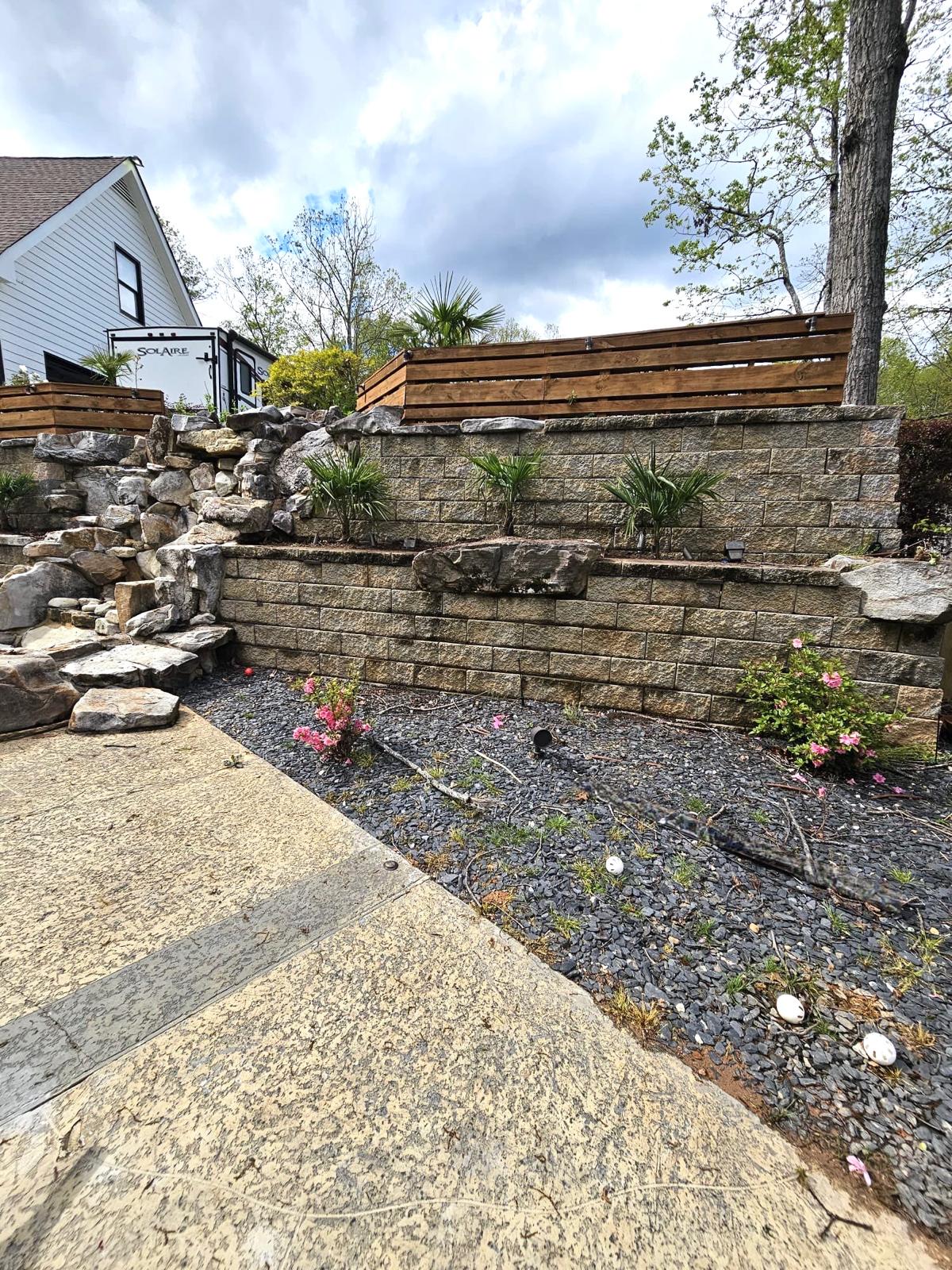
A masonry seat wall project in Cumming — designed to define the outdoor room, eliminate the furniture maintenance cycle, and hold up in Forsyth County’s climate for decades.
Masonry seat walls designed for your Cumming patio’s scale and use. Free evaluations across Cumming, Johns Creek, and all of Forsyth County.
Kaizen Scapes is based in Canton, Georgia and serves the greater North Atlanta region within 35 miles: