

The name “French drain” gets used to describe almost every underground drainage solution imaginable — which means a lot of Woodstock homeowners think they know what they’re getting when they ask for one, and a lot of contractors give them something different. Understanding what a French drain actually is, and when it’s the right tool, is the difference between solving a drainage problem and spending money on the wrong fix.
A true French drain intercepts subsurface water — water that is moving horizontally through the soil layer before it surfaces, pools, or pushes against a structure. It is not a surface drainage solution. It is not a replacement for grading. And it is not always the right answer. But for the specific problem it solves — soggy lawn areas that stay wet long after rain, water seeping under patio foundations, hydrostatic pressure building against retaining walls — it is often both the most effective and the most cost-efficient solution available.
How It Works
The system is conceptually simple: a trench is excavated at a depth that intercepts the water table or the subsurface flow path, lined with filter fabric to prevent soil migration, filled with clean angular gravel, and fitted with a perforated pipe at the bottom. Water enters the gravel bed from the sides and top, flows to the perforated pipe, and is carried by gravity to a daylight outlet — typically at a downslope property edge, a dry creek bed, or a storm drain connection.
The critical variable is depth. A French drain installed too shallow intercepts only the top layer of soil moisture and leaves the deeper water movement untouched. In Woodstock’s clay-heavy soils, effective French drain depth is typically 18 to 36 inches — deep enough to cut through the compacted clay layer where lateral water movement concentrates. Anything shallower sits above the problem rather than intercepting it.
“Most drainage problems in Woodstock are cheaper to fix than the homeowner expects — because most of them are a soil and grade problem, not a water volume problem.”
When It’s Right
Cherokee County’s red clay creates a specific failure mode for French drains installed without adequate filter fabric protection. Clay particles are fine enough to migrate through standard gravel fill and gradually clog the perforated pipe over three to seven years — a process called siltation. A French drain that worked perfectly for the first five years and now backs up is almost always a siltation problem, not a pipe failure.
The solution is non-woven geotextile fabric wrapped around the entire gravel bed — not just the pipe. The fabric acts as a filter, allowing water to pass while blocking clay particle migration. This single installation detail is the difference between a French drain system that lasts 20 years and one that needs to be excavated and rebuilt after a decade. Kaizen Scapes wraps every French drain system in geotextile fabric and uses clean angular stone — never rounded pea gravel, which has a lower void ratio and clogs faster.
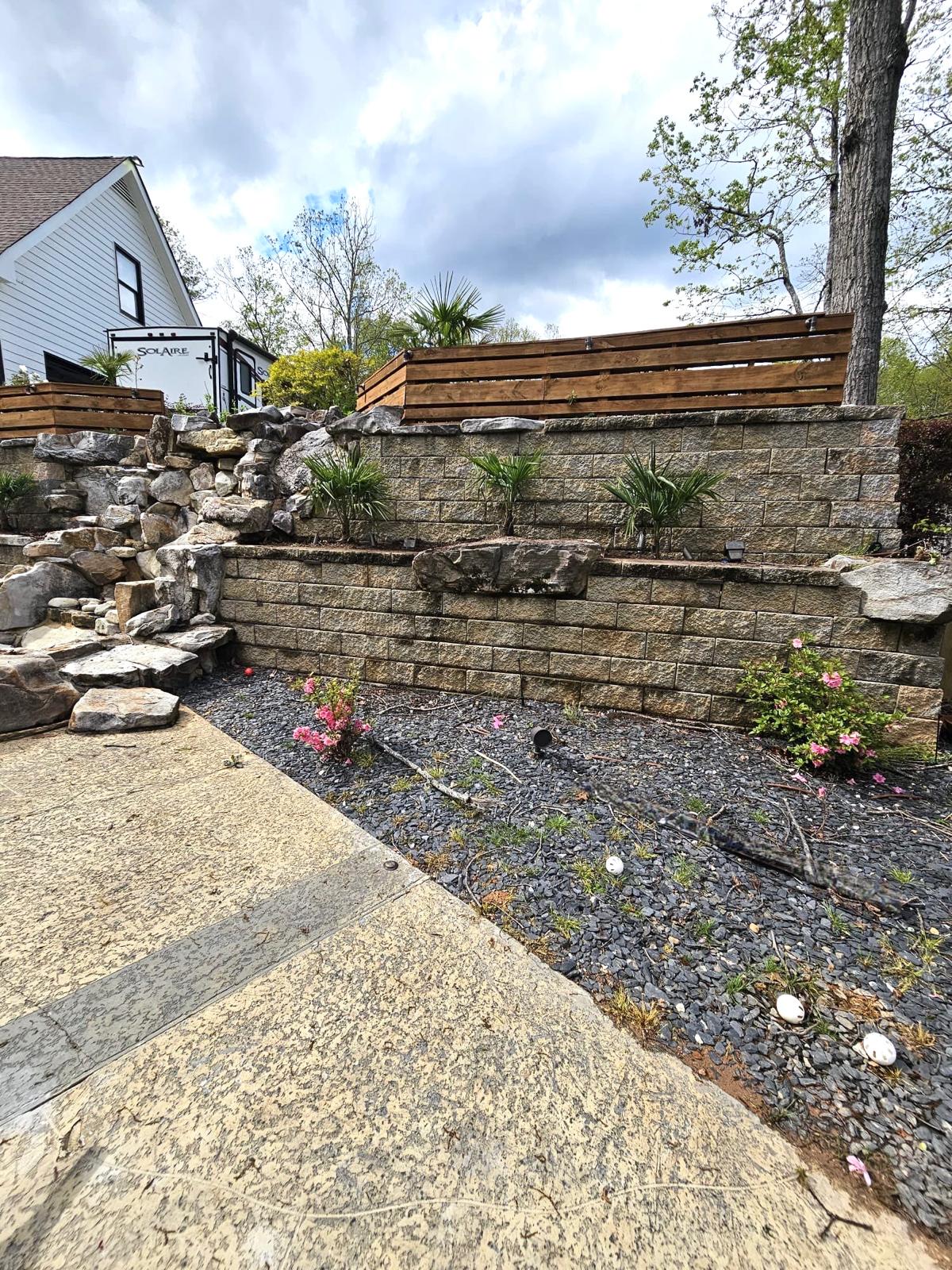
Retaining wall installation in the Woodstock area with integrated drainage system — perforated pipe behind the wall base prevents hydrostatic pressure buildup in Cherokee County clay soils.
The most common question Woodstock homeowners ask is how much a French drain costs. The honest answer depends almost entirely on linear footage and outlet conditions. A straightforward French drain installation — 60 to 80 linear feet, single outlet to a daylight point at the property edge — runs $2,500 to $4,500 in the Woodstock area. Longer runs, multiple outlets, difficult access, or connections to existing storm infrastructure push costs higher, with complex whole-yard drainage systems running $6,000 to $12,000.
That range sounds significant — and it is — but it needs to be understood relative to the cost of not acting. Foundation moisture damage in Cherokee County residential properties is one of the leading causes of structural repair costs in the $15,000–$50,000 range. A French drain that costs $3,500 and prevents a foundation repair call pays for itself the first time it works. The drainage conversation is never really about the cost of the system — it’s about the cost of the problem the system prevents.
Kaizen Scapes proudly serves homeowners across Canton, GA, Woodstock, GA, and the surrounding North Georgia communities including Holly Springs, Ball Ground, Acworth, Kennesaw, Marietta, Alpharetta, Milton, Roswell, Cumming, Johns Creek, and East Cobb. If you’re looking for hardscaping and landscaping craftsmanship within 35 miles of Canton or Woodstock, our team is ready to transform your outdoor space.
Whether you’re in Canton, Woodstock, Alpharetta, Milton, or anywhere across Cherokee County and the greater North Atlanta suburbs, Kaizen Scapes brings the same relentless standard to every project. We don’t do cookie-cutter. We do custom — built to last.
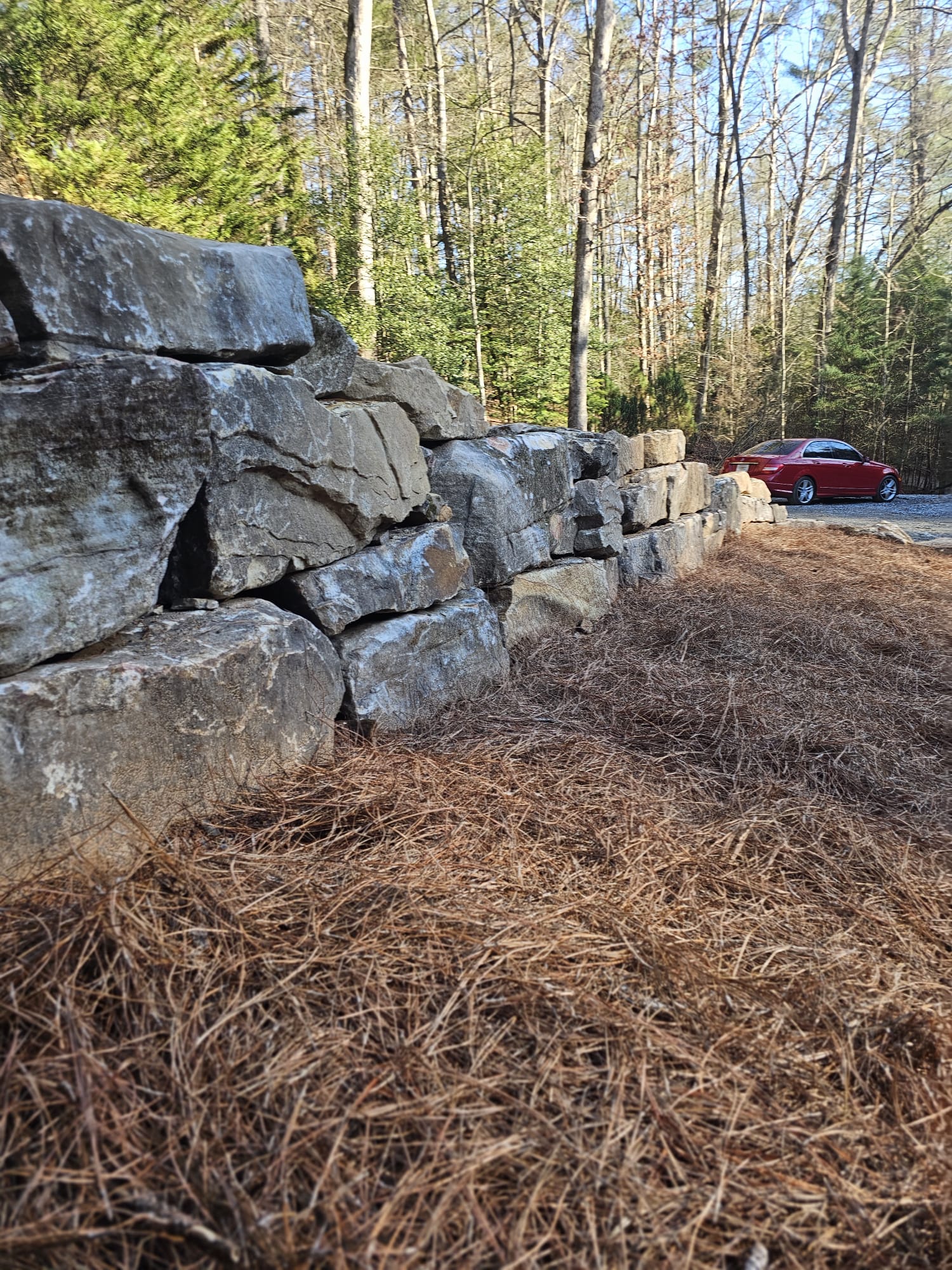
A completed drainage and retaining wall project in Woodstock — geotextile-wrapped gravel drainage bed manages subsurface water movement through Cherokee County clay soils.
We identify the water source before recommending a system. Free drainage evaluations across Woodstock, Cherokee County, and the greater North Atlanta area.
Kaizen Scapes is based in Canton, Georgia and serves the greater North Atlanta region within 35 miles: