

Alpharetta homeowners invest tens of thousands of dollars in patios, retaining walls, and outdoor living spaces — then discover two years later that the slopes around those installations are eroding badly. The hardscape looks beautiful. The ground around it is disintegrating. The two are not coincidental.
The mistake is not the hardscape. The mistake is treating erosion control as a landscaping afterthought rather than an infrastructure decision that shapes how the hardscape is designed, graded, and drained. When a patio is installed without coordinating the drainage outlets, the runoff that used to sheet across a lawn is now concentrated at specific edges — and those edges, if they’re vegetated slopes, are suddenly carrying four to five times the water they handled before. New hardscape on an Alpharetta lot doesn’t eliminate erosion risk — it often increases it by reorganizing where concentrated flow exits the paved surface.
The Newly Disturbed Site Problem
Any construction project — hardscape or otherwise — disturbs the soil around the work zone. Compacted subgrade exposed during excavation, stripped topsoil, and bare slopes left to establish after construction are all acutely vulnerable to erosion. Georgia red clay at a permeability rate of 0.05 to 0.2 inches per hour means almost all rainfall on a freshly disturbed slope becomes runoff immediately, and that runoff carries the fine clay particles with it.
The industry standard is to protect disturbed areas with erosion control blankets and seed immediately after construction — but the more important and frequently skipped step is designing drainage outlets into the hardscape itself so that concentrated flow from the paved surface is directed to stable, reinforced points rather than released onto unprotected slopes. A patio edge that drains onto a slope with only sod for protection is creating a new erosion problem every time it rains hard.
“Hardscape changes where water goes. If you don’t design for that change, the landscape around the hardscape absorbs the consequence — usually in the form of erosion you’ll be repairing within two years.”
How Retaining Walls Interact
Retaining walls are the most powerful erosion control tool available for steep Alpharetta slopes — but they need drainage integrated into the design to function correctly long-term. A retaining wall without drainage behind it captures not just the soil but all the subsurface water moving through that soil. That water has nowhere to go, pressure builds, and the wall eventually leans, cracks, or fails outright. The wall solved the erosion problem by creating a structural failure problem.
Permeable paver systems have become popular in Alpharetta as a drainage-integrated hardscape option. They work well in specific conditions — moderate rainfall, sandy or well-draining base material, relatively flat installation — and they underperform in others. On Georgia clay subgrade, the infiltration capacity of permeable pavers is limited by the clay below them, not the pavers themselves. Water entering the open joints reaches the clay and slows dramatically. In a heavy rain event, the system can temporarily fill and sheet drain just like a conventional paver.
Permeable pavers are a valuable part of a drainage strategy — but they’re not a replacement for it. On Alpharetta properties with significant grade, impermeable clay subsoil, or high-intensity summer rain patterns, permeable pavers should be combined with a French drain or underdrain system that collects the water that does infiltrate and carries it to a controlled outlet. The system works. The expectation that pavers alone solve a drainage problem is what causes disappointment.
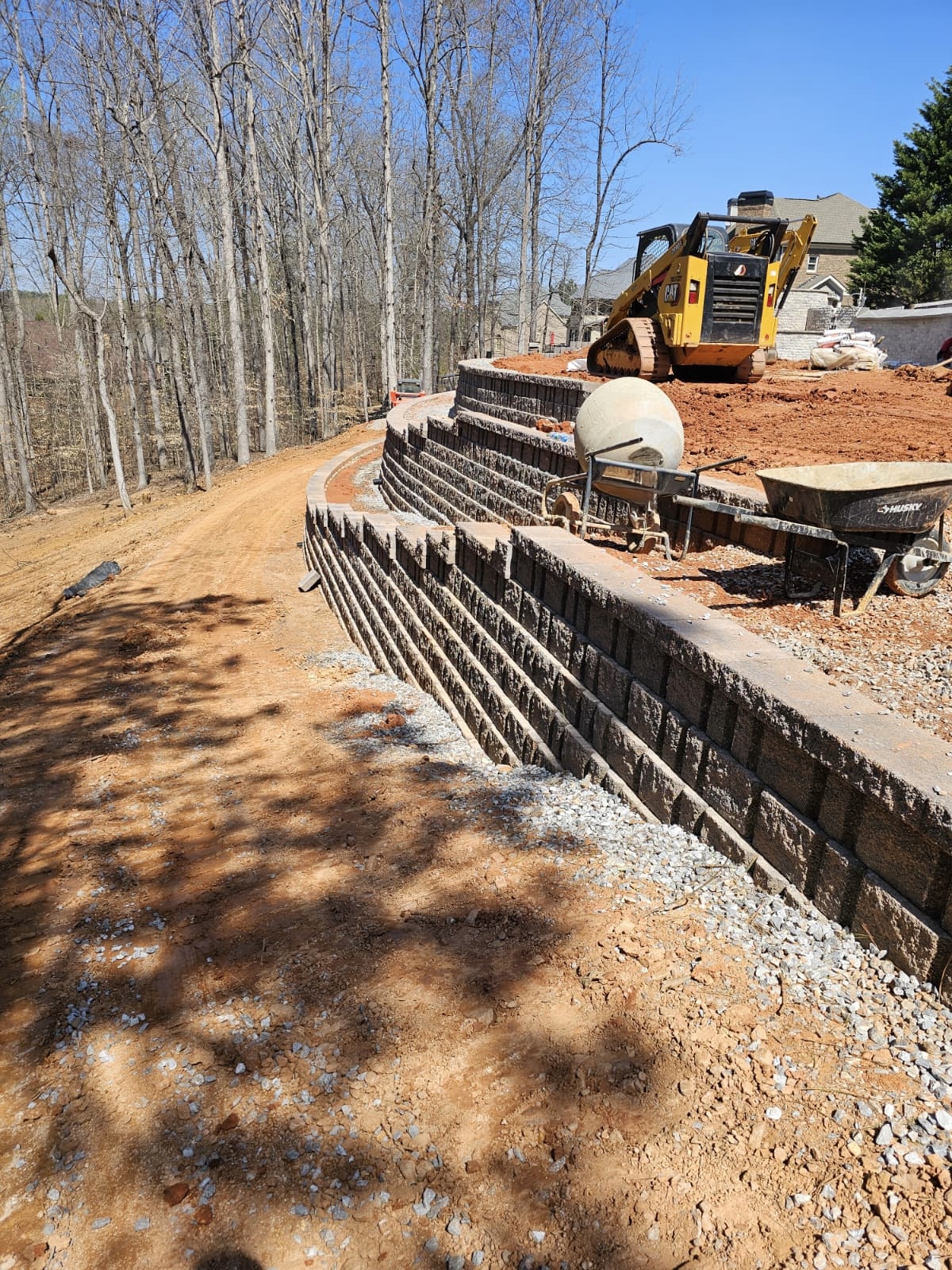
Erosion control installation in the Alpharetta area — integrated retaining wall, drainage bed, and slope stabilization designed to protect adjacent hardscape investment from runoff damage.
The most cost-effective approach to erosion control in Alpharetta is addressing it before construction begins, not after. Every hardscape design should start with a drainage plan that identifies where water currently flows, where it will flow after the installation changes the surface, and how those new flow paths are managed. That plan determines where retaining walls need drainage integrated, where outlet points need riprap protection, and whether the existing vegetation on adjacent slopes is adequate for the water volume they’ll receive after construction.
Erosion control in Alpharetta runs $2,500 to $12,000 for typical residential installations, depending on slope severity and the systems required. Erosion repair after the fact — once a slope has been actively losing soil for one to three years — typically costs $8,000 to $25,000 by the time the wall needs reconstruction, the slope needs regrading, and the damaged area needs replanting. The conversation about erosion control is always cheaper before the hardscape is installed than after.
Kaizen Scapes proudly serves homeowners across Canton, GA, Woodstock, GA, and the surrounding North Georgia communities including Holly Springs, Ball Ground, Acworth, Kennesaw, Marietta, Alpharetta, Milton, Roswell, Cumming, Johns Creek, and East Cobb. If you’re looking for hardscaping and landscaping craftsmanship within 35 miles of Canton or Woodstock, our team is ready to transform your outdoor space.
Whether you’re in Canton, Woodstock, Alpharetta, Milton, or anywhere across Cherokee County and the greater North Atlanta suburbs, Kaizen Scapes brings the same relentless standard to every project. We don’t do cookie-cutter. We do custom — built to last.
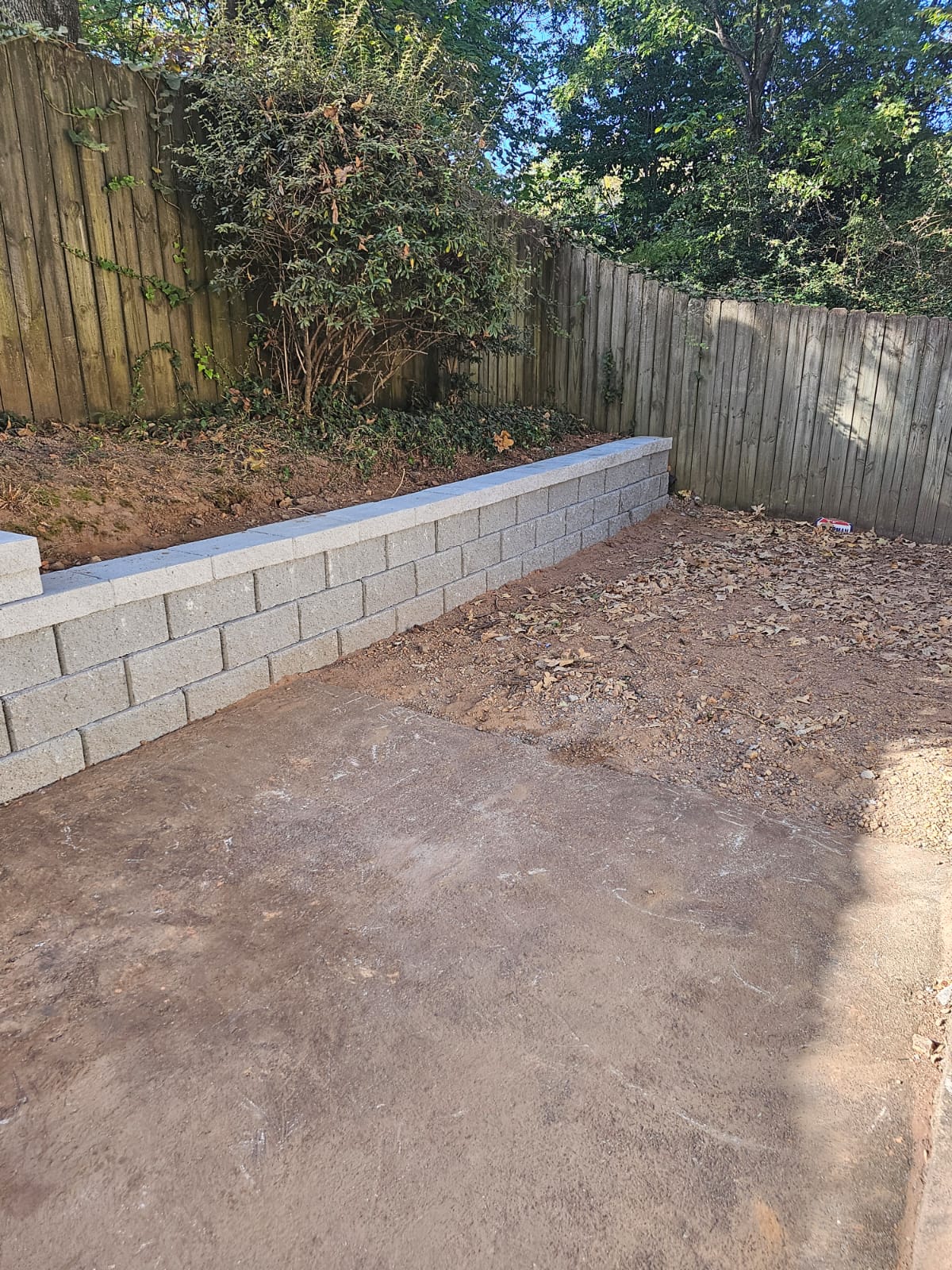
A finished erosion control and retaining wall system in Alpharetta — drainage-integrated design protects both the hardscape installation and the slopes it borders.
We design drainage into every hardscape project — before the first stone is placed. Free evaluations across Alpharetta, Fulton County, and the greater North Atlanta area.
Kaizen Scapes is based in Canton, Georgia and serves the greater North Atlanta region within 35 miles: