

Stone veneer transforms outdoor surfaces — retaining walls, home foundations, outdoor kitchen frames, fireplace surrounds — with the visual weight and texture of natural stone at a fraction of the structural load and material cost. Johns Creek homeowners are applying it widely, and the results range from exceptional to failed within three years. The difference between those outcomes is almost never the stone itself. It’s the substrate underneath it.
The stone veneer market in Johns Creek splits between two fundamentally different products that look similar in the catalog but behave differently on the wall: manufactured stone veneer (MSV) and natural thin stone veneer (NTSV). Understanding what separates them — in weight, in installation requirements, in longevity — is the first decision any Johns Creek homeowner needs to make before the first stone gets ordered. Getting it wrong means either overpaying for capability you don’t need or installing a product on a substrate that can’t support what you’ve ordered.
The Products
Manufactured stone veneer is a concrete product cast in molds to replicate the appearance of natural stone. It is lighter than natural stone — typically 8 to 15 pounds per square foot versus 15 to 25 for natural thin stone — which makes it suitable for a wider range of substrate conditions. The appearance quality has improved dramatically over the past decade, and premium MSV products from manufacturers like Eldorado or Cultured Stone are genuinely difficult to distinguish from natural stone at conversational distance. Cost installed in Johns Creek runs $18 to $28 per square foot depending on pattern complexity and substrate condition.
Natural thin stone veneer is real stone — typically granite, slate, limestone, or quartzite — split or sawn to roughly 3/4 to 1.5 inch thickness. It weighs more, costs more, and requires a substrate that can carry that load without deflection. But nothing replicates what natural stone looks like in direct sunlight — the variation in mineral content, the depth of the cleft face, the way light moves across a coursed ledgestone — and Johns Creek homeowners who want that result on an outdoor kitchen surround or a feature fireplace wall need the real material. Installed cost runs $28 to $45 per square foot depending on stone species, joint pattern, and access conditions.
“Ninety percent of stone veneer failures trace back to the substrate — not the stone. The most expensive veneer on earth won’t survive a bad scratch coat.”
Substrate & Installation
The installation sequence for stone veneer on a frame substrate — a wood-framed outdoor kitchen, a timber-frame fireplace surround, a garage wall — begins before any stone is touched. A weather-resistant barrier goes over the framing first. Then galvanized metal lath, fastened into studs or blocking at a maximum 16-inch spacing. Then a Portland cement scratch coat, applied in a single pass to a nominal 3/4-inch thickness, allowed to cure for 24 hours, and scratched with a notched trowel while still plastic. The scratch coat is what the stone bonds to — and its quality determines everything that follows.
In Johns Creek’s climate, freeze-thaw cycling is moderate but present — and moisture infiltration at improperly detailed joints or at the base course is the most common failure mechanism we see in residential stone veneer work. A base course that sits too close to grade, a cap detail without a drip edge, or a joint that wasn’t tooled to a consistent depth — these are the entry points for water that eventually freeze-expands, fractures the mortar bond, and begins the delamination process. These failures are entirely preventable with correct technique.
Johns Creek homeowners frequently ask about the dry-stacked look — stone veneer installed tight with minimal visible mortar, mimicking a traditional dry-stack fieldstone wall. This is achievable with both MSV and NTSV, but it requires a tighter installation tolerance and a mason who can read the stone’s natural break pattern to build a visually coherent joint without visible backing showing through. Mortared joints — typically 3/8 to 5/8 inch, tooled flush or concave — are more forgiving to install and actually perform better in high-moisture exterior applications because the mortar joint seals the face against water intrusion. For outdoor kitchen surrounds and fireplace faces in Johns Creek, we typically recommend a mortared joint for longevity.

Stone veneer application on an outdoor feature in the North Atlanta area — substrate-first approach, correct scratch coat, mortared joints tooled for longevity in Georgia’s climate.
Retaining wall faces are among the most popular stone veneer applications in Johns Creek because a block or poured concrete retaining wall is structurally sound but visually utilitarian. Applying a natural thin stone veneer face to a concrete block retaining wall — dry-stacked ledgestone or a coursed ashlar pattern — elevates the landscape to a level that reads as designed rather than constructed. The key specification here is mortar type: retaining wall applications need a Type S mortar minimum, not standard Type N, because the wall is in contact with soil moisture on the back face.
Outdoor kitchen frames and fireplace surrounds are the other dominant Johns Creek application. These structures are typically framed in steel stud or CMU, which gives a stable non-combustion-prone substrate for the veneer work. For any surface within 18 inches of a flame source, the specification changes: the substrate must be non-combustible, the mortar must be a refractory mix, and the stone selection should avoid high-silica content stones that can crack under thermal cycling. This is not a specification that general contractors typically know — it requires a mason who has built exterior fireplace surrounds and understands the thermal exposure requirements.
Why Kaizen Scapes
We don’t hand stone veneer work off to a tile sub. Our masons have installed both MSV and natural thin stone veneer on retaining walls, outdoor kitchens, fireplace surrounds, and home foundation facades across Fulton County. We start every stone veneer project with a substrate assessment — because the substrate is the project. The stone is the finish. A substrate that was not prepared correctly will eventually reject that finish regardless of the stone’s quality. That’s the evaluation we do before we quote. It’s also the reason our stone veneer work holds up.
Kaizen Scapes proudly serves homeowners across Canton, GA, Woodstock, GA, and the surrounding North Georgia communities including Holly Springs, Ball Ground, Acworth, Kennesaw, Marietta, Alpharetta, Milton, Roswell, Cumming, Johns Creek, and East Cobb. If you’re looking for hardscaping and landscaping craftsmanship within 35 miles of Canton or Woodstock, our team is ready to transform your outdoor space.
Whether you’re in Canton, Woodstock, Alpharetta, Milton, or anywhere across Cherokee County and the greater North Atlanta suburbs, Kaizen Scapes brings the same relentless standard to every project. We don’t do cookie-cutter. We do custom — built to last.
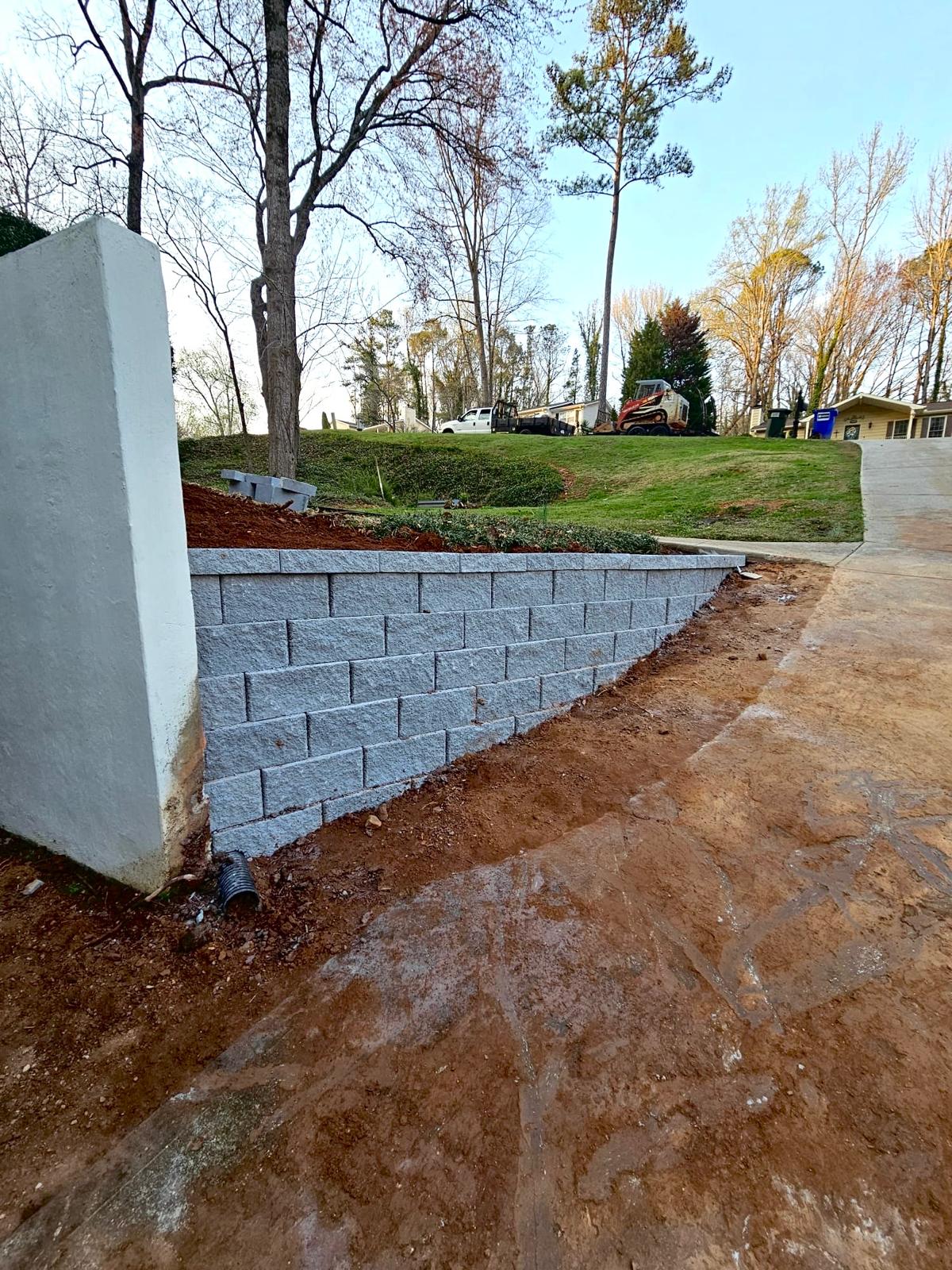
Stone veneer work in Johns Creek — substrate-first, specification-correct, and built to hold up in North Georgia’s climate for decades.
Substrate assessment before any stone is ordered. Free evaluations across Johns Creek, Alpharetta, and all of Fulton County.
Kaizen Scapes is based in Canton, Georgia and serves the greater North Atlanta region within 35 miles: