

Choosing a retaining wall material in Woodstock, GA is not a decision that should start with a catalog. Cherokee County’s clay-rich soils, elevation changes, and seasonal moisture swings make material selection a structural question — and the answer looks different for a four-foot garden border than it does for a twelve-foot hillside holding back a mature slope above a patio.
Every material system has a performance ceiling. The problem isn’t that segmental block is inferior to natural stone, or that concrete is overbuilt — it’s that each one is engineered for a specific range of conditions. Matching the material to the load, soil, and drainage context of your actual Woodstock property is the decision that determines whether this wall is still standing in fifteen years. Most quotes you’ll receive don’t start there. Ours do.
The Material Comparison
Segmental retaining wall block — the interlocking engineered block system most homeowners picture — is the workhorse of residential retaining walls in Cherokee County. Properly installed with geogrid reinforcement and a standard drainage package, it performs reliably at heights up to six feet and handles the expanding and contracting clay soils common throughout Woodstock and Canton. Its advantage is precision: each block is manufactured to a consistent dimension, which makes tiered systems and curved layouts clean and structurally sound. Cost typically runs $6,000 to $18,000 depending on wall height, length, and drainage complexity.
Natural stone — fieldstone, granite, or dry-stack flagstone — offers a performance profile that looks different on paper but delivers differently in practice. The permeability of a dry-stack natural stone wall is actually an asset in Georgia clay conditions: water migrates through the wall rather than building hydrostatic pressure behind it. The tradeoff is that natural stone walls require more precise craftsmanship to achieve structural integrity, and the material cost alone puts projects in the $12,000 to $32,000 range before labor. On high-visibility properties in Woodstock, Holly Springs, or the Uniform and Deer Run neighborhoods, that investment returns on curb appeal and resale.
“The right material isn’t the most expensive one. It’s the one matched to your actual slope, soil, and drainage conditions — not the one that photographs best in the showroom.”
Poured concrete and concrete block systems belong in a separate category: they are typically used in commercial applications or in residential situations where significant structural loads, vehicle proximity, or steep grade changes demand engineered-stamped specifications. For most Woodstock homeowners, the cost premium of poured concrete is not justified by the structural need — a properly engineered segmental block system with geogrid and drainage handles the same conditions at lower cost and with equal longevity when installed correctly.
Cherokee County Conditions
Woodstock sits in a zone where the Piedmont meets the Ridge and Valley transition — meaning the underlying soil profile varies significantly even within the same neighborhood. Properties east of Woodstock along the 92 corridor tend toward denser red clay with poor drainage, while lots in the foothills toward Ball Ground carry rockier subsoil that changes the footing specification entirely. A contractor who quotes the same material and same drainage package on every Woodstock job is not site-assessing — they are catalog-ordering.
A segmental block wall installed without geogrid reinforcement in Woodstock’s heavier clay soils will eventually bow under lateral pressure — not because the material is inadequate, but because it was specified below its required reinforcement threshold for those conditions. Natural stone without weep holes in a mortared application builds hydrostatic pressure behind the wall during sustained rain. Timber in contact with Woodstock’s consistently moist soil profile begins to degrade within five to eight years. These are not worst-case outcomes — they are the predictable result of mismatched material selection, and they account for the majority of wall rebuilds we assess in Cherokee County each year.
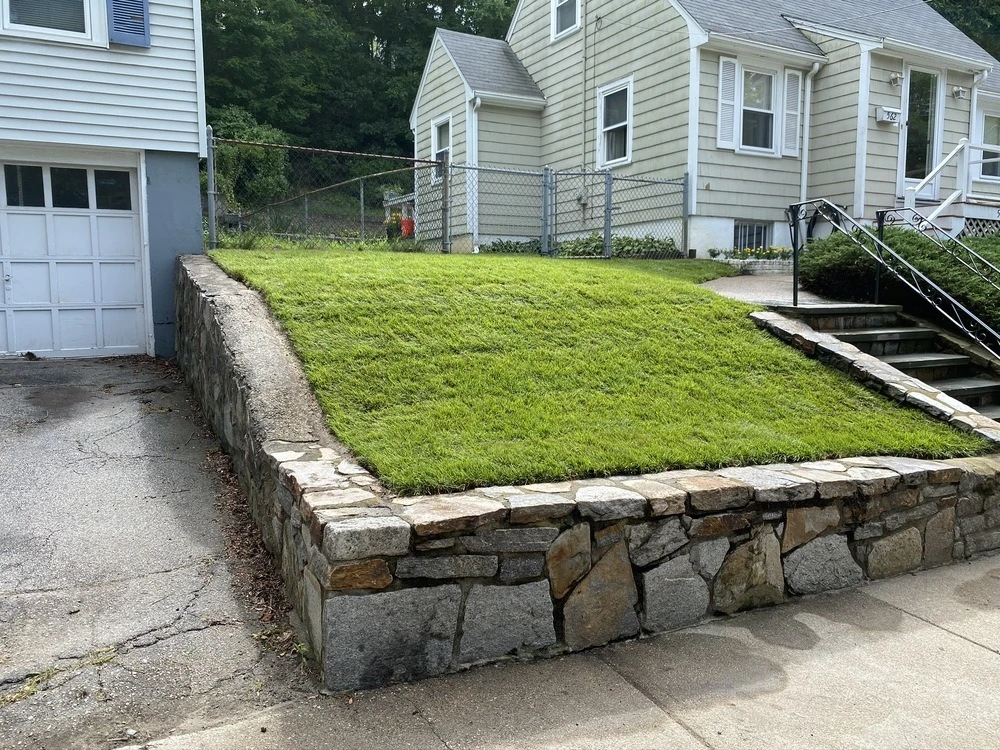
A segmental block retaining wall system in Woodstock — geogrid reinforced, full drainage package, matched to the site’s soil bearing conditions.
Segmental block retaining walls in Woodstock typically range from $6,000 for a straightforward single-tier system to $18,000 for a multi-tier installation with geogrid, full drainage infrastructure, and step-down access. Natural stone projects start near $12,000 for smaller applications and can reach $32,000 or more for grand-scale installations on larger Cherokee County lots. The range within each material category is not padding — it reflects wall height, drainage complexity, geogrid requirements, and site access conditions that vary significantly from one Woodstock property to the next.
What should concern any Woodstock homeowner is a quote that doesn’t vary meaningfully with those conditions. A flat-rate quote that looks the same regardless of whether your slope is four feet or eight feet is a quote that hasn’t accounted for the difference in drainage, footing, or reinforcement that difference actually requires.
Ask any retaining wall contractor in Woodstock to itemize their quote. A complete proposal includes: site assessment and grading evaluation, base excavation and compaction, drainage aggregate, perforated drain pipe, filter fabric, the block or stone system, geogrid reinforcement (if applicable), and finish grading. If the quote is a single line item or includes only “labor and material” without specification, you are not comparing equivalent projects across your bids. You are comparing two contractors who are quoting two different outcomes.
Why Kaizen Scapes
We don’t have a preferred material that we push on every project. We have a site assessment process that tells us which system actually fits your conditions — and we quote accordingly. If segmental block with geogrid is the right answer for your Woodstock slope, that’s what we recommend. If natural stone’s natural drainage profile is a better match for your site’s moisture conditions, that’s the conversation we have. The material decision should follow the site evaluation, not precede it.
Kaizen Scapes proudly serves homeowners across Canton, GA, Woodstock, GA, and the surrounding North Georgia communities including Holly Springs, Ball Ground, Acworth, Kennesaw, Marietta, Alpharetta, Milton, Roswell, Cumming, Johns Creek, and East Cobb. If you’re looking for hardscaping and landscaping craftsmanship within 35 miles of Canton or Woodstock, our team is ready to transform your outdoor space.
Whether you’re in Canton, Woodstock, Alpharetta, Milton, or anywhere across Cherokee County and the greater North Atlanta suburbs, Kaizen Scapes brings the same relentless standard to every project. We don’t do cookie-cutter. We do custom — built to last.
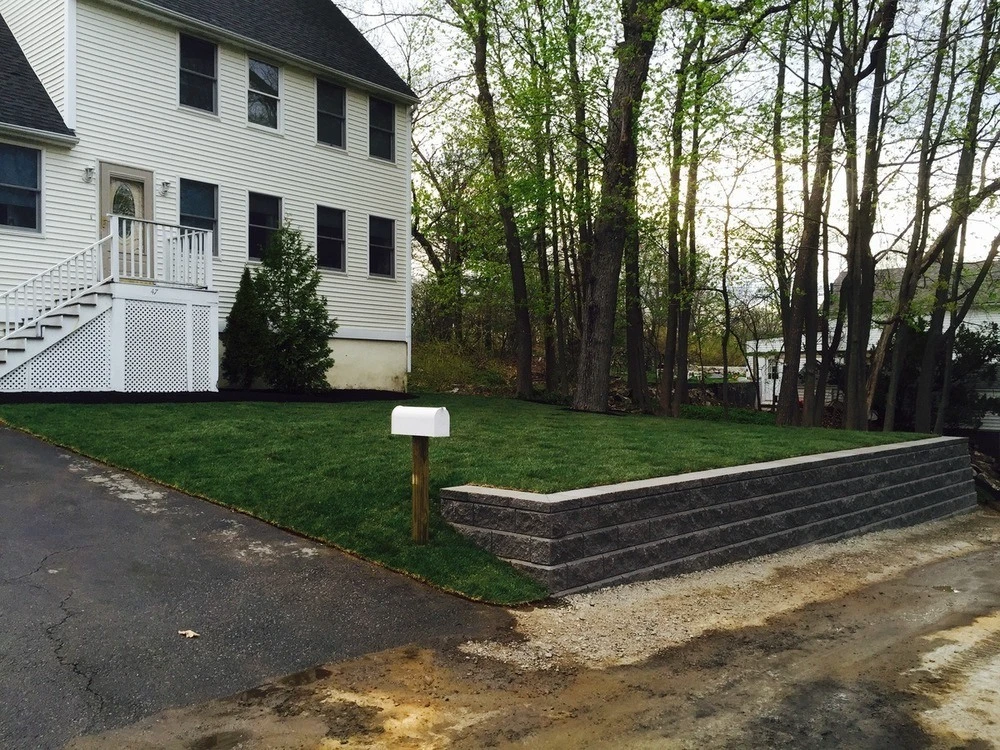
A completed retaining wall in Woodstock — material selected to match the site conditions, drainage engineered for Cherokee County’s clay soil profile.
We assess the site before recommending anything. Free retaining wall evaluations across Woodstock, Canton, and all of Cherokee County.
Kaizen Scapes is based in Canton, Georgia and serves the greater North Atlanta region within 35 miles: