

A leaning retaining wall is not just an aesthetic problem. It is a structural announcement — the wall is telling you that the forces acting on it have exceeded what it was designed or built to resist, and that the situation will continue to worsen until something changes. In Alpharetta, where premium landscaping investments and high-value properties are the norm, understanding exactly what a lean means determines whether you spend $4,000 on a repair or $18,000 on a rebuild that could have been avoided.
The critical distinction that most homeowners don’t know is the difference between leaning and bowing. They look similar from the yard but indicate completely different failure mechanisms — and require entirely different remediation approaches. Getting this diagnosis right before any work begins is the difference between a fix that lasts and money spent on the wrong problem.
Lean vs. Bow — The Diagnosis
A leaning wall tilts as a single unit. The entire face of the wall — or a significant section of it — has rotated forward from the base. If you hold a level against the face, it’s consistently off-plumb along the full height. The top of the wall has moved more than the bottom. This is a base failure. The footer course or the soil beneath it has shifted, allowed rotation, or was never properly established to begin with. The wall is rotating around a point at or near its base.
A bowing wall is different. The center of the wall face has pushed outward while the top and bottom remain more or less in position. If you hold a straight edge from the top of the wall to the bottom, the middle protrudes. This is a pressure failure — lateral earth pressure, usually combined with hydrostatic pressure from poor drainage, has overcome the resistance capacity at the mid-height of the wall where stress concentrates. The base and top are still structurally engaged; the mid-section has yielded.
“Leaning means the base has failed. Bowing means the pressure behind the wall has exceeded the wall’s resistance capacity. Same visual result from 20 feet away — completely different repair requirements.”
Why does this distinction matter so much? Because the repairs are fundamentally different. A bowing wall that hasn’t exceeded 1.5 inches of deflection over 10 feet is often repairable by dismantling the bowing section, correcting the drainage, and rebuilding with geogrid reinforcement. The base is fine. The surrounding sections are fine. You’re addressing the specific failure zone. A leaning wall, by contrast, almost always requires rebuilding from the footer up — because the base failure that allowed rotation has compromised the entire structural foundation of the wall in that area. Patching a leaning wall without addressing the base is like fixing a leaking roof by replacing the shingles without replacing the rotted decking beneath them.
Alpharetta-Specific Causes
Alpharetta sits on a transitional geology — the Piedmont Plateau’s decomposed granite and clay soils, with pockets of residual soil that behave inconsistently. North Fulton County sees more differential settlement in retaining walls than many other Metro Atlanta areas precisely because of this geological variability. A wall built across a zone where the soil transitions from dense decomposed granite to expansive red clay can experience dramatically different settlement rates along its length — one section remains stable while an adjacent section sinks, producing the rotation that causes lean.
Root intrusion from Alpharetta’s mature tree canopy is a meaningful secondary factor. Segmental block walls with missing or deteriorated cap blocks, or walls with joints that have opened through settling, become pathways for tree roots seeking the gravel drainage aggregate behind the wall face. A root system that has established itself in the drainage zone can create progressive heaving and displacement that looks, from the front, like a gradual lean. The wall isn’t rotating from base failure — it’s being pushed by biology. The repair approach for root-driven lean is completely different from base-failure lean.
The third common cause of leaning walls in Alpharetta is what we call original construction under-spec: walls built during the rapid residential development boom that didn’t include appropriate base preparation, footer courses, or drainage. Alpharetta saw significant subdivision development from the mid-1990s through the 2010s, and many retaining walls installed during that period were built to minimum spec or below it. A wall that was built in 1998 and held for 22 years before beginning to lean isn’t a mystery — it’s a wall that used up all the margin that was never engineered in.
Before any repair quote is generated on a leaning Alpharetta retaining wall, a competent contractor should walk through a specific diagnostic sequence. If a contractor skips these steps and goes straight to a price, treat that as a red flag:
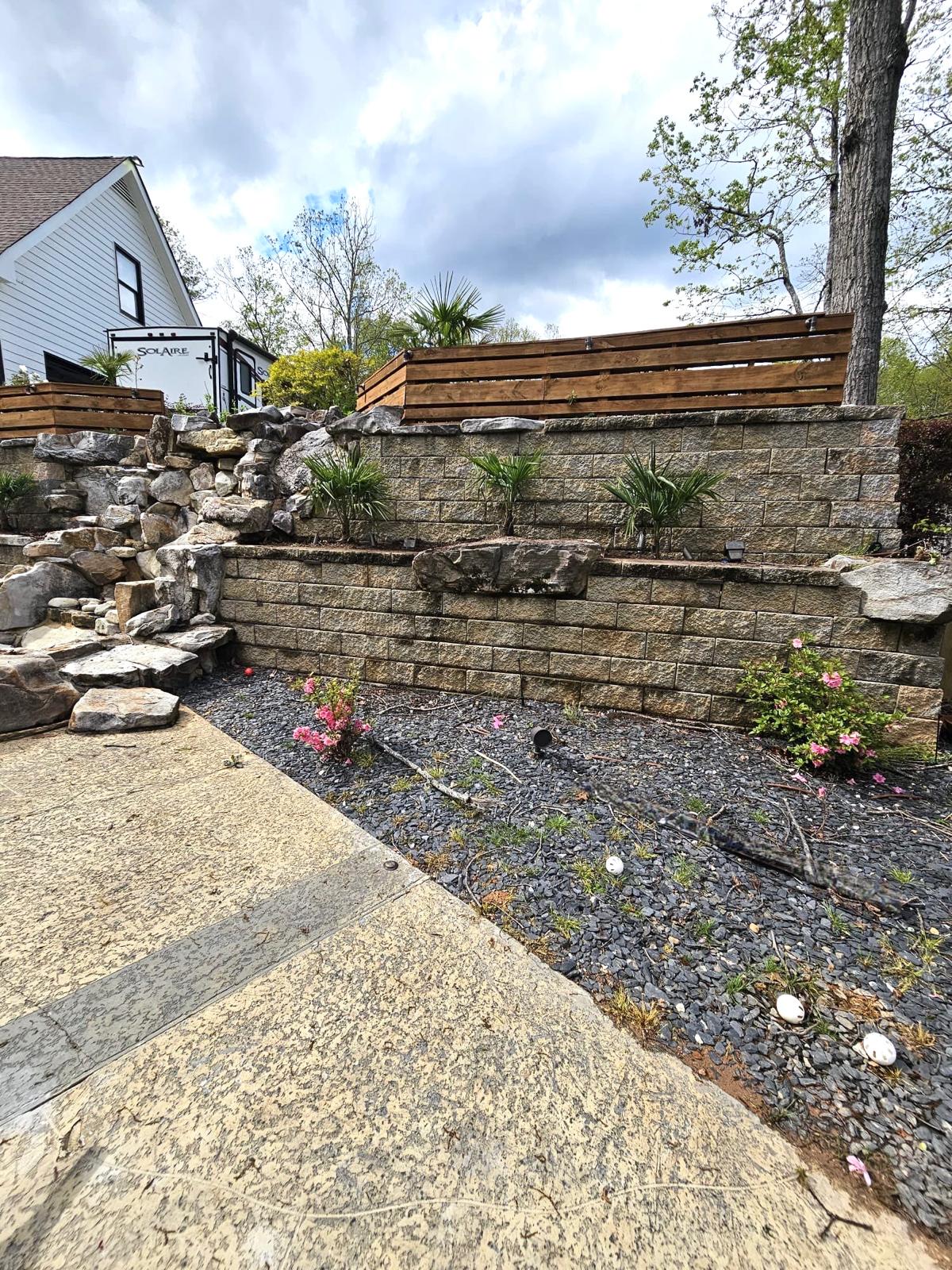
Retaining wall assessment in Alpharetta, GA — measuring lean, evaluating drainage, and documenting failure extent before any repair recommendation.
Fixing a Leaning Wall
A genuine repair of a leaning retaining wall in Alpharetta involves full demolition of the failed section back to the footer course, excavation of the backfill zone to evaluate base conditions, regrading and recompacting the bearing soil, installing or replacing the drainage system, and rebuilding the wall from the ground up with appropriate reinforcement. This is not the same as dismantling and resetting the blocks in the same configuration. The base failure that caused the lean must be corrected before a single block is replaced.
For most residential Alpharetta wall failures — sections 20 to 40 linear feet in length, 4 to 7 feet tall — the repair timeline is two to three days. Salvageable block from the demolished section can typically be reused, which reduces material cost. The drainage system installation — perforated pipe in clean gravel aggregate, properly graded to a daylight outlet — adds one half-day but is not optional. Skipping it produces the same wall that failed to begin with.
On walls where root intrusion is the driver, the repair scope expands to include root barrier installation — a physical membrane installed between the drainage zone and the root system — and typically trimming or removal of the offending root mass in the immediate repair zone. This is a conversation to have with an arborist when the tree involved is mature and valuable, as aggressive root removal can stress a specimen tree. In most Alpharetta cases, targeted barrier installation is sufficient to prevent re-intrusion without compromising the tree.
Kaizen Scapes proudly serves homeowners across Canton, GA, Woodstock, GA, and the surrounding North Georgia communities including Holly Springs, Ball Ground, Acworth, Kennesaw, Marietta, Alpharetta, Milton, Roswell, Cumming, Johns Creek, and East Cobb. If you’re looking for hardscaping and landscaping craftsmanship within 35 miles of Canton or Woodstock, our team is ready to transform your outdoor space.
Whether you’re in Canton, Woodstock, Alpharetta, Milton, or anywhere across Cherokee County and the greater North Atlanta suburbs, Kaizen Scapes brings the same relentless standard to every project. We don’t do cookie-cutter. We do custom — built to last.
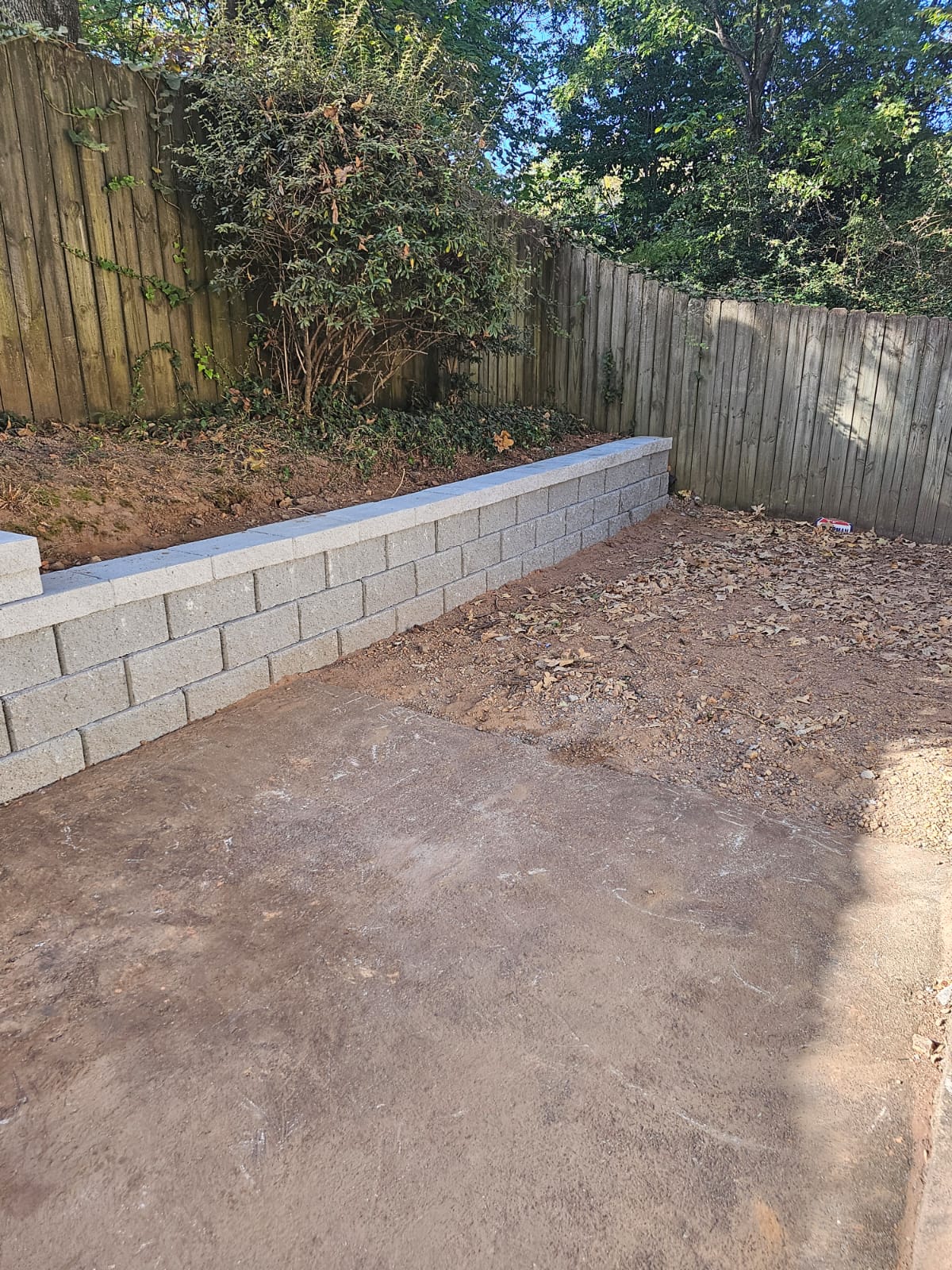
A leaning wall repaired and rebuilt in Alpharetta — base re-established, drainage corrected, geogrid reinforcement added. Built to stand another generation.
We’ll diagnose the exact failure mode before recommending any repair. Free wall assessments across Alpharetta and North Fulton County.