

Most Marietta homeowners who have received three retaining wall quotes have received three different prices for what appears to be the same project. The line item they almost never see itemized — but that accounts for much of the structural difference between those quotes — is geogrid. Understanding what geogrid is, when Georgia code requires it, and how to read a quote for its presence or absence will tell you more about a retaining wall contractor’s standard of practice than almost any other question you can ask.
This is not a minor technical detail. Geogrid is the difference between a wall that stands for twenty-five years and a wall that develops a progressive lean and requires full demolition and rebuild within eight to ten. In Cobb County’s clay-heavy soils, that distinction matters on nearly every wall over four feet of exposed height.
What Geogrid Is
Geogrid is a high-density polyethylene (HDPE) or polyester grid material — visually similar to a rigid plastic mesh — manufactured in rolls and installed horizontally in the compacted gravel backfill behind a retaining wall as the wall is constructed. It is not a structural element in the way that a beam or footing is structural — it is a reinforcement layer that transforms the soil behind the wall into a composite structural system.
The engineering principle behind geogrid is called mechanically stabilized earth (MSE). When geogrid is embedded in compacted fill and connected to the wall face, the friction and interlock between the grid and the surrounding soil particles creates a reinforced zone that resists lateral earth pressure across a broad plane. Instead of all the lateral force concentrating at the wall face and attempting to push it forward, the MSE zone distributes the load back into the hillside over the entire reinforced area. The result is a composite structure — grid-reinforced fill plus block face — that is substantially more stable than either element alone.
“Geogrid doesn’t reinforce the block — it reinforces the earth behind the block. That distinction matters: you are building a stable earth structure, and the wall face is its visible expression.”
The geogrid runs extend horizontally back into the hillside behind the wall. The depth of extension — called the embedment length — is typically calculated as 60 to 80 percent of the total wall height. A five-foot wall requires geogrid embedment of roughly three to four feet behind the wall face. Each layer of grid is placed on compacted gravel fill, then covered with another lift of fill that is compacted before the next wall courses are laid. The process continues up the wall height at manufacturer-specified intervals — typically every two to three courses in the mid-height zone where lateral pressure is highest.
Georgia Code Requirements
Georgia’s adopted building codes require engineered retaining wall drawings — and by extension, geogrid where specifications call for it — for walls meeting certain height thresholds and conditions. In Cobb County, walls exceeding four feet of exposed height above finished grade generally require a building permit and may require engineering drawings, depending on the wall’s proximity to structures, property lines, and the surcharge load above the wall (patios, driveways, and structures above the wall add significant additional lateral force that changes the geogrid requirement).
The practical standard for Marietta residential retaining walls is:
Cobb County’s building department does inspect permitted retaining wall work. A contractor who builds a wall that required a permit without pulling one is exposing the homeowner to a stop-work order, potential demolition requirement, and title issues at resale. Ask every contractor you’re quoting whether a permit is required for your specific wall — and ask to see the permit if they say yes. If they say no on a wall that exceeds four feet, that’s a conversation worth having in detail before you sign anything.
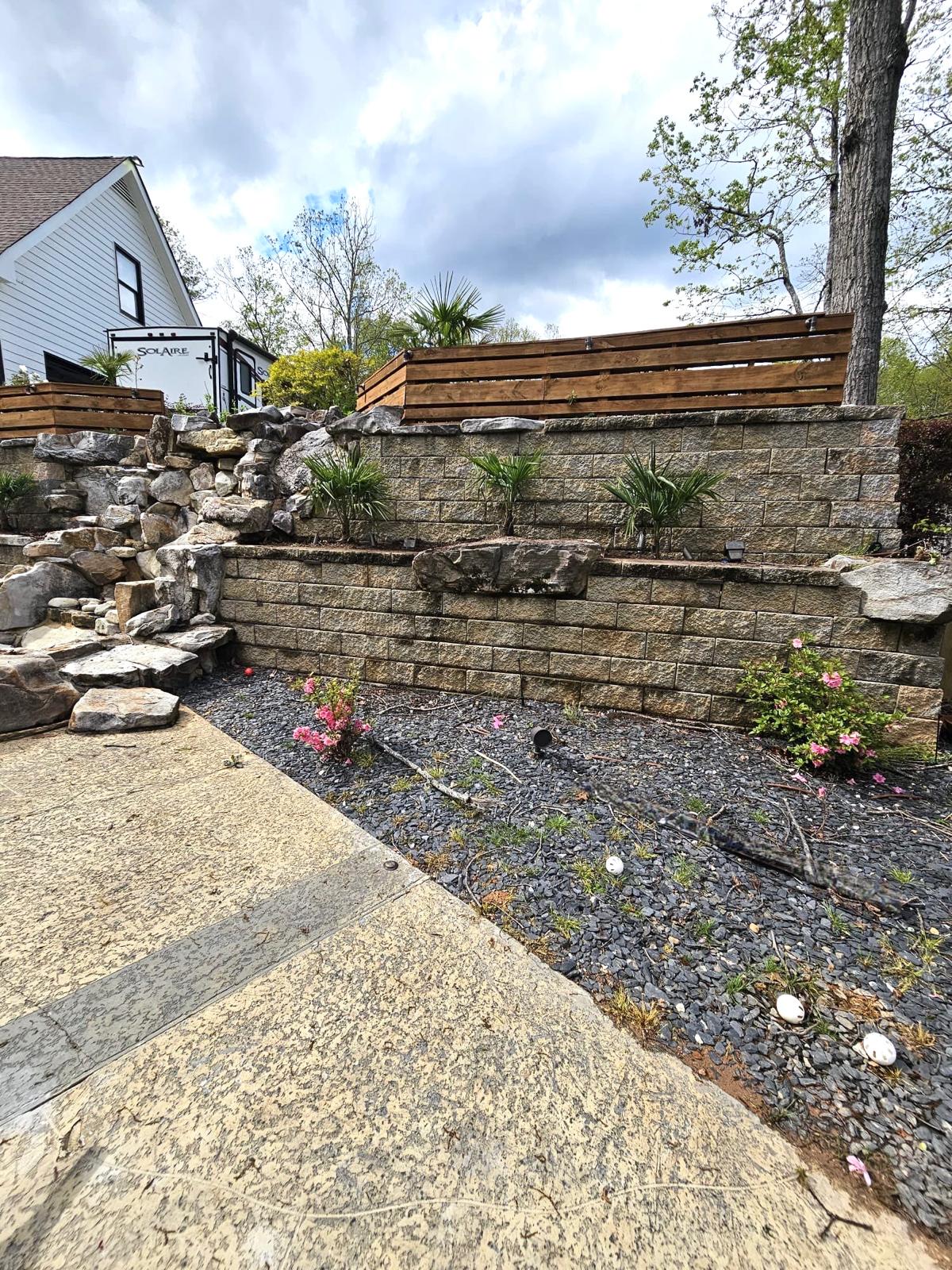
Geogrid installation in progress on a Marietta retaining wall — HDPE grid embedded in compacted gravel backfill, embedment depth matched to wall height and soil conditions.
A retaining wall built without required geogrid doesn’t fail immediately — and that delayed failure is part of what makes the omission so costly. In the first two years after installation, the wall looks fine. The block courses are level, the face is plumb, and there is no visible indication of the structural deficiency below grade. The problem is building slowly: seasonal moisture changes cause Cobb County’s clay soils to expand and contract, each cycle pushing the wall face outward incrementally.
By year three to five, the outward lean becomes visible — a slight bow at mid-height is the first sign. The base course, held by compaction and its own mass, stays in place while the middle courses are pushed forward by the unreinforced earth pressure behind them. By year seven or eight, the lean is structural: the wall face is no longer plumb, the blocks are beginning to separate, and the drainage aggregate behind the wall has been disturbed by the movement. At this stage, the wall cannot be repaired — it must be fully demolished and rebuilt. The demolition and disposal cost alone typically runs $1,500 to $3,500 before the new wall construction begins.
The most direct approach: ask the contractor to itemize the quote and list every material by name and quantity. A complete retaining wall quote should include a line item for geogrid — named by manufacturer and series (Tensar BX1200, Mirafi RS580i, or equivalent), the number of linear feet of grid per layer, and the number of grid layers. If the quote has no geogrid line item and the wall exceeds four feet, ask directly: “Does this proposal include geogrid reinforcement, and if not, why not?”
The answer will tell you everything you need to know about the contractor’s standard of practice. A contractor who omits geogrid on a wall that requires it is either unaware of the requirement (competence concern) or aware and omitting it to lower the bid price (integrity concern). Neither scenario ends well for the homeowner. The geogrid material cost on a typical Marietta residential wall runs $400 to $900 — roughly $2 to $4 per square foot of wall face. The labor to install it correctly adds perhaps $600 to $1,200. A wall that costs $1,000 to $2,100 more to build correctly will not cost $8,000 to $15,000 to rebuild in eight years.
Why Kaizen Scapes
Every retaining wall we quote in Cobb County starts with a site assessment that includes soil type evaluation, surcharge load identification, and wall height calculation. If the wall requires geogrid, the geogrid is in the quote — named, quantified, and priced transparently. We don’t omit it to win a bid, and we don’t install it without telling you why it’s there. Call us at (470) 535-0252 or reach us through our contact page for a free site evaluation and itemized quote.
Kaizen Scapes proudly serves homeowners across Canton, GA, Woodstock, GA, and the surrounding North Georgia communities including Holly Springs, Ball Ground, Acworth, Kennesaw, Marietta, Alpharetta, Milton, Roswell, Cumming, Johns Creek, and East Cobb. If you’re looking for hardscaping and landscaping craftsmanship within 35 miles of Canton or Woodstock, our team is ready to transform your outdoor space.
Whether you’re in Canton, Woodstock, Alpharetta, Milton, or anywhere across Cherokee County and the greater North Atlanta suburbs, Kaizen Scapes brings the same relentless standard to every project. We don’t do cookie-cutter. We do custom — built to last.
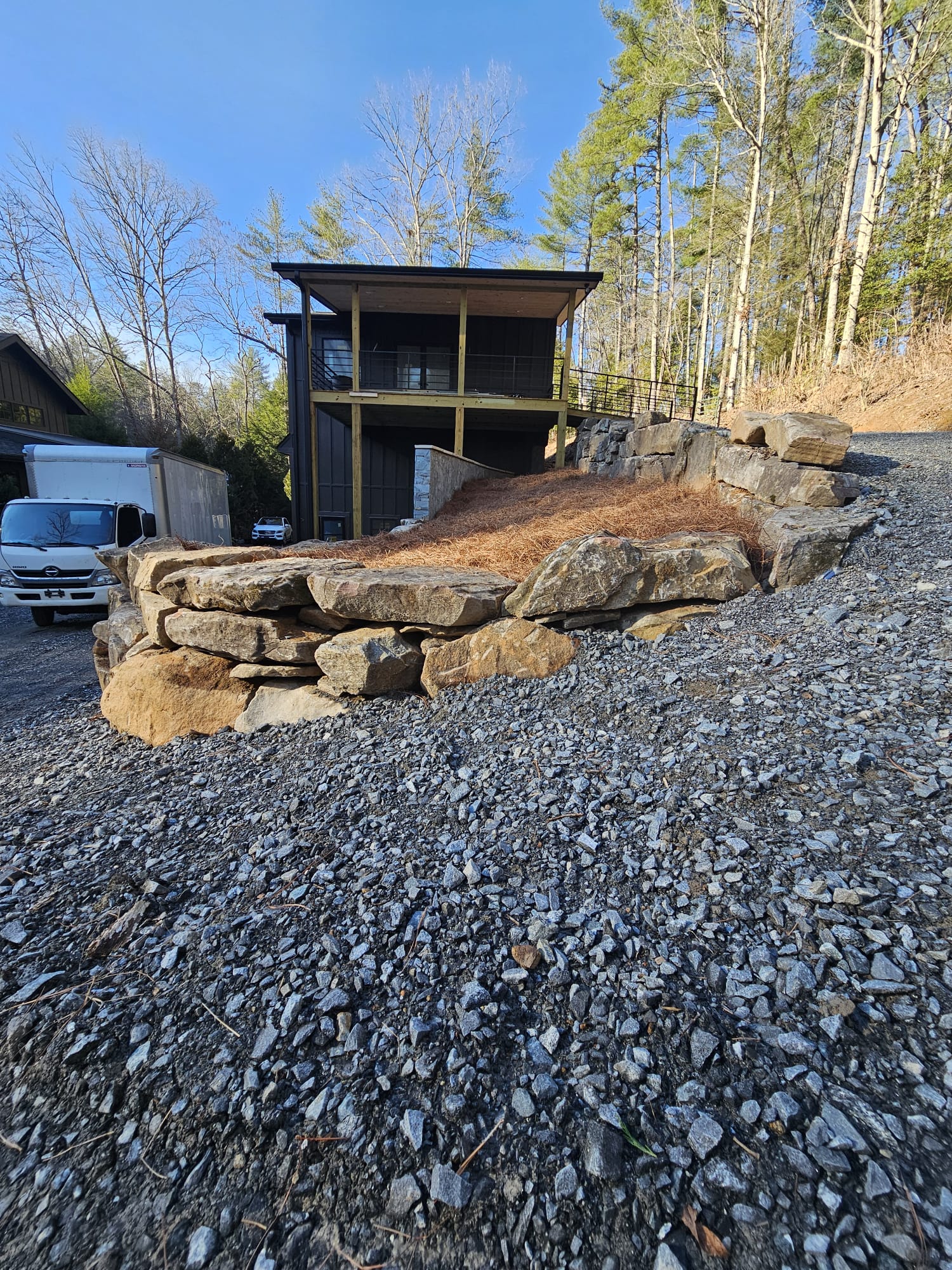
A completed retaining wall in Marietta — geogrid reinforced, permitted, drainage package matched to Cobb County clay soil conditions. Built to stand, not to be rebuilt.
We itemize every spec before we price. Free retaining wall site evaluations across Marietta, Kennesaw, Acworth, and all of Cobb County.
Kaizen Scapes is based in Canton, Georgia and serves the greater North Atlanta region within 35 miles: