

Ask any experienced hardscaping contractor in Marietta what kills most retaining walls in Cobb County and the answer is the same: not the storm that pushed it over, not the age of the installation, not the quality of the block. It’s the water that had nowhere to go. Georgia clay doesn’t drain — it holds. And a wall built without a system designed to move that water away is under continuous siege every time it rains.
Hydrostatic pressure is the technical term for what happens when saturated soil pushes against the back of a retaining wall. It is not a rare condition — it is the default condition for any untreated retaining wall in Cobb County’s clay-heavy soils. Marietta sees enough rain in its wet season that even a well-constructed wall without drainage infrastructure is holding back significant water pressure within 48 hours of a heavy storm. Over months and years, that pressure finds the weakest point in the wall — a joint, a footer seam, a block with substandard depth — and it moves. Once it moves, it keeps moving.
The Science of Failure
Cobb County’s soil profile is dominated by Cecil and Lloyd clay series — fine-textured residual soils with very slow permeability. After a significant rain event, these soils remain saturated for three to five days, compared to sandy loam soils that drain within hours. That extended saturation window means the hydrostatic pressure behind an undrained retaining wall doesn’t spike and recover — it builds and sustains. A wall experiencing 48 hours of saturation per storm event, across 40 rain events per year in Marietta’s climate, is experiencing structural stress that compounds annually.
What makes this particularly damaging is that the failure is invisible at first. A wall can absorb three or four years of hydrostatic cycles before visible movement begins — which is why so many Marietta homeowners are surprised when their wall, which “looked fine last year,” suddenly leans noticeably. The pressure damage was accumulating the entire time. What changed is that the damage crossed the threshold where the wall’s structural resistance could no longer compensate for it.
“A retaining wall without drainage in Georgia clay isn’t a question of whether it will fail — it’s a question of which rain season finally tips it past the point of no return.”
The Drainage Standard
The drainage system behind a properly built retaining wall in Marietta is a three-component assembly. First: a layer of clean angular gravel — typically 3/4 inch crushed stone — packed behind the wall and extending from the base to within a few inches of the top course. This creates a permeable column that moves water down rather than letting it saturate against the wall face. Second: a perforated drain pipe at the base of that gravel column, sloped to drain at the wall’s lowest point or tied into a downslope outlet. Third: filter fabric wrapped around the gravel column to prevent clay migration into the drainage aggregate. Without the fabric, the gravel clogs within a few wet seasons and stops functioning entirely.
Skip the filter fabric and the gravel column silts in — your drainage aggregate becomes a clay-filled mass that transmits hydrostatic pressure as efficiently as the surrounding soil. Skip the perforated pipe and the water has no outlet — it collects at the base of the wall and saturates the footing zone. Skip the gravel and put only pipe against the clay: the pipe collapses under soil load within a few years. All three components are interdependent. A contractor who includes only one or two of them is not building a drainage system — they are building the appearance of one. The Marietta clay doesn’t care about appearances.
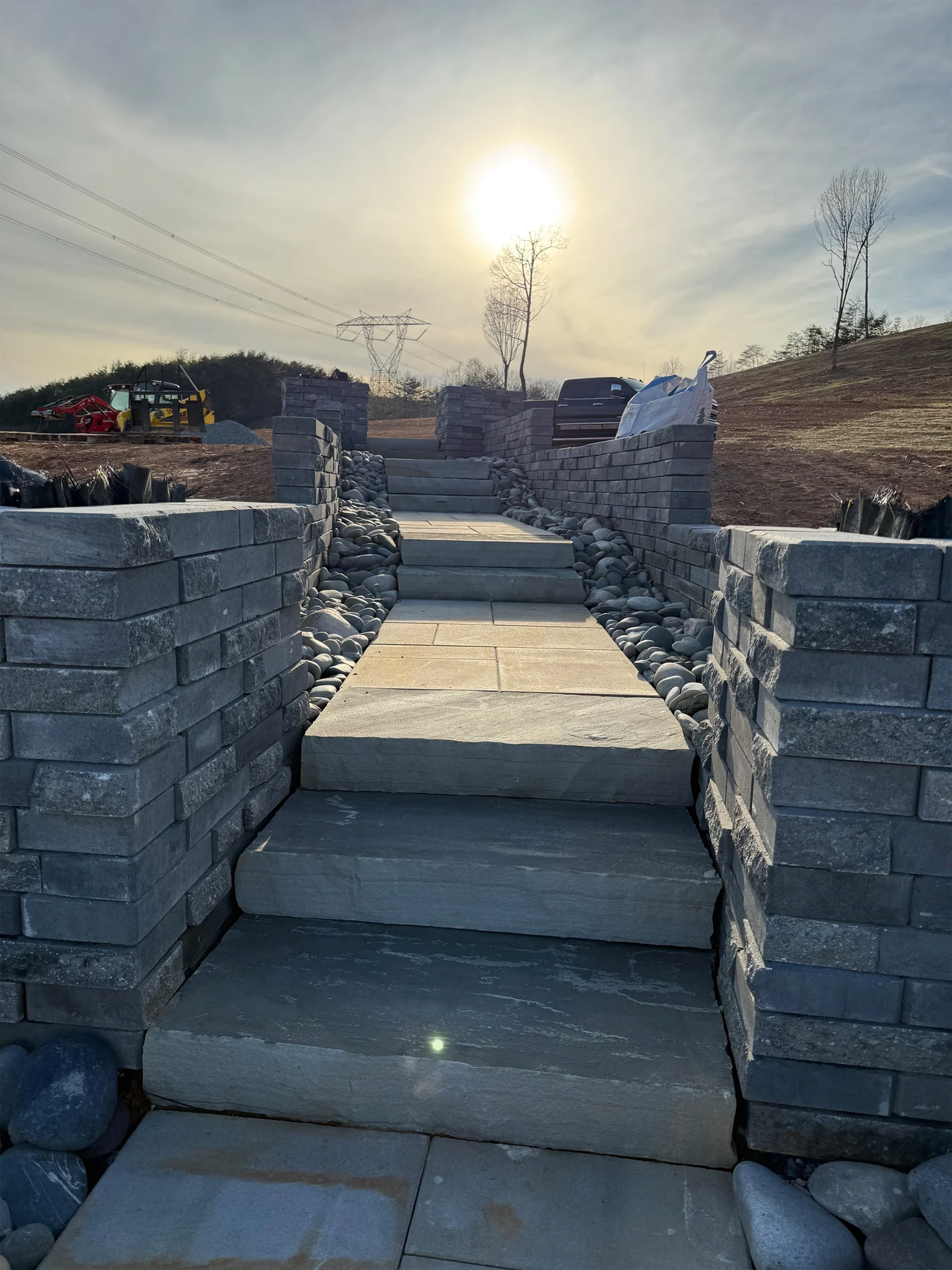
The drainage assembly behind every Kaizen Scapes wall in Marietta — gravel column, perforated pipe, and filter fabric installed as a complete system before any block goes up.
A complete drainage package — gravel, pipe, and filter fabric — typically adds $800 to $2,500 to a retaining wall project depending on wall length and complexity. That addition raises a $9,000 wall to $10,500. It raises a $16,000 wall to $18,000. In every case, it is the cheapest insurance available for the full project cost. A wall that fails due to drainage omission requires full demolition and rebuild — there is no drainage retrofit that doesn’t involve dismantling the wall to access the soil behind it. The rebuild cost is always more than the drainage package would have been.
When evaluating quotes in Marietta, ask every contractor to specify the drainage package in writing. Ask for the gravel spec, the pipe diameter, the fabric product name, and the outlet location. A contractor who hedges that question is a contractor who is planning to omit something from that list.
Why Kaizen Scapes
We include the full three-component drainage assembly — gravel, pipe, and filter fabric — on every retaining wall project we build in Marietta and across Cobb County. It is not an add-on and it is not optional. Our site assessments identify drainage patterns uphill from the wall, existing water flow paths, and the lowest-point outlet location before we quote anything. The drainage design is part of the proposal, not a footnote. If a Marietta slope has existing water management challenges — as many do in older Cobb County neighborhoods — we document them and address them as part of the project scope.
Kaizen Scapes proudly serves homeowners across Canton, GA, Woodstock, GA, and the surrounding North Georgia communities including Holly Springs, Ball Ground, Acworth, Kennesaw, Marietta, Alpharetta, Milton, Roswell, Cumming, Johns Creek, and East Cobb. If you’re looking for hardscaping and landscaping craftsmanship within 35 miles of Canton or Woodstock, our team is ready to transform your outdoor space.
Whether you’re in Canton, Woodstock, Alpharetta, Milton, or anywhere across Cherokee County and the greater North Atlanta suburbs, Kaizen Scapes brings the same relentless standard to every project. We don’t do cookie-cutter. We do custom — built to last.
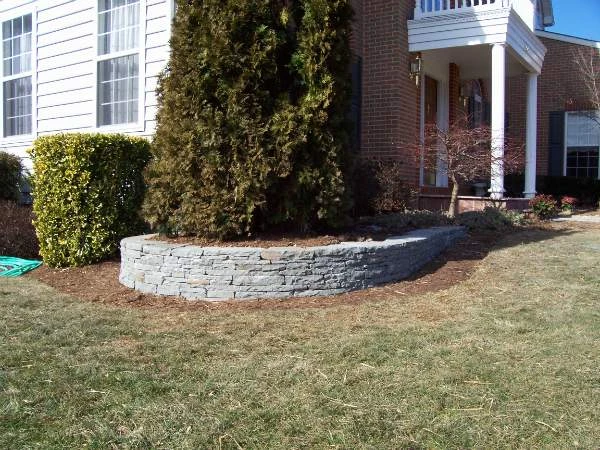
A finished retaining wall built for Marietta’s soil and moisture conditions — drainage system properly installed behind every course before the first block was placed.
We assess existing walls for drainage failure and quote new installations with complete drainage specifications included. Free evaluations across Marietta and Cobb County.
Kaizen Scapes is based in Canton, Georgia and serves the greater North Atlanta region within 35 miles: