What a Retaining Wall in Woodstock GA Actually Costs — And What the Low Bids Are Leaving Out
Kaizen Scapes | Woodstock, GA | Retaining Wall Cost Guide
Woodstock’s rolling terrain and clay-heavy soils make retaining walls one of the most requested — and most misquoted — hardscape projects in Cherokee County. When the bids come back, most homeowners have no framework for understanding a 40% price gap between contractors. This guide gives you that framework.
The installed cost of a retaining wall in the Woodstock, GA area typically ranges from $35 to $85 per square foot of wall face, depending on material, height, engineering requirements, and site conditions. A 40-linear-foot wall standing 3 feet tall represents 120 square feet of wall face — that project would typically run $4,200 to $10,200 depending on how it’s built. A taller wall at 5–6 feet could easily double the per-square-foot cost due to engineering requirements and structural reinforcement needs.
Understanding why that range exists — and what a suspiciously low bid is actually skipping — is the most valuable thing you can do before signing a contract.
In North Georgia’s clay soils, a retaining wall that lacks proper drainage behind it isn’t just failing slowly — it’s being actively undermined every time it rains. The problem won’t show up in year one. It shows up in year four, when the wall starts bowing outward.
Segmental retaining wall installation — Woodstock, GA
Material MattersWhat You’re Building With Changes Everything
Segmental concrete block (brands like Allan Block, Versa-Lok, or Belgard) is the most common residential retaining wall material in the Woodstock area. It’s durable, relatively fast to install, and available in a wide range of textures. Expect installed costs of $35–$55 per square foot for standard heights. The block itself typically costs $10–$18 per square foot in material before installation.
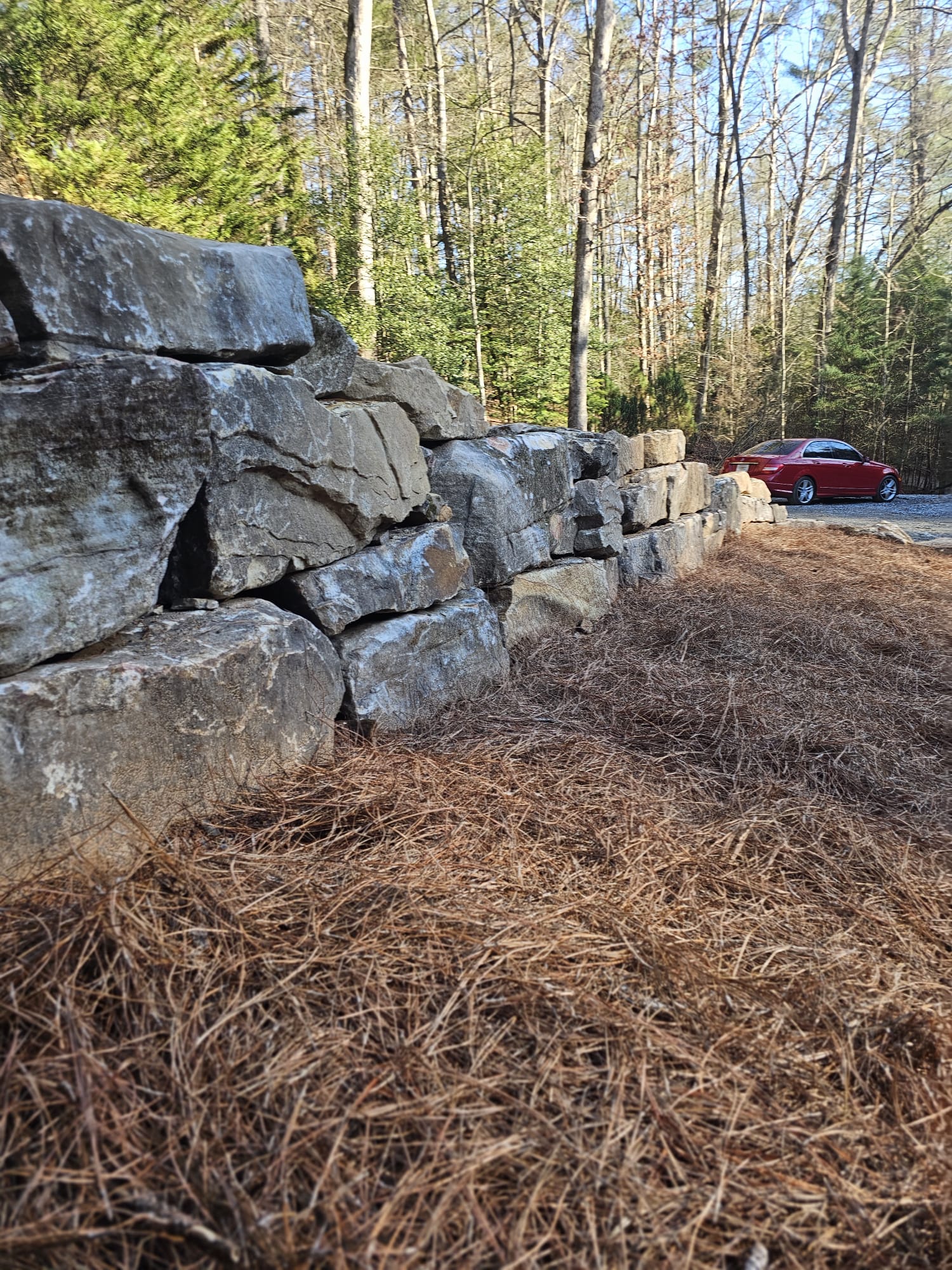
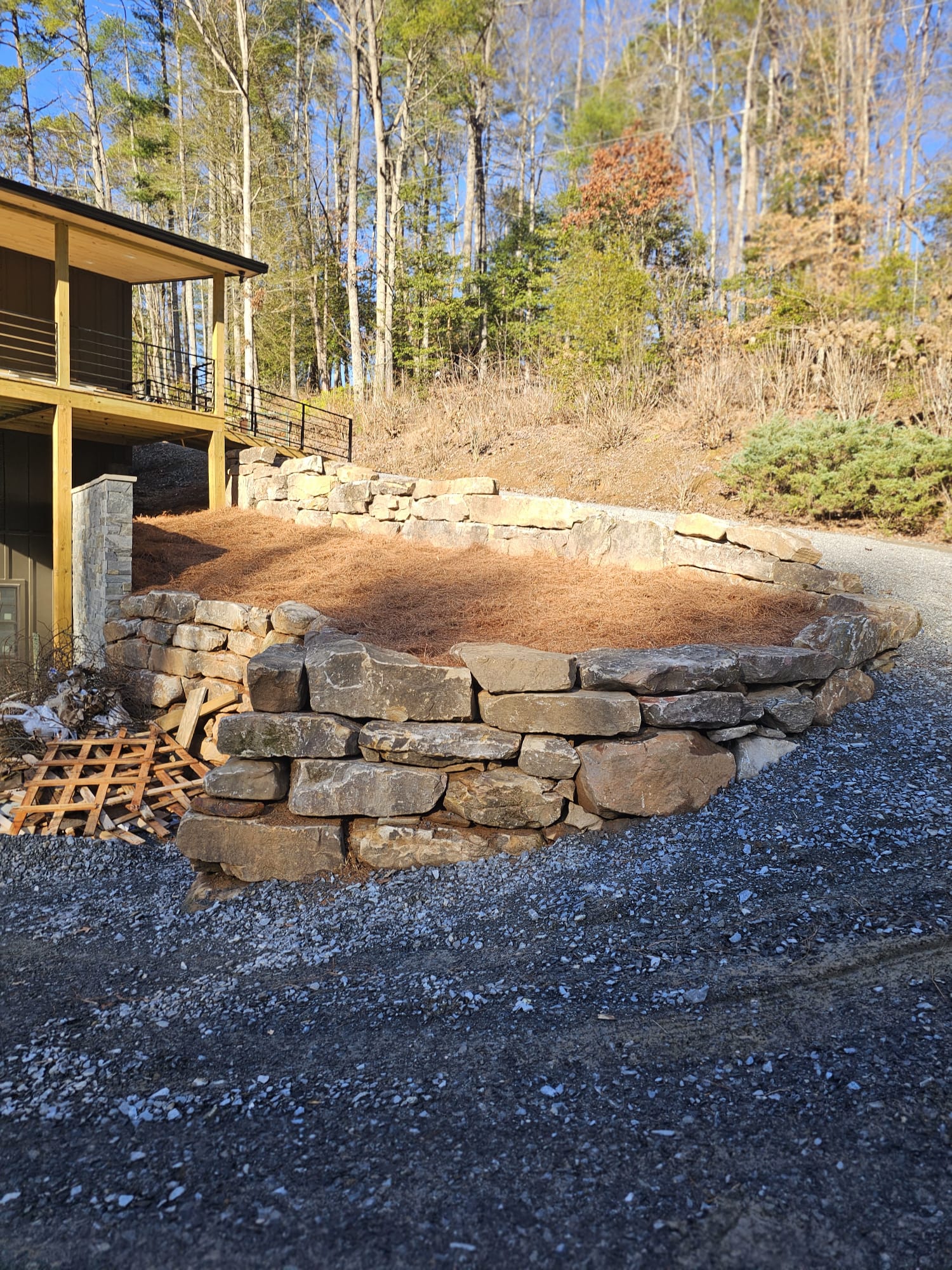
Natural fieldstone or boulders give a more organic, naturalistic look that blends well with North Georgia’s wooded landscape aesthetic. The material cost can be comparable to block or higher depending on local stone availability, but the labor is typically more time-intensive. Expect $45–$65 per square foot installed for fieldstone dry-stack walls.
Poured concrete or concrete block (CMU) is less common in residential settings but used when structural requirements demand it or when the wall will be veneered with stone. These are typically the highest-cost option at $60–$85+ per square foot installed, with the advantage of maximum strength and longevity.
Timber or railroad ties are the lowest upfront cost — sometimes as low as $15–$25 per square foot — but they’re not a long-term solution in North Georgia’s humid climate. Treated wood in contact with soil degrades. If a contractor is quoting timber and everyone else is quoting block, that’s why the number looks lower.
Height Is a MultiplierWhy Taller Walls Cost Disproportionately More
Retaining wall cost doesn’t scale linearly with height. A wall that’s 4 feet tall isn’t twice the cost of a 2-foot wall — it may be three times the cost or more. Here’s why:
Engineering requirements: In most Georgia jurisdictions, retaining walls over 4 feet require a stamped engineer’s drawing. That’s an additional cost ($800–$2,500 depending on complexity) that many low bids quietly omit or assume won’t be enforced.
Geogrid reinforcement: Walls over 3–4 feet typically need geogrid layers embedded in the backfill to prevent the wall from rotating or sliding. Each geogrid course adds material and labor cost.
Excavation depth: Taller walls require deeper base excavation. More material removed, more time, more gravel brought in to create a proper footing base.
Drainage volume: A taller wall is holding back more soil, which means more water pressure during rain events. The drainage system (gravel backfill + perforated pipe) needs to be proportionally more robust.
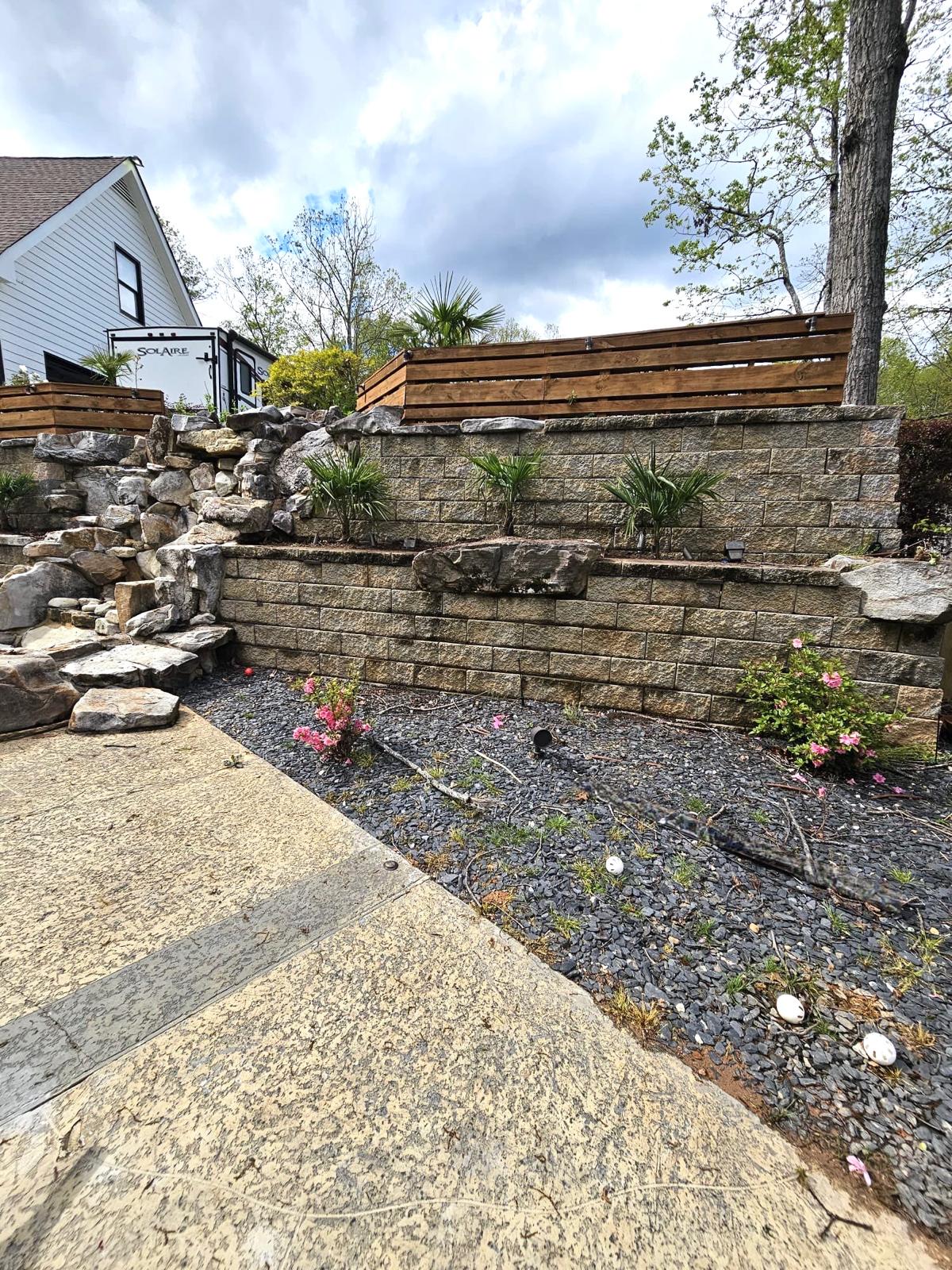
Multi-tier retaining wall with drainage — Cherokee County, GA
What Cheap Bids OmitThe Hidden Costs That Show Up Later
Retaining walls that fail almost always fail for the same reasons — and almost all of those reasons were foreseeable at the time of installation. A low bid that skips these elements isn’t saving you money; it’s deferring a more expensive problem.
Drainage aggregate behind the wall: Clean crushed stone (not fill dirt) should be backfilled behind every retaining wall to allow water to drain away from the face. Without it, hydrostatic pressure builds up with every rainfall. Many low bids use excavated soil as backfill.
Perforated drain pipe at the base: A drainage pipe running behind the base of the wall and daylighting at the ends directs collected water away from the structure. This is standard practice in good builds — and conspicuously absent in cheap ones.
Proper base depth and compaction: The base course of any retaining wall must be buried below grade on a compacted gravel footing. Skimping here — even by 4 inches — compromises everything above it.
Permits and inspections: Some contractors build walls that require permits without pulling them, banking on the fact that most homeowners don’t know the requirement. This can create problems at resale.
Kaizen Scapes proudly serves homeowners across Canton, GA, Woodstock, GA, and the surrounding North Georgia communities including Holly Springs, Ball Ground, Acworth, Kennesaw, Marietta, Alpharetta, Milton, Roswell, Cumming, Johns Creek, and East Cobb. If you’re looking for hardscaping and landscaping craftsmanship within 35 miles of Canton or Woodstock, our team is ready to transform your outdoor space.
Whether you’re in Canton, Woodstock, Alpharetta, Milton, or anywhere across Cherokee County and the greater North Atlanta suburbs, Kaizen Scapes brings the same relentless standard to every project. We don’t do cookie-cutter. We do custom — built to last.
Retaining wall project — Woodstock, GA
Get a Free Estimate
Ready to Price Your Retaining Wall in Woodstock?
We’ll assess the site, spec the drainage, and give you a quote that covers every detail — upfront.