

The pool looked great on the sales brochure. The deck — the four feet of bare concrete poured around the perimeter — was never discussed as part of the package. Two summers later, Holly Springs homeowners are calling us because that concrete is already cracking, the deck is too narrow to put a chair down without someone walking into the pool, and the builder-installed coping looks like it belongs on a 1994 HOA clubhouse.
This is not an isolated complaint. It is the standard outcome of builder-grade pool deck installation in Cherokee County’s new-construction market. The pool company builds a pool. The deck is not the pool company’s core product — it’s the minimum surround required to complete the permit. It is priced, designed, and installed accordingly. Holly Springs homeowners who didn’t know to ask about the deck specification before signing didn’t ask — and now they’re two years into ownership of a pool environment that doesn’t function the way they imagined it would.
What Builder Decks Actually Are
Builder-installed pool decks in Holly Springs’s new-construction communities share a predictable set of deficiencies — not because every pool company builds the same deck, but because the economics of tract construction produce the same outcome across different contractors. Here is what you’re dealing with if you have a builder-grade deck.
These are not quality control failures — they are design choices made at the budget constraint of a pool package. A pool company building pools in Holly Springs at a competitive price point cannot include a properly designed, properly sized, properly drained paver deck in that price without repricing the pool. The deck is a separate project — and in Holly Springs’s builder-grade pool market, it was almost certainly underbudgeted or not budgeted at all.
“Builder-grade concrete around a Cherokee County pool isn’t a starter solution you’ll upgrade someday. It’s a two-year countdown to your first call to a hardscaping contractor.”
Why Cherokee County Clay
Cherokee County’s clay soil profile is the compounding factor that turns an undersized, unreinforced concrete deck into a cracked, settling slab within two pool seasons. Georgia red clay expands when saturated and contracts when dry — a seasonal cycle that exerts lateral force on any rigid surface poured directly against it. Unreinforced concrete poured over a minimally prepared clay base in Cherokee County is not just a matter of when it cracks — it’s a matter of whether the cracking is cosmetic or structural when it does.
Pool deck concrete is exposed to two additional stress factors that accelerate the process: constant moisture from splash-out and deck drainage, and thermal expansion from full-sun exposure through Georgia summers. The combination of clay soil movement, moisture, and thermal cycling produces cracking timelines as short as eighteen months on decks that weren’t reinforced or properly isolated from the pool shell. When those cracks reach the pool shell interface — the bond beam where the deck meets the pool — you’re no longer looking at a cosmetic repair. You’re looking at a potential bond beam inspection and repair before the new deck can be installed.
A proper builder-grade pool deck replacement in Holly Springs follows a consistent process: concrete demolition and haul-off (typically one to two days for a standard residential pool perimeter), base assessment and preparation — any settled or voided areas identified and corrected before new base material is placed, full drainage system installation including channel drains and perimeter drainage where needed, and paver installation with coping replacement on the pool edge. The result is a properly sized, properly drained paver deck that will outlast the concrete it replaced by fifteen to twenty years.
Cost for a standard Holly Springs builder-grade paver conversion: $18,000 to $35,000 depending on pool perimeter size, how far the deck is extended from the original footprint, coping material selection, and drainage complexity. That range includes demolition, base preparation, paver materials and installation, new coping, and drainage. Extending the deck from the builder’s four-foot walkway to a properly livable eight-to-ten-foot surround adds to that cost but changes the function of the space entirely — it converts a wet concrete ledge into an outdoor room.
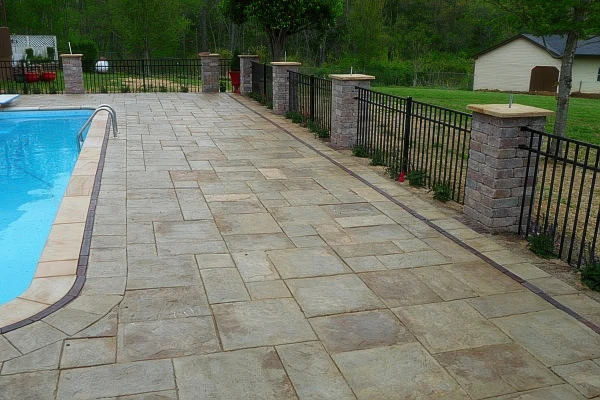
A completed paver conversion in Holly Springs — cracked builder concrete removed, properly sized travertine deck installed with full drainage system and natural stone coping replacing the original builder-grade lip.
When we build or rebuild a pool deck in Holly Springs, the footprint is designed first. A pool deck should be sized to the way it will be used — not to the minimum that satisfies the pool permit. A 16×32 standard pool with a family that actually wants to sit outside requires at least 800 to 1,000 square feet of deck surface before furniture, shade structures, and transition to the lawn are considered. That’s roughly 8 to 10 feet of deck on the long sides and a wider landing at the house-end where people enter and exit. The four-foot builder surround doesn’t come close to that.
The drainage system is specified before the first paver is laid. Surface pitch is calculated to drain away from the pool shell and toward a collection point — a channel drain, catch basin, or perimeter drain routed to appropriate discharge. The goal is zero standing water on the deck surface after rain and zero subsurface water migration under the base. On a Holly Springs lot with any grade variance between the pool and the property boundary, that system requires more than surface pitch alone — it requires subsurface drainage infrastructure that the original builder deck almost certainly didn’t include.
Why Kaizen Scapes
We do a large portion of our Cherokee County pool deck work as builder-grade replacements — and we’ve seen the full range of what the original installation looked like. We know what Cherokee County clay does to unreinforced concrete. We know what properly sized paver decks look like on Holly Springs lots. And we know how to spec the drainage system that prevents the next slab from failing on the same timeline as the first one. The conversion from a builder deck to a properly designed paver environment is one of the most noticeable before-and-after changes in hardscaping — and it’s a change that affects how much you actually use the pool you already own.
Kaizen Scapes proudly serves homeowners across Canton, GA, Woodstock, GA, and the surrounding North Georgia communities including Holly Springs, Ball Ground, Acworth, Kennesaw, Marietta, Alpharetta, Milton, Roswell, Cumming, Johns Creek, and East Cobb. If you’re looking for hardscaping and landscaping craftsmanship within 35 miles of Canton or Woodstock, our team is ready to transform your outdoor space.
Whether you’re in Canton, Woodstock, Alpharetta, Milton, or anywhere across Cherokee County and the greater North Atlanta suburbs, Kaizen Scapes brings the same relentless standard to every project. We don’t do cookie-cutter. We do custom — built to last.

A Holly Springs pool environment after paver conversion — properly sized deck, natural stone coping, and integrated lighting turning a builder-grade surround into an outdoor living space.
We’ll assess the existing slab, drainage, and coping and give you an honest picture of what the conversion involves. Call (470) 535-0252 for a free evaluation.
Kaizen Scapes is based in Canton, Georgia and serves the greater North Atlanta region within 35 miles: