

A paver driveway in Cumming, GA looks the same on the surface whether it was built correctly or not — at least for the first few years. What separates a driveway that holds for twenty-five years from one that starts settling in year four is entirely below grade. The base depth, the aggregate specification, the geotextile separation layer, and the drainage plan are the decisions that determine outcome in Forsyth County’s clay soil conditions. This post is about those decisions — what they are, why they matter, and what a complete installation spec for a Cumming paver driveway actually has to include.
Forsyth County has grown faster than almost any county in Georgia over the past decade. With that growth has come a lot of hardscape installation — and, inevitably, a lot of hardscape installed incorrectly. The failure patterns are consistent and preventable. They all trace back to the same root: a base that wasn’t built for the load it was asked to carry in the soil conditions it was placed in.
Base Depth
The most common misspecification on paver driveways in the Cumming area is base depth. Contractors who build primarily patios and walkways sometimes apply walkway base standards to driveway projects — and the failure mode arrives within a few years. A walkway or patio in Forsyth County requires a 4 to 6 inch compacted aggregate base under normal conditions. A driveway requires a minimum of 8 to 10 inches of compacted aggregate base — sometimes more on sites with poor native soil bearing capacity or drainage issues.
The additional base depth does two things: it distributes vehicle load over a larger soil area, reducing point stress on the subgrade, and it provides a thicker drainage reservoir that prevents subgrade saturation. In Forsyth County’s heavier clay zones — particularly in the northern Cumming area where the soil transitions toward the foothills — soil bearing capacity can be low enough to warrant geogrid reinforcement within the base itself. A site assessment before excavation determines whether standard base depth is sufficient or whether additional engineering is warranted.
Aggregate Specification
Not all aggregate is the same material for driveway base purposes. The critical distinction is particle shape: angular vs. rounded. Angular crusher run — stone that has been mechanically crushed and carries sharp, irregular faces — compacts into a dense, interlocked mass when vibrated. The angular faces lock against each other under compaction and load, and the resulting base behaves almost like a rigid layer rather than a loose granular fill. This is what a driveway base needs to do.
Rounded aggregate — pea gravel, river stone, or natural creek gravel — cannot achieve the same compaction density. Rounded particles roll against each other rather than interlocking, which means the base will compress and shift laterally under vehicle loads. On a patio where the heaviest load is foot traffic, rounded aggregate can perform adequately. On a driveway that sees a 4,500-pound SUV twice a day, rounded aggregate in the base will produce surface settlement within three to five years — regardless of what’s on top of it.
If a contractor’s quote specifies “gravel base” without identifying the material as angular crusher run or 21A/21B crushed stone, ask directly. The material specification should appear on every legitimate driveway quote as a named item, not a generic placeholder.
“You can’t see the base once the pavers are set. That’s why the base specification is the most important line on a driveway quote — and the one most likely to get replaced with something cheaper on a budget bid.”

A paver installation in the Cumming corridor — angular crusher run base compacted to driveway specification, geotextile fabric installed, edge restraint set before bedding sand placement.
Geotextile fabric is a woven or non-woven synthetic barrier installed between the native subgrade and the aggregate base. Its function is separation: it prevents the fine clay particles in Forsyth County’s subgrade from migrating upward into the aggregate base over time. Clay migration is a slow process — it happens over years, not months — but the end result is a contaminated base that has lost its drainage capacity and load-bearing structure. A driveway base that has been compromised by clay migration begins to behave more like a clay bed than a compacted aggregate base, and surface settlement follows.
Geotextile fabric is an inexpensive line item — typically $0.30 to $0.60 per square foot on a standard driveway installation. It is not optional in Forsyth County clay conditions. If it doesn’t appear on the quote, add it or find a contractor who includes it by default. The cost is negligible relative to the protection it provides over the life of the installation.
Forsyth County requires a land disturbance permit for driveway work that involves excavation or impervious surface expansion above a certain threshold. A standard driveway replacement — same footprint, same dimensions — typically does not require a permit in unincorporated Forsyth County. However, expanding an existing driveway, adding a parking court, or installing a new driveway approach from the road may trigger permit requirements from Forsyth County Public Works and, in some cases, a DOT driveway permit if the approach connects to a state route.
HOA requirements apply separately from county permits in most Cumming communities. Many of Forsyth County’s established neighborhoods — particularly in the Windermere, Polo, and North Gate corridors — have Architectural Review Committees that require material and design approval before exterior work begins. We help every Cumming client navigate both the county permit process and HOA approval as part of pre-construction planning. Starting without the right approvals is a risk that always transfers cost back to the homeowner.
Why Kaizen Scapes
We build paver driveways in Cumming the way Forsyth County clay demands — with the base depth, aggregate specification, geotextile separation, and drainage planning that the conditions require. Every quote we deliver includes a named aggregate specification, a geotextile line item, edge restraint, and a drainage plan. We don’t reduce the base spec to hit a budget number. We reduce the scope or change the surface material — never the base. The base is the investment. The pavers are the finish.
Kaizen Scapes proudly serves homeowners across Canton, GA, Woodstock, GA, and the surrounding North Georgia communities including Holly Springs, Ball Ground, Acworth, Kennesaw, Marietta, Alpharetta, Milton, Roswell, Cumming, Johns Creek, and East Cobb. If you’re looking for hardscaping and landscaping craftsmanship within 35 miles of Canton or Woodstock, our team is ready to transform your outdoor space.
Whether you’re in Canton, Woodstock, Alpharetta, Milton, or anywhere across Cherokee County and the greater North Atlanta suburbs, Kaizen Scapes brings the same relentless standard to every project. We don’t do cookie-cutter. We do custom — built to last.
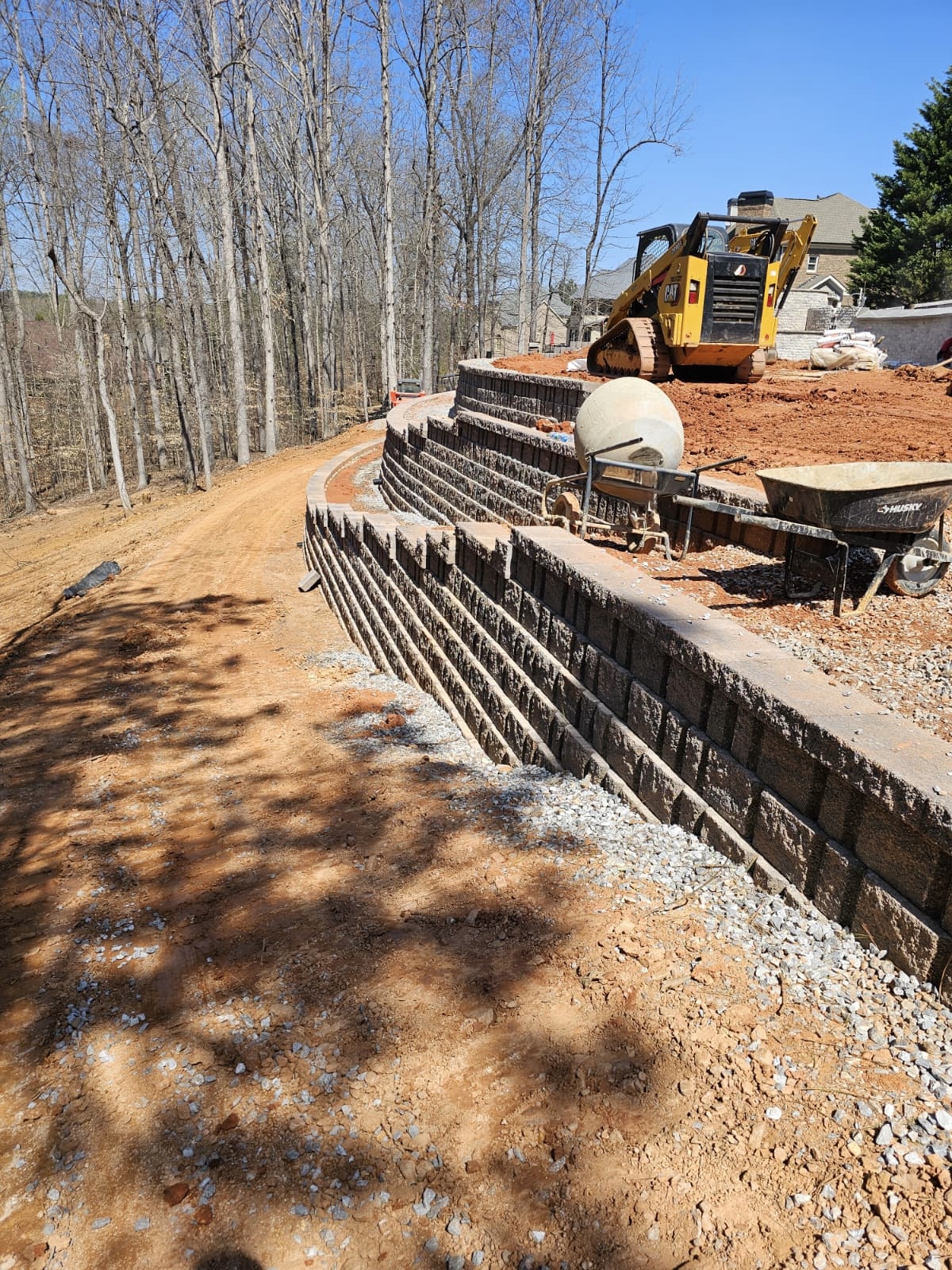
A completed paver driveway in the Cumming area — angular base compacted to driveway depth, geotextile separation installed, surface pavers locked to edge restraint.
We assess your Forsyth County site, specify the base correctly for your soil conditions, and give you a quote that reflects the full installation — not a shortcut. Free estimates available.
Kaizen Scapes is based in Canton, Georgia and serves the greater North Atlanta region within 35 miles: