

New construction homeowners in Canton go through a recognizable pattern. The first fall after closing, they notice that the area along the rear foundation stays wet for days after a heavy rain. By spring, there is standing water in a low corner of the yard after every storm. By summer, the sod in that corner is thin and yellow, and the mulch in the planting beds along the back of the house has migrated two feet downhill. By year two, a drainage professional is standing in their backyard explaining what was there when they closed — and what it costs to fix it now that the yard is established.
Drainage problems on Canton new-construction properties are not freak occurrences or builder defects in the traditional sense. They are the predictable result of how residential grading is engineered in Cherokee County — to the minimum code standard, not the performance standard. Understanding what “positive grade” means, why it degrades, and how to identify drainage failure before it reaches the foundation is the difference between a $4,000 correction and a $35,000 one.
Why Builder Grading Creates the Problem
Cherokee County building code requires positive grade — the ground must slope away from the foundation at a minimum rate of six inches over ten feet. Builders achieve this minimum during construction, when the soil is freshly disturbed and compacted. The problem is what happens to that grade after the homeowner takes possession.
Cherokee County’s red clay, once disturbed and backfilled against a foundation, settles unevenly over the first one to three years. The fill material placed against the foundation during construction — which was never native undisturbed soil — compresses and migrates as water infiltrates and seasonal freeze-thaw cycles work on it. The positive grade that passed the builder’s inspection at closing may have degraded by two to four inches within eighteen months — enough to reverse the drainage direction in a low spot and begin directing water toward the foundation instead of away from it.
The second factor is the grading geometry itself. Builders create a positive slope immediately adjacent to the foundation, but the drainage pathway that slope is supposed to follow — across the yard and to a swale, storm drain, or property edge — is often underdeveloped. Water moves away from the house for the first few feet, then encounters a low spot, a fill boundary, or a neighboring lot’s grade that stops it. It pools, saturates the clay, and eventually finds the path of least resistance — which is often back toward the foundation.
“Positive grade passes the inspection. It does not guarantee that water actually leaves your property. In Cherokee County clay, the path water takes after it leaves the foundation line is often the more important question.”
Identifying Drainage Problems Early
The signs of developing drainage failure on a Canton new-construction property are readable before the damage becomes structural — if you know what to look for. Standing water that persists more than 48 hours after rain in any part of the yard is a drainage failure indicator, not normal behavior for Georgia clay. Clay absorbs moisture slowly, but a properly graded property should not retain standing water for more than two days after a standard rain event.
Other early indicators include: sod that thins and yellows in specific zones, particularly along the rear foundation line or in low corners; mulch migration — beds that consistently lose mulch to a downhill location after rain; efflorescence or moisture staining on the foundation at or below grade; and soft, spongy turf along the foundation perimeter that remains soft between rain events. Any of these signs in a Canton property under three years old warrant a drainage assessment before the next major rain season.
Drainage correction on Canton new-construction properties typically involves one or more of three systems, chosen based on the specific water pathway problem identified during assessment. A drainage contractor who recommends one solution before assessing the actual water movement pattern on your property is guessing. The solution has to follow the water.
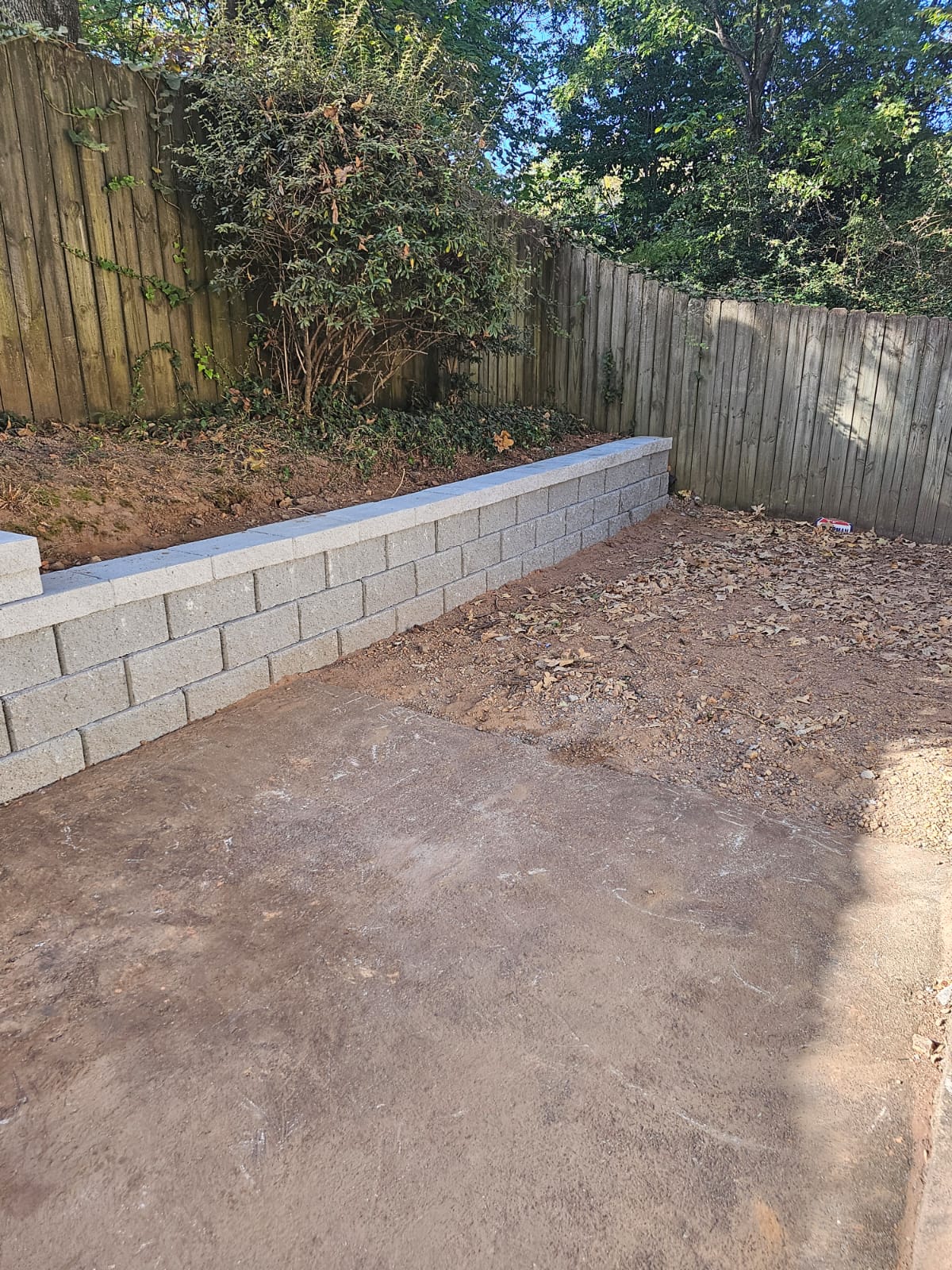
Grade correction and drainage installation on a Canton new-build property — French drain and surface swale combined to redirect water away from the foundation.
The honest budget range for drainage correction on a typical Canton new-build lot — a standard subdivision property with moderate grade and one to three drainage problem zones — runs $3,500 to $12,000. That range reflects the difference between a single-zone surface swale and regrade correction at the lower end, and a multi-zone system combining a French drain along the rear foundation, catch basins at low points, and corrected downspout discharge routing at the upper end.
What most homeowners underestimate is the cost multiplier of delay. A drainage problem addressed in year one — before the foundation’s waterproofing membrane has experienced repeated saturation cycles, before the basement or crawl space shows moisture intrusion signs, and before the soil under the patio slab begins to erode — costs dramatically less than the same drainage problem addressed in year four. Foundation waterproofing repair, crawl space remediation, and patio slab lifting or replacement are all downstream costs of unaddressed drainage failures that typically run $15,000 to $50,000 depending on severity — an order of magnitude above the drainage correction that prevents them.
The Canton homeowners who act on early drainage indicators — the persistent wet corner, the thinning sod, the mulch migration — spend $4,000 to $8,000 on a permanent correction. The ones who wait for visible foundation moisture spend ten times that, and that number does not include the drywall, flooring, and personal property damage that often accompanies a foundation moisture event.
Why Kaizen Scapes
We assess drainage problems in Canton by tracing water movement — not by defaulting to a standard installation package. Before we recommend a French drain, a swale, or a catch basin system, we identify where water enters the problem zone, how it moves across the property, and where it needs to exit. That assessment tells us which system actually solves the problem, rather than which system is easiest to install.
We also coordinate drainage correction with any hardscape work that is planned — because the sequencing matters here too. A French drain that runs under an area where a future patio will be installed needs to be routed and sleeved before the patio base goes in. A catch basin located at a low spot needs to be sited before the patio design is finalized. Getting these decisions right the first time is what separates a drainage correction that lasts from one that creates the next problem.
Kaizen Scapes proudly serves homeowners across Canton, GA, Woodstock, GA, and the surrounding North Georgia communities including Holly Springs, Ball Ground, Acworth, Kennesaw, Marietta, Alpharetta, Milton, Roswell, Cumming, Johns Creek, and East Cobb. If you’re looking for hardscaping and landscaping craftsmanship within 35 miles of Canton or Woodstock, our team is ready to transform your outdoor space.
Whether you’re in Canton, Woodstock, Alpharetta, Milton, or anywhere across Cherokee County and the greater North Atlanta suburbs, Kaizen Scapes brings the same relentless standard to every project. We don’t do cookie-cutter. We do custom — built to last.
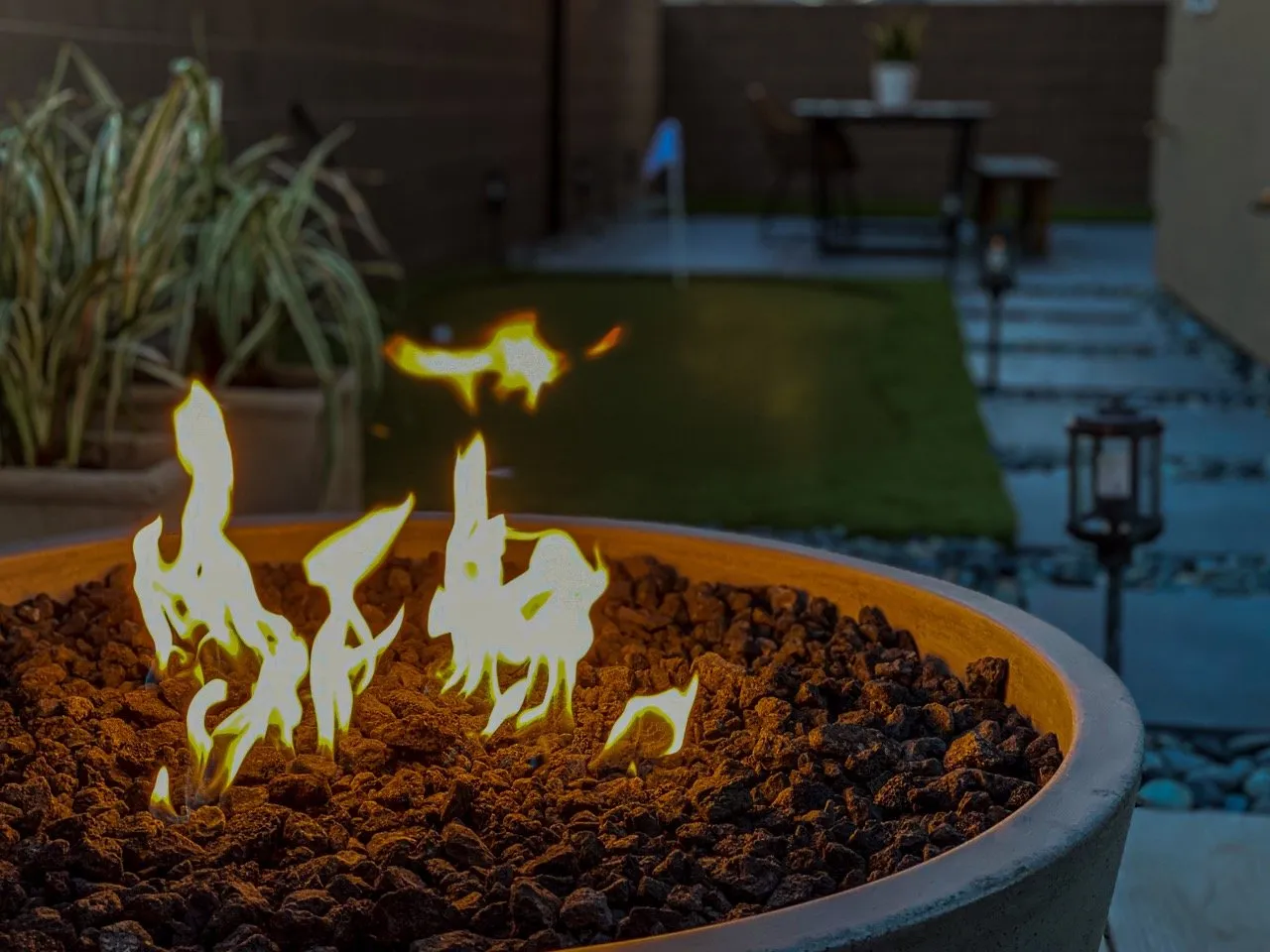
Completed outdoor living and drainage installation on a Canton new-build — drainage corrected before hardscape was installed, foundation protected for the long term.
Free drainage assessment for Canton homeowners. Year-one drainage problems are far cheaper to fix than year-four foundation damage. Let’s look at it now.
Kaizen Scapes is based in Canton, Georgia and serves the greater North Atlanta region within 35 miles: