

Woodstock’s hillside lots are among the most misunderstood real estate in Cherokee County. Buyers see the slope and budget for problems. Smart ones see an outdoor space waiting to be unlocked — one that will outperform every flat-lot patio on the street when the design is done right. Hillside patio design isn’t harder than flat-lot work. It’s different work, and the difference shows in the finished result.
The Woodstock market has shifted meaningfully in the last several years toward intentional outdoor living — screened rooms, multi-level patios, outdoor kitchens adjacent to natural grade changes. That shift has created a visible split between properties where the grade was worked with and properties where it was worked around. The ones worked with look like they were designed. The ones worked around look like the patio was placed wherever the builder could find a flat spot.
Reading the Hillside
Every hillside patio project begins the same way: we walk the slope before we draw anything. Grade changes that look uniform from the house reveal micro-topography on the ground — areas that drain differently, transitions between soil types, existing root masses from mature hardwoods, and natural level breaks in the terrain that the original grade happened to create. Those breaks are design opportunities, not obstacles.
On most Woodstock residential lots, the grade change between the house and the property line runs somewhere between four and fourteen feet — enough to mandate retaining structures for any meaningful patio area, but not so extreme that the site becomes an engineering challenge rather than a design one. The slope percentage — measured as rise over run — determines which design approach is appropriate:
For most of the Woodstock lots we work on, the 10–20% range is the sweet spot: enough grade to create a genuinely interesting multi-level space, manageable enough that the earthwork doesn’t dominate the budget.
“The most successful hillside patios in Woodstock don’t fight the slope — they choreograph it. The grade becomes the transition between rooms, not the reason the outdoor space doesn’t work.”
Design Principles
Good hillside patio design follows a few non-negotiable principles that separate the ones that function beautifully from the ones that look better in the rendering than in real life. The first principle: level pads must be genuinely level — not “close enough.” Any patio surface with more than a 1% cross-slope becomes uncomfortable for furniture and noticeably awkward over time. Achieving true level on a hillside requires precise earthwork and a compacted gravel base that accounts for drainage direction without sacrificing surface flatness.
The second principle: steps must be generous. The most common failure mode in hillside patio design is steps that are functionally adequate but visually stingy — narrow treads, abrupt risers, squeezed into the tightest possible footprint. Steps on a well-designed hillside patio should be wide enough to sit on, deep enough to feel deliberate, and spaced at a riser-to-tread ratio that invites movement rather than demanding it. The standard is a 6-inch riser paired with a 14–16-inch tread. On a high-visibility transition, wider is almost always better.
The third principle: drainage is designed, not assumed. On any sloped site, water moves downhill — and on a hardscaped hillside, the hardscape concentrates that movement in ways a natural slope wouldn’t. Every level pad must drain positively away from the house and toward a designed outlet — French drain, channel drain, or daylighted gravel trench depending on the water volume and path length. Getting drainage wrong on a hillside patio means getting water in the basement or against the foundation. We design drainage before we design the patio layout, not after.
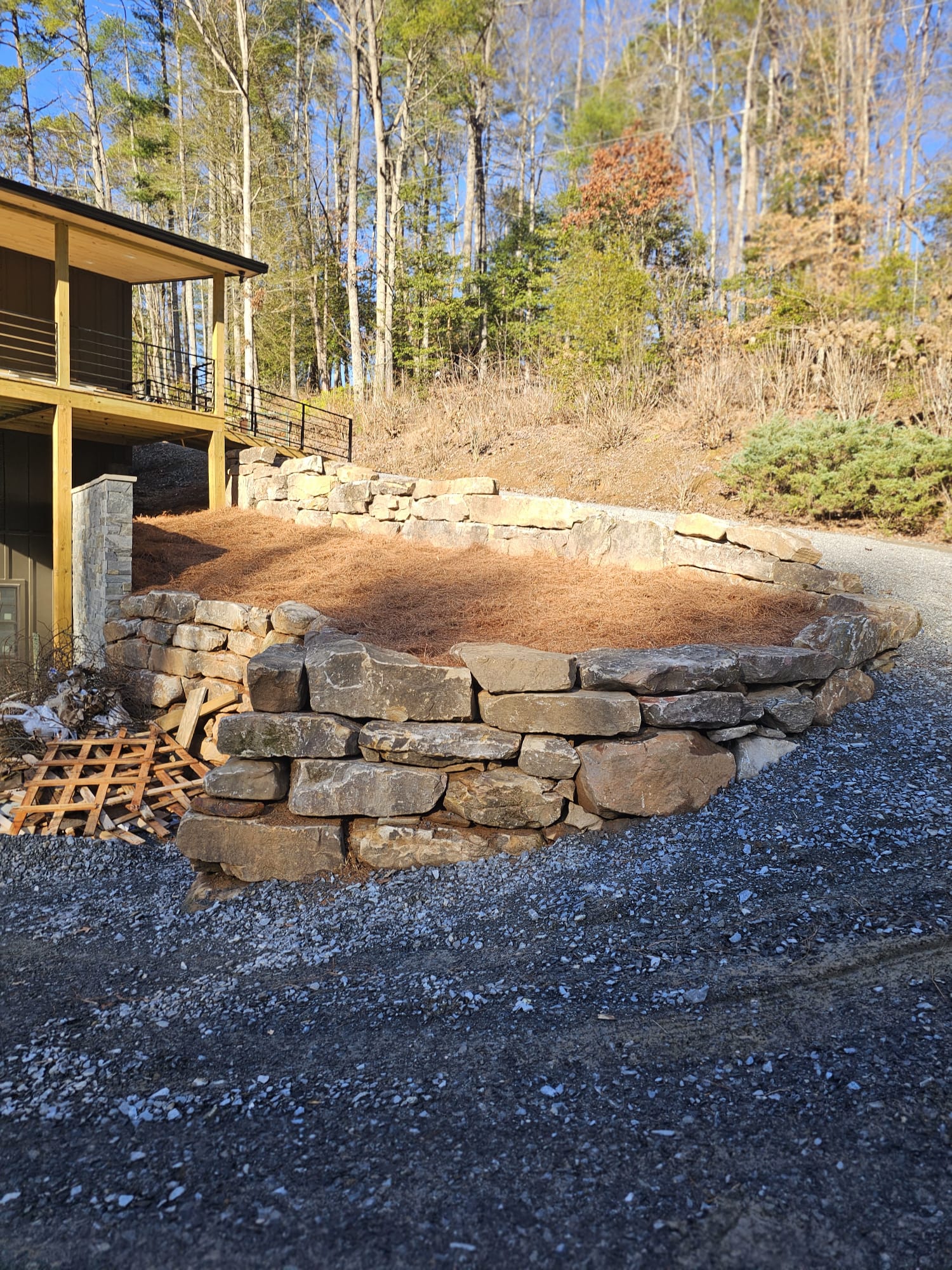
Hillside patio design in Woodstock — retaining walls create level platforms at each elevation, generous steps connect the levels, and drainage routes away from the foundation.
Material selection matters more on hillside patios than on flat ones because the structural demands are higher. Concrete pavers on a properly prepared base perform excellently on slopes — the interlock between units accommodates minor movement without cracking, individual units can be reset if settlement occurs, and the range of textures and profiles available allows the patio to match the aesthetic of the home. For Woodstock properties with traditional or transitional architecture, large-format concrete pavers in a running bond pattern read as intentional and high-quality.
Natural flagstone — bluestone, travertine, or local fieldstone — integrates visually with Woodstock’s wooded terrain in ways no manufactured material can fully replicate. The tradeoff is installation complexity on slopes: natural flagstone requires a thicker mortar or dry-laid gravel base, and irregular pieces must be fit on a grade. For homeowners whose primary goal is a naturalistic aesthetic that blends with an existing wooded landscape, the additional labor is consistently worth it.
What doesn’t work on hillside patios: poured concrete as a primary surface material. Concrete slabs on sloped sites are prone to cracking as the base compresses unevenly over time — Cherokee County’s clay soils are particularly susceptible to seasonal movement that concrete cannot accommodate. Stamped concrete carries the same vulnerability on slopes that plain concrete does. For a material investment meant to last decades, concrete pavers or natural stone on a properly engineered base is the correct choice every time.
Honest Cost Range
A two-level patio on a Woodstock hillside lot — one lower entertaining area, one upper grilling or seating area, connected by a step system with a retaining wall between the levels — typically runs $24,000–$45,000 depending on materials, wall height, and total square footage. That range reflects the slope premium (typically 25–35% above flat-lot equivalent) applied to a mid-size residential patio project.
The variables that move that number: retaining wall height and material (a four-foot concrete block wall costs significantly less than a six-foot engineered boulder wall), total patio square footage, step configuration (simple two-step transitions cost far less than grand staircase features), and drainage complexity (a straightforward slope with a clear outlet costs less than a site that requires French drain systems or channel drain integration). We break every quote into these components so homeowners understand exactly what drives the number — and what can be phased if the full scope exceeds the immediate budget.
Why Kaizen Scapes
Hillside patio work in Woodstock requires a contractor who has built enough of them to have developed real intuitions about what works — how a slope reads after construction when the landscaping fills in, where drainage problems hide until the first heavy rain, which retaining wall materials age gracefully on a wooded Cherokee County lot and which ones don’t. Kaizen Scapes has built extensively across Woodstock’s hillside neighborhoods, and that experience is in our designs before we show you a single sketch.
Kaizen Scapes proudly serves homeowners across Canton, GA, Woodstock, GA, and the surrounding North Georgia communities including Holly Springs, Ball Ground, Acworth, Kennesaw, Marietta, Alpharetta, Milton, Roswell, Cumming, Johns Creek, and East Cobb. If you’re looking for hardscaping and landscaping craftsmanship within 35 miles of Canton or Woodstock, our team is ready to transform your outdoor space.
Whether you’re in Canton, Woodstock, Alpharetta, Milton, or anywhere across Cherokee County and the greater North Atlanta suburbs, Kaizen Scapes brings the same relentless standard to every project. We don’t do cookie-cutter. We do custom — built to last.
Explore the full scope of what we build at our hardscaping services page.
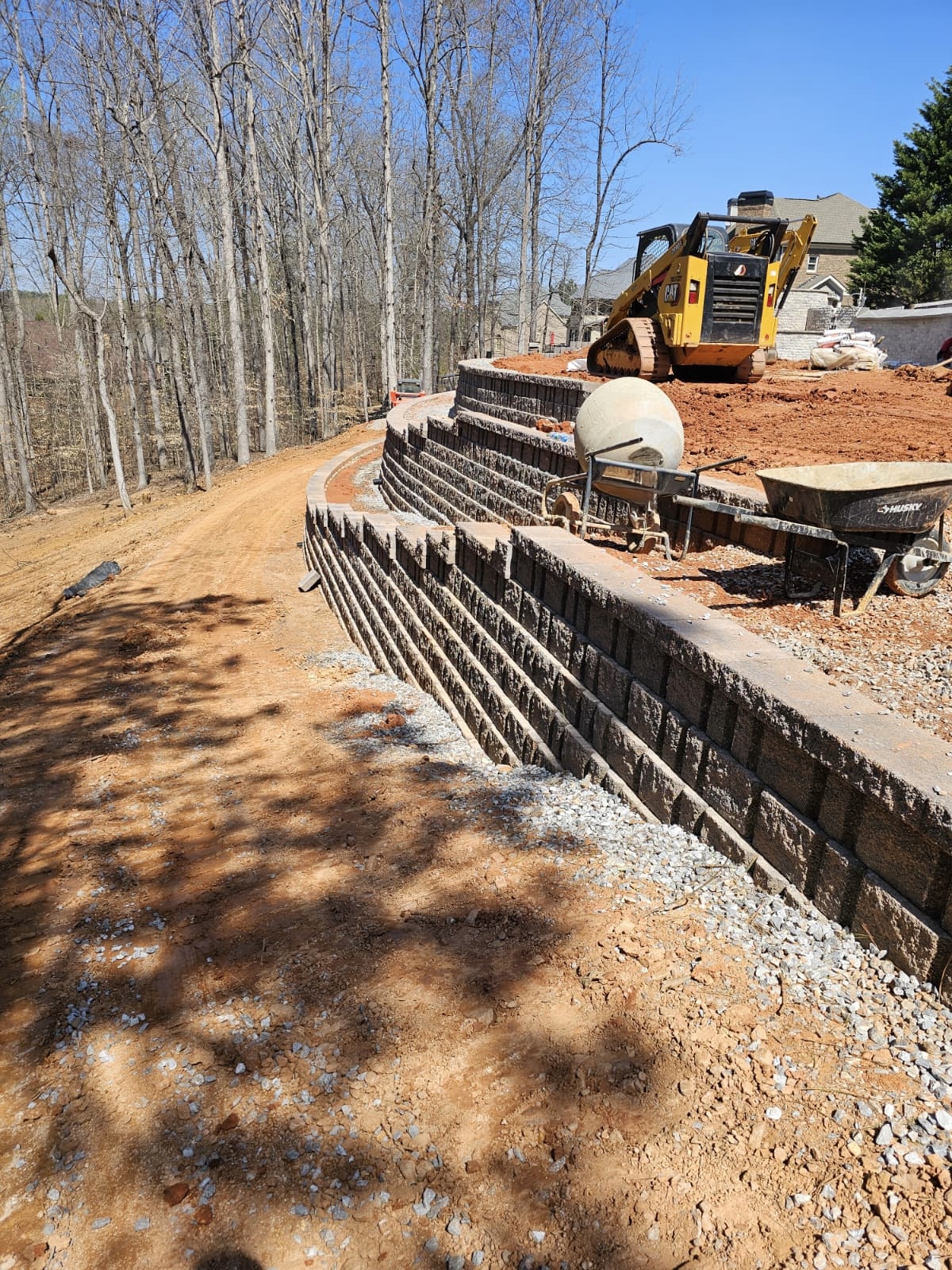
A completed hillside patio in Woodstock — two-level design, retaining wall transition, and integrated drainage built to last through Cherokee County’s seasons.
We walk the slope before we design anything. Free site evaluations across Woodstock and Cherokee County.