

Traditional and colonial homes in Alpharetta are among the most architecturally considered homes in North Atlanta — columns, symmetry, formal entry sequences, brick or stucco cladding in restrained palettes. And then, far too often, a concrete paver driveway in a standard running bond that looks like it was specified from a big box store catalog. The mistake isn’t choosing the wrong color. It’s choosing materials that carry no relationship to the home’s architectural DNA.
Traditional architecture is anchored in European classical precedent — it has specific material preferences that evolved over centuries, not seasons. When the hardscape around a traditional home ignores those preferences, the result is a property that looks expensive but somehow not quite right. Alpharetta homeowners feel it without always being able to name it. Here’s what’s actually happening — and what the right answer looks like.
The Defining Mistake
The single most common mistake on traditional homes in Alpharetta is large-format concrete pavers in a running bond or 4×8 Holland unit pattern without any material hierarchy. These materials were designed and marketed for contemporary and transitional homes. They read as contemporary: uniform color, consistent texture, linear joint patterns that emphasize the horizontal plane. Traditional architecture emphasizes vertical order, symmetry, and material warmth — none of which standard contemporary pavers provide.
The second mistake is stamped concrete in a natural stone or brick pattern. Stamped concrete is almost never the right answer on a traditional home, regardless of the pattern. The material reads as a reproduction rather than the real thing, and traditional architecture is deeply invested in material authenticity. Classical design borrowed from stone, brick, and mortar because those materials aged gracefully and communicated permanence. A stamped concrete surface that simulates those materials while being fundamentally neither creates a visual dissonance that worsens over time as the surface wears unevenly.
The third mistake is using tumbled concrete pavers in the wrong color range — specifically, pavers in gray, charcoal, or blue-gray tones on homes with warm brick exteriors. Traditional homes in Alpharetta’s established neighborhoods are heavily represented in red and buff brick, white and cream stucco, and painted wood trim in warm whites and creams. Cool-toned hardscape under a warm brick home creates a chromatic conflict that the eye registers as wrong every single time it sees it.
“Traditional homes were designed around material consistency — the same family of materials from the roof line to the ground plane. Hardscape that breaks that family apart doesn’t just look mismatched. It looks unfinished.”
What Actually Belongs
The right answer for traditional homes in Alpharetta almost always begins with genuine clay brick pavers that match or complement the home’s exterior brick. Traditional architecture was built on brick. The driveway, front walk, and motor court should continue that material from the foundation to the street — not introduce a competing material at grade. A herringbone or running bond brick paver driveway on a red or buff brick traditional home reads as architecturally resolved in a way that no concrete paver can replicate.
Where the home’s cladding is stucco or painted wood rather than exposed brick, natural bluestone or Pennsylvania bluestone in cut-to-size rectangular formats is the appropriate choice. Cut bluestone — not irregular flagstone — in a coursed rectangular pattern reads as classical and formal, referencing the kind of stone terracing and walkways found on traditional European estates. The material has genuine age when it’s actually old, and it acquires age gracefully when it’s new. For Alpharetta homes where the budget supports it, bluestone is the definitive traditional hardscape material.
For front walks specifically, a brick border with a central field of bluestone or cut limestone is a classically correct detail that appears on historic homes across New England, Virginia, and Georgia’s oldest neighborhoods. The border frames the walk as a designed element rather than a utilitarian surface. It introduces the same material hierarchy that appears in the home’s architecture — primary material, secondary accent, purposeful detail.
Pattern & Hierarchy
Pattern selection is as important as material selection on traditional homes. The running bond (offset half-brick or half-paver pattern) reads as the baseline for traditional hardscape — it’s correct, but it’s the minimum. More architecturally engaged patterns include herringbone at 45 degrees, which appears on historic brick walks throughout the American South; basketweave, which was the standard pattern for formal garden paths in 18th and 19th century estate design; and Flemish bond patterns reserved for the most formal applications.
The border is where traditional hardscape earns its formality. A double or triple soldier course border in a contrasting material — dark granite cobbles framing a brick driveway, a limestone border around a bluestone walk — creates the material hierarchy that traditional architecture demands. Without a border, a paved surface is just a paved surface. With a correctly detailed border, it becomes part of the architectural composition.
Entry gate piers, column bases, and low perimeter walls are opportunities to extend the traditional vocabulary into the site. Brick piers with precast stone or limestone caps, mortared fieldstone walls, and cast stone balustrades are all period-correct on traditional Alpharetta homes. These details matter especially on the elevated lots common in Alpharetta’s established neighborhoods — where the grade change is handled with a traditional masonry wall rather than a concrete block retaining system, the entire property reads differently.
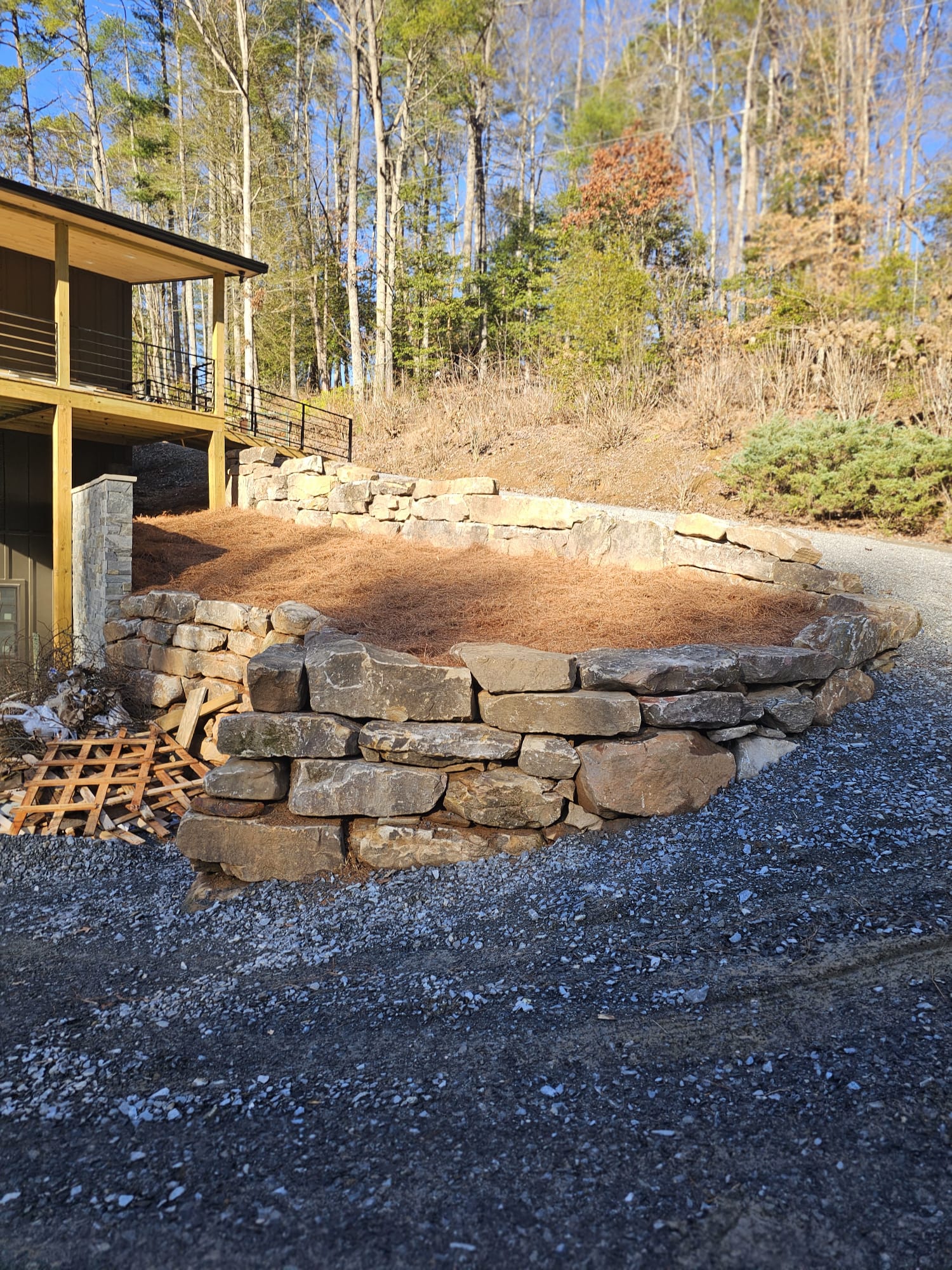
A hardscape installation in Alpharetta — warm-toned materials with formal border details matched to a traditional home’s exterior palette.
Traditional homes have historically been paired with formal landscape design: symmetrical plantings flanking entry walks, clipped boxwood hedges framing motor courts, allees of matched trees creating formal arrival sequences. The hardscape should support and reinforce that formal structure rather than undercut it. A casual, organic hardscape layout — curved walks, informal transitions, mixed-pattern paving — signals a design vocabulary that doesn’t belong on a traditional property.
Symmetry at the entry is not optional on traditional homes — it’s architectural. The front walk, steps, and entry landing should be centered on the front door. If the existing hardscape is off-center (which happens when homes are remodeled without attention to the original design intent), correcting that alignment is often the single highest-value change a Alpharetta traditional homeowner can make to their curb approach.
Kaizen Scapes proudly serves homeowners across Canton, GA, Woodstock, GA, and the surrounding North Georgia communities including Holly Springs, Ball Ground, Acworth, Kennesaw, Marietta, Alpharetta, Milton, Roswell, Cumming, Johns Creek, and East Cobb. If you’re looking for hardscaping and landscaping craftsmanship within 35 miles of Canton or Woodstock, our team is ready to transform your outdoor space.
Whether you’re in Canton, Woodstock, Alpharetta, Milton, or anywhere across Cherokee County and the greater North Atlanta suburbs, Kaizen Scapes brings the same relentless standard to every project. We don’t do cookie-cutter. We do custom — built to last.
See how the right materials transform a traditional Alpharetta property. Explore our full hardscaping services or book a free site evaluation below.

Traditional hardscape in Alpharetta — brick, natural stone, and formal borders built to match the home’s classical architecture.
Material-correct design for Alpharetta’s traditional and colonial homes. Free estimates, no obligation.