

Georgia’s climate has a wide seasonal range — mild winters, humid summers, dramatic spring rain events, and fall conditions that are genuinely excellent for construction. The season you start a hardscaping project in North Georgia affects curing times, crew efficiency, drainage observation windows, and whether your finished patio is ready to use when you actually want to use it.
This is not a post that will tell you there’s only one acceptable season. Hardscaping projects get built successfully in every season in Cherokee County. But there are real differences in outcome, timeline, and in what you need to account for depending on when you break ground — and most homeowners making this decision don’t have access to the contractor’s-eye view of what those differences actually look like. Here is that view.
Season by Season
September through November is the best hardscaping build window in North Georgia, and most experienced contractors will tell you the same thing. Temperatures are mild — typically between 50°F and 75°F — precipitation is lower than spring, and the ground is not frozen. Concrete work cures cleanly. Paver base compaction achieves consistent density. Drainage systems can be installed and observed through the early-season rain events that typically arrive in November and December. A project completed in October is fully settled, cured, and ready to use by the time spring entertaining season arrives in April.
The other underappreciated advantage of fall construction is site visibility. With deciduous trees cleared of leaves, grade changes, drainage paths, and soil conditions are visibly clearer during a fall site assessment than during summer’s full canopy cover. We often identify drainage issues during fall site evaluations that would have required an active rain event to catch in July.
“A fall build gives you the best conditions for installation, the full winter for settling, and a project that’s ready to use the moment spring arrives. That sequence is hard to beat.”
Spring is when homeowners start calling — and when that reality collides with the calendar. If you call a reputable hardscaping contractor in Canton or Woodstock in late April, you are booking a project that starts in late June or July at the earliest. The spring rush begins in March and most quality contractors are fully booked within three to four weeks of their schedule opening for the season. Booking in spring for spring use is rarely possible for projects over $15,000.
Spring construction also carries real weather risk in North Georgia. March and April precipitation averages are among the highest of the year — and sustained wet conditions during base preparation can delay a project by one to two weeks, which cascades into the summer booking behind it. If you want a project completed by Memorial Day, the consultation needs to happen in January or February. That is not an exaggeration — it is the reality of the spring booking market in Cherokee County.
Summer projects in Georgia proceed on a compressed morning schedule. Crews typically start at 6:30 AM and work until early afternoon when heat index climbs above 95°F. This is not a quality compromise — it is a standard operating procedure across every reputable hardscaping crew in North Georgia. The actual work quality does not suffer, but the daily production rate does, which means a project that takes 8 days in October may take 11 days in July. Budget for that timeline extension.
Concrete and mortar applications in summer heat require more careful management of mix ratios and hydration. Concrete poured in direct sun above 90°F must be misted and shaded during curing to prevent surface cracking. A contractor who pours concrete at 2 PM in July without managing the curing environment is taking a quality shortcut. Ask how their crew handles summer curing before you book a summer start.
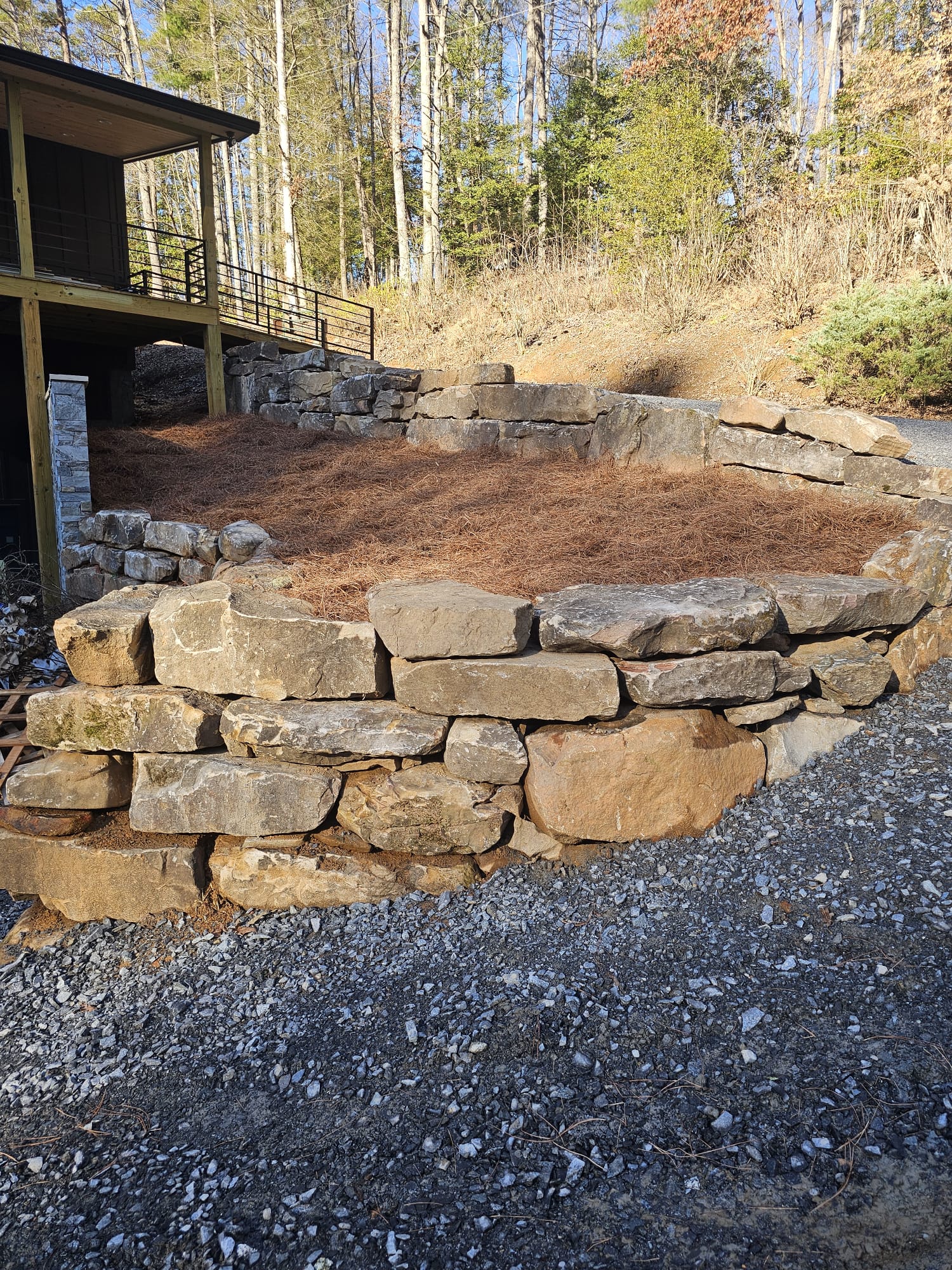
A retaining wall project in Cherokee County — fall construction conditions allowed the base drainage system to be installed and tested before winter, confirming performance before the surface was completed.
North Georgia winters are mild by national standards — Canton and Woodstock average only 3 to 6 frost days per year where overnight temperatures drop below 25°F. This means hardscaping work continues through most of December, January, and February with only brief interruptions. The practical effect is that winter is a realistic build window for most hardscaping projects, with a few important caveats.
Concrete placement requires ambient temperatures above 40°F and rising — meaning morning pours on a day forecast to stay above freezing through evening are typically fine, while pours on days where temperatures drop overnight require blanket insulation of the cured surface for the first 24 to 48 hours. This is manageable but adds a step that experienced contractors factor into their winter scheduling. Paver installation is not meaningfully affected by winter temperatures in North Georgia — base compaction and bedding sand performance are not temperature-dependent in the range Cherokee County experiences.
The pricing dynamic worth knowing: winter is typically when hardscaping contractors have the most calendar availability, which means the least waiting time from consultation to project start. If your project is not time-sensitive for spring use and you want minimal wait time, a January or February consultation is often the fastest path to a completed project.
Paver Installation Specifically
Concrete paver installation has a specific seasonal consideration that homeowners often don’t know: the base material compaction phase is sensitive to soil moisture content, not temperature. A base preparation done in saturated soil — which is most common in late March and early April in North Georgia — produces a less stable base layer than one done in drier conditions, regardless of material or technique. This is one of the structural arguments for fall installation over spring installation that goes beyond scheduling convenience.
The joint sand stabilization phase — where polymeric sand is swept into the paver joints and activated with water — performs identically across seasons in North Georgia’s temperature range. There is no meaningful seasonal performance difference in the finished joint stability between a fall and spring installation. The difference is entirely in the base preparation conditions, which favor the drier fall window.
Kaizen Scapes proudly serves homeowners across Canton, GA, Woodstock, GA, and the surrounding North Georgia communities including Holly Springs, Ball Ground, Acworth, Kennesaw, Marietta, Alpharetta, Milton, Roswell, Cumming, Johns Creek, and East Cobb. If you’re looking for hardscaping and landscaping craftsmanship within 35 miles of Canton or Woodstock, our team is ready to transform your outdoor space.
Whether you’re in Canton, Woodstock, Alpharetta, Milton, or anywhere across Cherokee County and the greater North Atlanta suburbs, Kaizen Scapes brings the same relentless standard to every project. We don’t do cookie-cutter. We do custom — built to last.

A fall-completed outdoor fireplace project in North Georgia — finished in November and fully ready for winter use, with the patio base installed in optimal dry-soil conditions.
We’ll tell you when to start for the outcome you want. Free consultations and honest scheduling timelines across all of Cherokee County.
Kaizen Scapes is based in Canton, Georgia and serves the greater North Atlanta region within 35 miles: