

A walkway isn’t just circulation. It’s the first thing every visitor experiences — and in Woodstock, where mature landscaping and canopy trees define so many residential properties, the material you choose either works with that environment or fights against it. Flagstone walkways work with it. They create a path that reads as belonging to the landscape rather than imposed upon it.
Concrete paver walkways have their place. They are consistent, predictable, and clean — which is exactly why they feel right for certain formal settings and exactly why they feel wrong alongside a naturalistic Woodstock landscape. The uniform edge, the consistent joint, the manufactured color — none of it competes well with mature oaks, azalea beds, and the kind of organic landscaping that Cherokee County properties develop over decades. Flagstone’s irregular geometry doesn’t compete with the landscape. It continues it.
Walkway Formats
The first design decision for any Woodstock flagstone walkway is whether to install a continuous surface — flagstones set edge to edge with jointed fill between them — or a stepping stone format, where individual stones are set at walking intervals through planted groundcover or lawn. Each produces a fundamentally different character, and the right choice depends on the path’s function and the property’s scale.
A continuous flagstone walkway reads as a defined, permanent path. It accommodates side-by-side walking, handles foot traffic in all weather, and creates a strong visual line from entry to destination. For front entry walkways in Woodstock, where the path is the primary arrival experience and sees regular use, continuous flagstone is typically the right specification. It’s also the better choice for any route that crosses lawn that needs to be mowed — continuous edging is easier to maintain than individual stepping stones scattered through turf.
A stepping stone path — individual stones set at 24–30 inch centers — works differently. It guides movement through a garden or yard without hard-surfacing the entire route. The spaces between stones become design elements: filled with thyme, moss, creeping Jenny, or fine gravel, they produce a path that looks as much like a garden feature as a circulation element. On larger Woodstock properties where a path winds through a planted area or connects distant zones without formalizing the journey, stepping stones are often the more elegant choice.
“The best walkway isn’t the most durable one or the least expensive one. It’s the one that makes you want to slow down and actually notice the property you’re approaching.”
Joint Treatment
Flagstone walkway joint treatment is one of the most underspecified decisions in residential hardscaping — and it has an enormous impact on the finished character of the installation. The joint is not a gap to be filled. It’s a design element to be specified.
This is where the material difference matters most over time. Concrete pavers age in one direction: the color fades, the edges chip, and the manufactured surface begins to look its age. A concrete paver walkway that looked crisp in 2010 often looks tired by 2025 — particularly if the joints have allowed weed growth or the base has settled unevenly. Flagstone ages in the opposite direction. The patina that develops on natural stone over years of weathering deepens the color, blends the installation into the landscape, and produces a surface that looks more settled and intentional with every passing season. A twenty-year-old flagstone walkway in Woodstock looks like it always belonged there. A twenty-year-old concrete paver walkway typically looks like it needs replacing.
On properties where the walkway is a genuine design feature — front entry paths, garden connections, pool surrounds — the long-term aesthetic trajectory of the material matters as much as the initial installation quality. Choosing natural stone is choosing a material that rewards patience.
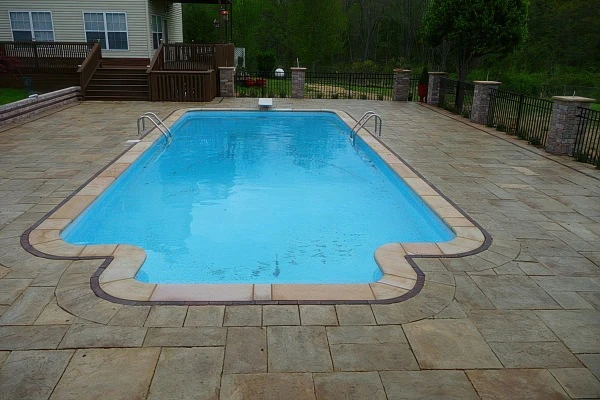
A naturalistic flagstone path in Woodstock — stone selected for the property’s color palette, joints treated to integrate with the surrounding landscape planting.
Flagstone walkway pricing in Woodstock depends on format, stone selection, joint treatment, and the base preparation the site requires. Continuous flagstone walkways on a properly compacted gravel and sand base typically run $20–38 per square foot, with stone type being the primary variable — Tennessee Crab Orchard tends toward the lower end, Pennsylvania Bluestone toward the upper, and Georgia Granite depending on cutting complexity. Stepping stone paths run somewhat less on a per-stone basis but are typically quoted by the linear foot of path rather than square footage.
Installation timeline for a standard Woodstock front entry walkway — 60 to 100 square feet — typically runs two to three days. Base excavation and compaction on day one, stone setting and fitting on day two, joint treatment and cleanup on day three. Larger or more complex paths — those with curves, elevation changes, or integrated planted joints — require additional time and should be scoped accordingly. Any contractor quoting a complete flagstone walkway installation in a single day is shortcutting the base work — and that’s where twenty-year performance lives.
The visible part of a flagstone walkway — the stone surface — is the last 20% of the work. The 80% that determines long-term performance is underground: base excavation depth (minimum 6 inches for a walkway application), compaction quality, drainage slope, and bedding layer consistency. A flat stone on an improper base will rock, settle, and tip within three to five years regardless of how beautiful the stone itself is. Ask every contractor for their base specification before comparing quotes — you are not comparing equivalent projects if one contractor excavates 4 inches and another excavates 8.
Why Kaizen Scapes
We spec every walkway base to the site conditions, not to a template. A shaded Woodstock property with established tree roots and moist soil requires a different base approach than a sunny slope with dense clay. We assess those conditions before we set a single stone — and our joint treatment recommendations come from what the landscape will actually support, not from what’s fastest to install. When a flagstone walkway is done correctly in Woodstock, it becomes part of the property’s character within one growing season and stays that way for decades.
Kaizen Scapes proudly serves homeowners across Canton, GA, Woodstock, GA, and the surrounding North Georgia communities including Holly Springs, Ball Ground, Acworth, Kennesaw, Marietta, Alpharetta, Milton, Roswell, Cumming, Johns Creek, and East Cobb. If you’re looking for hardscaping and landscaping craftsmanship within 35 miles of Canton or Woodstock, our team is ready to transform your outdoor space.
Whether you’re in Canton, Woodstock, Alpharetta, Milton, or anywhere across Cherokee County and the greater North Atlanta suburbs, Kaizen Scapes brings the same relentless standard to every project. We don’t do cookie-cutter. We do custom — built to last.
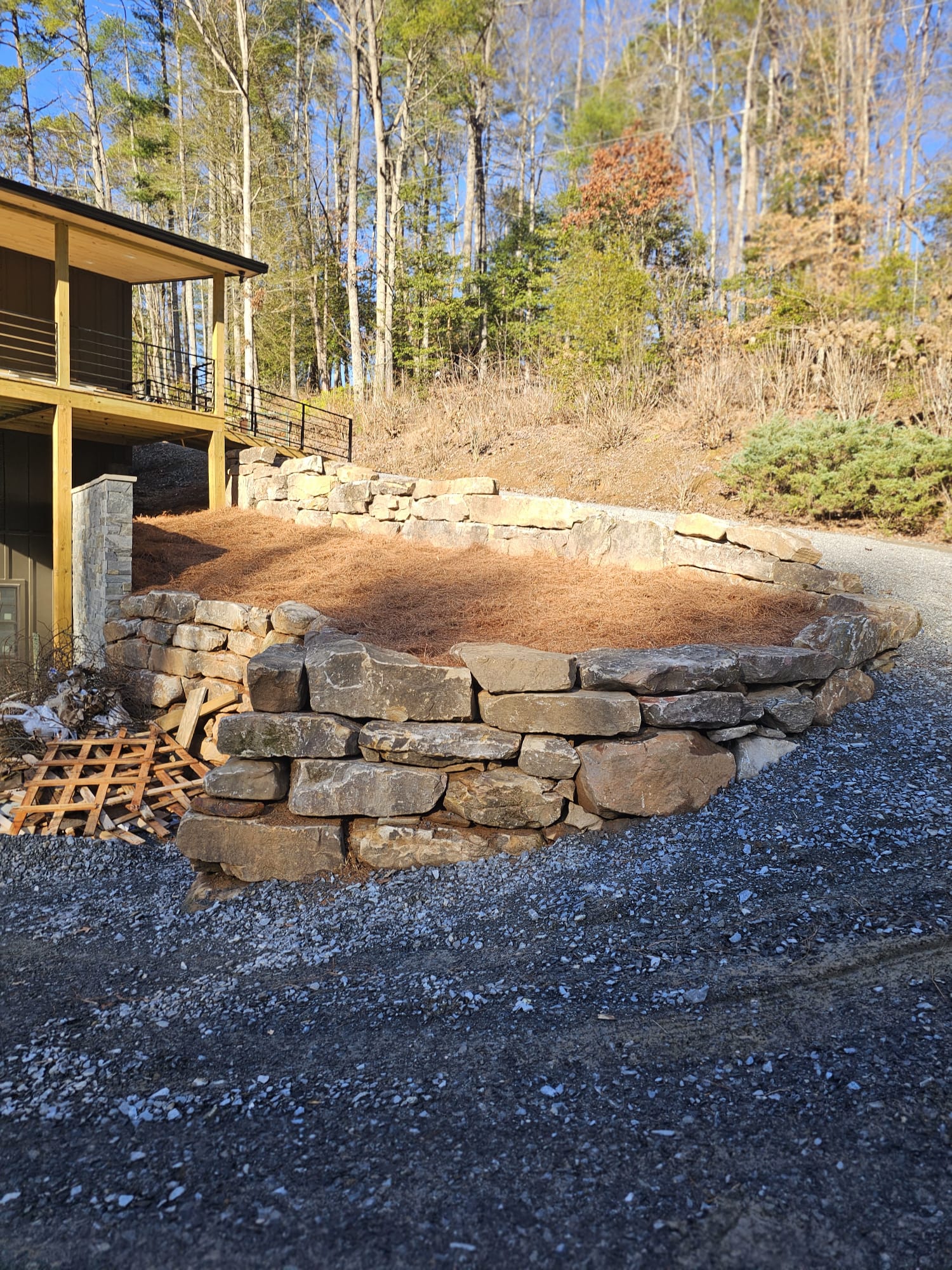
A completed Kaizen Scapes project in the Woodstock area — natural stone work integrated with the site’s mature landscape character.
We design to the site and the landscape — not a catalog. Free walkway evaluations across Woodstock, Canton, and all of Cherokee County.
Kaizen Scapes is based in Canton, Georgia and serves the greater North Atlanta region within 35 miles: