

Marietta has thousands of homes built between 1970 and 1995 — solidly built houses with backyards that were functional when they were poured and are now dated, cracked, and holding those properties back from what they could be. The concrete patio was the standard specification for thirty years. It did its job. And now it looks exactly like what it is: a thirty-year-old concrete pad that hasn’t aged gracefully.
Flagstone is the most common replacement material for aging concrete patios in Marietta’s established neighborhoods — and the transformation it produces is not subtle. Replacing a cracked, stained concrete slab with natural flagstone doesn’t just update a patio. It changes how the entire backyard reads. What was a utilitarian surface becomes a design feature that anchors the outdoor space the way a quality floor anchors an interior room. The effect on property appeal — and on how much the homeowner actually uses the space — is significant.
Marietta’s Concrete Problem
Concrete patios in Marietta face a specific set of challenges that explain why so many of the original slabs from the 1970s and 1980s are now at or past the end of their useful aesthetic lives. Georgia’s freeze-thaw cycles — less severe than the northern states but persistent — create surface scaling over decades. Tree roots from Marietta’s mature canopy exert steady upward pressure that cracks slabs from below. Pool chemistry, fertilizer runoff, and organic debris staining accumulate in concrete’s porous surface in ways that can’t be cleaned out, only covered up.
The average concrete patio in Marietta’s 1980s-era subdivisions is structurally marginal but aesthetically past its prime. It hasn’t failed — it still holds weight and drains adequately — but it looks tired, and no amount of pressure washing, sealing, or surface coating changes that. The options are to live with it, cover it, or replace it. More and more Marietta homeowners are choosing replacement — and natural flagstone is the material that produces the most dramatic transformation per invested dollar.
“The concrete patio did its job for thirty years. Now it’s time to replace it with something that will do its job for the next thirty — and look better every year it does.”
The Installation Decision
This is the first decision every Marietta homeowner faces when replacing a concrete patio with flagstone — and it’s the one where contractor advice varies most, often based on what’s fastest to install rather than what’s best for the property. The right answer depends on the structural condition of the existing slab, its drainage slope, and how the surface finishes at its edges.
Flagstone set over an existing concrete slab is the faster and less disruptive approach. If the existing slab is structurally sound — no significant heaving, cracking, or differential settlement — it can serve as a stable substrate for a mortar-set flagstone installation. The flagstone is bedded in a mortar mix over the cleaned slab surface, joints are mortared, and the result is a clean, rigid flagstone surface that sits approximately 1.5–2.5 inches higher than the original concrete. This approach works well when the existing slab drains correctly and its elevation doesn’t create conflicts with door thresholds, drainage grades, or transitions to other surfaces. Cost advantage: no demo, no haul-away, no base reconstruction — savings typically run $3–6 per square foot versus full removal.
Full demolition and fresh installation is the right specification when the existing slab has significant issues: heaved sections, drainage problems, root damage that will continue expanding under the new surface, or elevation conflicts that the added flagstone thickness would worsen. It’s also the right call when you want a dry-laid flagstone installation — the organic, permeable format that reads most naturally — because dry-laid flagstone requires a proper gravel and sand base, not a concrete substrate. Full demo and reconstruction typically adds $4–8 per square foot to the project cost over the overlay approach, reflecting excavation, haul-away, and base reconstruction.
A complete Marietta concrete patio assessment looks at: crack pattern and depth (surface scaling vs. structural cracking), slab level consistency (a 4-foot level reveals differential settlement), drainage grade confirmation (water should run away from the house at minimum 1/4 inch per foot), and elevation at all thresholds and transitions. We walk every slab before making a recommendation — and we don’t recommend overlay to homeowners whose slabs need replacement, regardless of the cost difference.
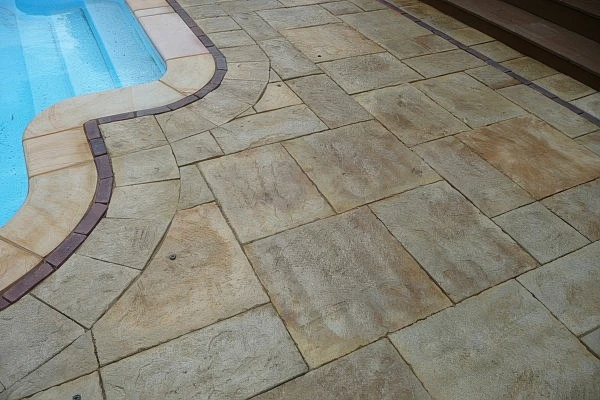
A natural stone installation in the Marietta area — concrete replaced with flagstone, the backyard transformed from functional to distinctive.
The concrete-to-flagstone transformation is one of those projects where before-and-after photography genuinely fails to capture the full effect — because the change isn’t just visual. It’s experiential. A backyard built around a concrete slab is a space you use. A backyard built around natural flagstone is a space you inhabit. The warmth of natural stone, the irregular geometry that invites the eye rather than ending it, the way the stone reads differently at different times of day — none of that is present in concrete, no matter how well the surface is maintained.
For Marietta’s 1970s and 1980s housing stock specifically, the flagstone upgrade has a particular impact because these homes were built before outdoor living became a design priority. The backyard was an afterthought — a lawn, a concrete slab, a grill. Replacing that concrete with flagstone and adding the hardscaping and softscaping that surrounds it — a defined edge, planted borders, perhaps a low natural stone wall or raised bed perimeter — produces a space that looks like it was designed rather than default. That change is visible from the kitchen window. It’s visible from a real estate listing. And it’s felt every time the back door opens.
The cost for a flagstone patio replacement in Marietta — including slab removal, base work, and mortar-set or dry-laid flagstone installation on a typical 200–400 square foot patio — typically runs $8,500 to $18,000 depending on square footage, stone selection, whether demo is required, and drainage or grading work the site needs. It is not an inexpensive project. It is also not a project that needs to be repeated in fifteen years.
Why Kaizen Scapes
We don’t recommend overlay to homeowners whose slabs need replacement. We don’t recommend flagstone to homeowners whose sites, budgets, or aesthetic goals aren’t aligned with what natural stone requires. We assess the existing slab, the drainage context, and the homeowner’s priorities before recommending anything — and we give an honest answer about which approach is actually right for that property. If the slab is sound and overlay is the correct specification, we say so. If it needs to come out, we explain why. That conversation happens before the first dollar is committed.
Kaizen Scapes proudly serves homeowners across Canton, GA, Woodstock, GA, and the surrounding North Georgia communities including Holly Springs, Ball Ground, Acworth, Kennesaw, Marietta, Alpharetta, Milton, Roswell, Cumming, Johns Creek, and East Cobb. If you’re looking for hardscaping and landscaping craftsmanship within 35 miles of Canton or Woodstock, our team is ready to transform your outdoor space.
Whether you’re in Canton, Woodstock, Alpharetta, Milton, or anywhere across Cherokee County and the greater North Atlanta suburbs, Kaizen Scapes brings the same relentless standard to every project. We don’t do cookie-cutter. We do custom — built to last.
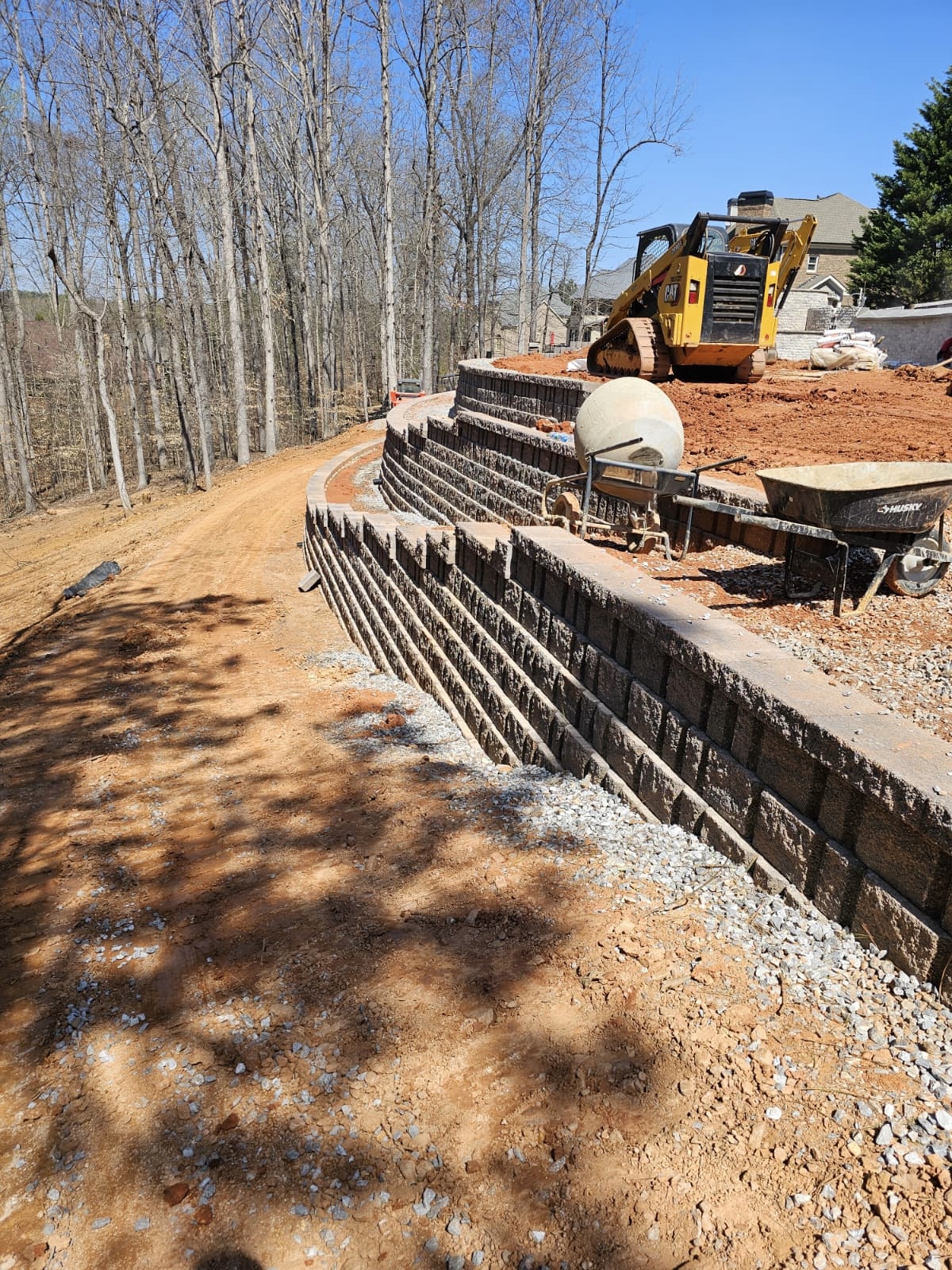
A completed Kaizen Scapes project in the Marietta area — natural stone installed where concrete was, the space transformed from default to designed.
We assess the existing slab and give you an honest recommendation before any work begins. Free flagstone evaluations for Marietta, Kennesaw, Acworth, and all of Cobb County.
Kaizen Scapes is based in Canton, Georgia and serves the greater North Atlanta region within 35 miles: