

There is a moment on many Canton properties — usually standing at the back of a sloped lot, looking up at a grade change of six, eight, maybe twelve feet — where a homeowner decides between the structural and the beautiful. Boulder retaining walls argue that you do not have to choose. But that argument only holds when the boulder wall is engineered for what the slope actually demands, not simply stacked because it looks good in photos.
Cherokee County’s wooded lots, mature hardwoods, and irregular terrain create conditions where natural boulder walls genuinely outperform segmental block in ways that go beyond aesthetics. The decision isn’t about taste — it’s about understanding what a mass gravity system does differently from a geogrid-anchored block wall, and when that difference matters for your specific slope.
The Engineering Case
Segmental block retaining walls work through a combination of block mass, mechanical interlock, and — for walls over four feet — geogrid reinforcement layers embedded horizontally into the compacted backfill. The geogrid creates what engineers call a mechanically stabilized earth zone: the backfill soil and the grid work together as a composite structure that resists the lateral earth pressure pushing against the wall face. It’s a reliable, proven system when installed correctly.
Boulder retaining walls operate on a fundamentally different principle: mass gravity resistance. The boulders themselves — typically granite fieldstone weighing between 300 and 2,000 pounds per stone — resist lateral pressure through sheer weight and the friction between stones. There are no geogrids, no pins, no mechanical interlocks. The wall’s stability comes from mass, batter (the slight backward lean of the face), and the precision with which each stone is set. A properly engineered boulder wall on a Cherokee County slope can handle loads that would require significant geogrid engineering in a block system — because the physics work differently.
“On wooded Canton lots with irregular terrain and existing tree root systems, boulder walls often require less excavation and less disruption than a block system that needs clean, compacted geogrid layers.”
The engineering difference also changes what happens to the wall’s footprint behind the face. A geogrid block wall requires a reinforced zone that typically extends back into the hillside by a distance equal to 60–80% of the wall height — for an eight-foot wall, that’s five to six feet of excavation behind the face. A boulder wall’s reinforced zone is largely the mass of the stones themselves. On tightly wooded Canton properties where excavating deep into a hillside means losing mature trees or disturbing root systems, that difference can determine which system is actually buildable on the site.
Sizing & Site Fit
Not every boulder is a retaining boulder. The distinction matters more than most homeowners realize. Decorative boulders placed at the base of a slope for aesthetic definition are a completely different application from structural boulders engineered to hold back a grade change under lateral earth pressure. Structural boulder selection considers the soil bearing capacity at the base, the height of the wall, the batter angle, and the weight class of stone needed to resist movement.
For most Canton residential applications — grade changes between four and ten feet — structural boulders in the 400 to 1,200 pound range provide the right combination of mass and maneuverability. Stones below 300 pounds don’t provide reliable gravity resistance in Cherokee County’s clay-heavy soils, which expand and contract seasonally. Stones above 1,500 pounds require crane equipment and increase mobilization cost significantly. The sweet spot for residential boulder walls in our region is what the industry calls Class B or Class C fieldstone: irregular granite pieces with flat bearing surfaces and enough mass to interlock under load.
The aesthetic case for boulder walls on Canton properties comes down to one thing: they belong there. Cherokee County’s landscape is fundamentally a granite and hardwood environment. Exposed granite outcroppings, fieldstone in creek beds, and moss-covered boulders are native features of this terrain. A well-built boulder retaining wall doesn’t look installed — it looks like it was always there. That continuity is genuinely difficult to replicate with manufactured block, regardless of finish or texture.
For wooded lots with existing mature hardwoods, boulder walls offer another practical advantage: the irregular geometry of natural stone accommodates existing root systems and irregular grade in ways that block systems — which require continuous level courses — cannot. We have built boulder walls in Canton that navigate around 50-year-old white oaks in ways a block system simply could not have managed without removing the trees.
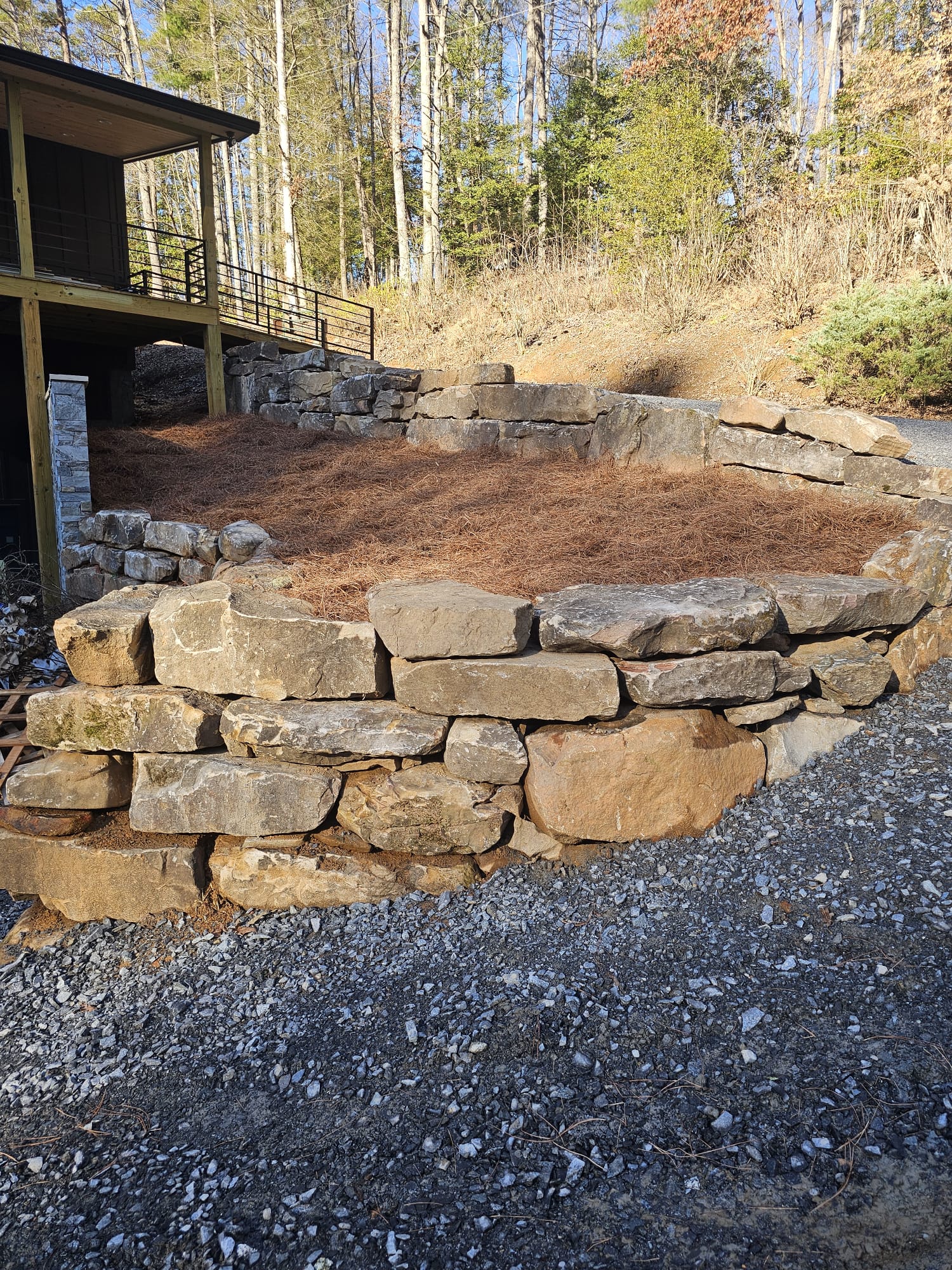
A boulder retaining wall on a Canton property — granite fieldstone sized for the slope load, set with structural batter, gravel drainage behind each course.
Boulder retaining walls carry a meaningful cost premium over segmental block, and that premium deserves an honest explanation. Segmental block retaining walls in Canton typically run $22 to $45 per square foot of wall face, depending on block specification, geogrid requirements, and drainage complexity. Boulder retaining walls typically run $35 to $75 per square foot — the range driven by stone class, wall height, site access, and whether crane equipment is required for larger stones.
The premium covers three things: material cost (quarried granite vs. manufactured block), labor intensity (each boulder is individually placed with an excavator operator who needs the skill to read a stone and set it correctly the first time), and site complexity (access for excavator and stone delivery on wooded Canton lots often requires more planning and time than a block installation). For a 40-foot-long, 5-foot-tall wall section, expect a boulder wall to run $10,000 to $18,000 versus $6,500 to $12,000 for an engineered block system.
The premium is worth it when aesthetics and site context are load-bearing factors in the project decision. On high-visibility Canton properties — rear yards visible from living areas, front slopes on corner lots, any wall adjacent to a pool or outdoor living space — the natural stone aesthetic pays back in property value and daily livability in ways that justify the additional cost. On wooded lots where manufactured block would look out of place against the existing landscape character, the premium is structural in a different sense: you are paying to not diminish the property’s natural appeal.
The premium is less clearly justified on rear utility slopes, drainage-channel walls, or any application where the wall is not visible from the primary living areas. In those contexts, a properly engineered segmental block system delivers the structural outcome at lower cost. We will tell you which category your project falls into during the site evaluation — even if the honest answer points you toward the less expensive option.
Why Kaizen Scapes
Boulder wall construction requires a different skill set than block installation. The excavator operator who places structural boulders is making structural decisions with each stone — reading the bearing surface, judging the interlock with the course below, managing the batter angle as the wall rises. This is not a skill that transfers from general grading work. Our boulder wall crews have built extensively across Canton and Cherokee County’s wooded terrain, and they understand how Georgia granite behaves under load and over time.
Kaizen Scapes proudly serves homeowners across Canton, GA, Woodstock, GA, and the surrounding North Georgia communities including Holly Springs, Ball Ground, Acworth, Kennesaw, Marietta, Alpharetta, Milton, Roswell, Cumming, Johns Creek, and East Cobb. If you’re looking for hardscaping and landscaping craftsmanship within 35 miles of Canton or Woodstock, our team is ready to transform your outdoor space.
Whether you’re in Canton, Woodstock, Alpharetta, Milton, or anywhere across Cherokee County and the greater North Atlanta suburbs, Kaizen Scapes brings the same relentless standard to every project. We don’t do cookie-cutter. We do custom — built to last.
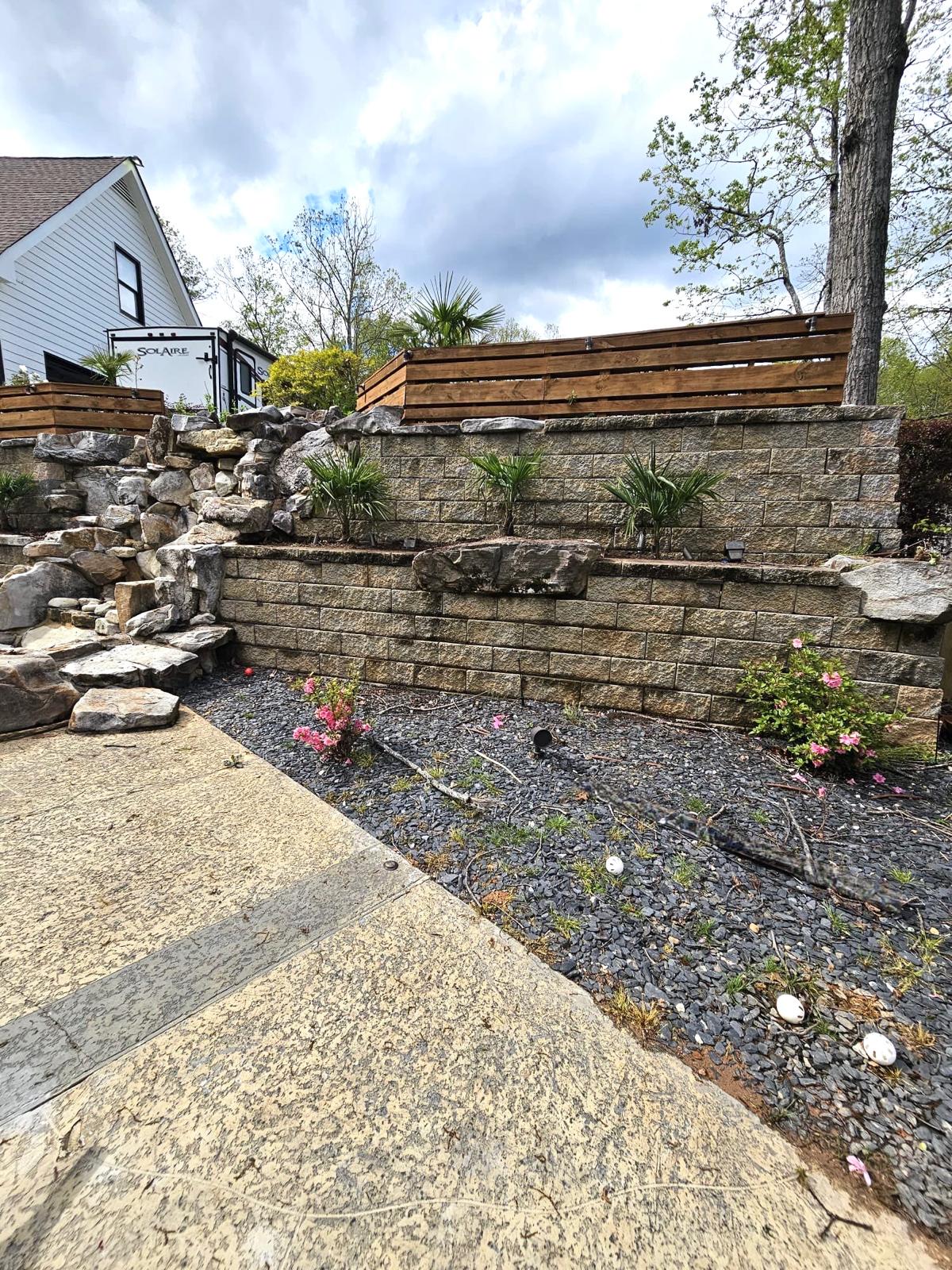
A completed boulder retaining wall in Canton — natural granite integrated with the existing wooded landscape, engineered for long-term gravity resistance.
We evaluate the slope, soil, and site conditions before recommending any material. Free retaining wall assessments across Canton and all of Cherokee County.
Kaizen Scapes is based in Canton, Georgia and serves the greater North Atlanta region within 35 miles: