

Artificial turf backyard installations in Woodstock GA and Canton GA have shifted from a niche product associated with sports fields and water-conscious desert landscaping to a legitimate, visually excellent option for North Georgia residential properties. The product itself has changed dramatically over the past decade — the visual difference between today's premium turf and natural sod, in terms of color variation, blade texture, and density, is minimal to anyone not looking for it. What hasn't changed is the set of conditions that make artificial turf the right answer: properties where irrigation cost is high, where shade prevents natural grass from ever performing consistently, where pet traffic creates recurring bare spots, or where the combination of slope and drainage creates a maintenance problem that natural sod has never solved.
The Cherokee County homeowners who benefit most from artificial turf aren't the ones who gave up on natural grass. They're the ones who did the honest assessment of their property and realized that several specific conditions were working against them — and that no amount of correct variety selection or irrigation investment was going to change those conditions. A backyard with 70% tree coverage, two large dogs, and a slope that drains poorly isn't a sod problem. It's an artificial turf conversation.
Shade is the clearest case for artificial turf. Even Fescue — the most shade-tolerant option available in North Georgia — requires at least four hours of direct sun to maintain reasonable density. Properties with heavy canopy coverage from mature oaks or pines that block significant sky exposure struggle to maintain any natural grass variety without recurring intervention: overseeding, fertilizing, and replacing sections that die out every summer. Artificial turf installed correctly under a dense tree canopy maintains consistent appearance year-round with no intervention required. The trees stay, the shade stays, and the lawn still looks like a lawn.
Slopes present a different but equally compelling case. Natural grass on grades steeper than roughly 3:1 is difficult to mow safely, erodes under Georgia's heavy rainfall events, and requires significant irrigation management because water runs off faster than it infiltrates the shallow root zone. Artificial turf installed on slopes with a properly compacted base and adequate sub-surface drainage addresses all three problems: it doesn't erode, it doesn't require mowing, and its drainage layer manages runoff at the same rate regardless of rainfall intensity. Pool surrounds are another strong application — the combination of constant moisture from splashing, chlorine exposure, and high foot traffic around pool coping creates conditions where natural grass struggles to recover between uses. Artificial turf in pool surrounds eliminates the mud, the dead patches, and the tracking of organic material into the pool water.
"Artificial turf isn't a compromise for homeowners who gave up on grass. It's the right choice for yards where irrigation costs, shade coverage, or pet traffic make natural sod a maintenance problem that never gets solved."
The criticism most commonly leveled at artificial turf — that it gets too hot in summer — is real but manageable with the right infill specification. Standard crumb rubber infill does retain heat significantly, and surface temperatures on a black rubber-filled turf field on a 95-degree Georgia afternoon can exceed 150 degrees. However, modern installations increasingly use alternative infills — coated sand, cork, or hybrid infill products — that reduce heat retention meaningfully. For residential backyards, especially areas with afternoon shade from trees or structures, heat is a manageable consideration rather than a disqualifying one. The homeowner who replaces a problematic backyard with artificial turf and a cork infill, shaded by the existing tree canopy, will experience surface temperatures comparable to a conventional hardscape surface — not a synthetic sports field in full sun at midday.
Modern premium turf products use multi-tonal polyethylene blades with a natural curl pattern that disperses light the way natural grass does, rather than reflecting it uniformly. Pile heights typically range from 1.5 to 2.25 inches for residential backyard applications, with denser face weight products providing the most realistic visual texture. The quality difference between a $2.50/square-foot product and a $4.50/square-foot product is visible on installation and becomes more visible over time as the lower-grade product flattens and loses blade recovery. Drainage requirements are met through a perforated backing that drains at a rate typically exceeding three inches per hour — faster than any natural soil in Cherokee County's clay-heavy landscape.
The upfront cost of artificial turf installation — including base preparation, edging, infill, and the product itself — runs significantly higher than natural sod installation for the same area. On a typical 2,000-square-foot backyard, the difference may be $6,000–$10,000 in initial installation cost. Over a 10-year period, however, the calculation shifts: artificial turf eliminates irrigation cost (which on a 2,000-square-foot backyard in a dry Georgia summer can run $400–$800 per season), eliminates fertilizer, herbicide, and pesticide cost, eliminates the mowing time and equipment cost, and eliminates the periodic replacement or overseeding required by Fescue. For yards with recurrent problems — shade, pets, slopes — where natural sod has already been replaced or repaired multiple times, the 10-year cost comparison often favors artificial turf by a meaningful margin.
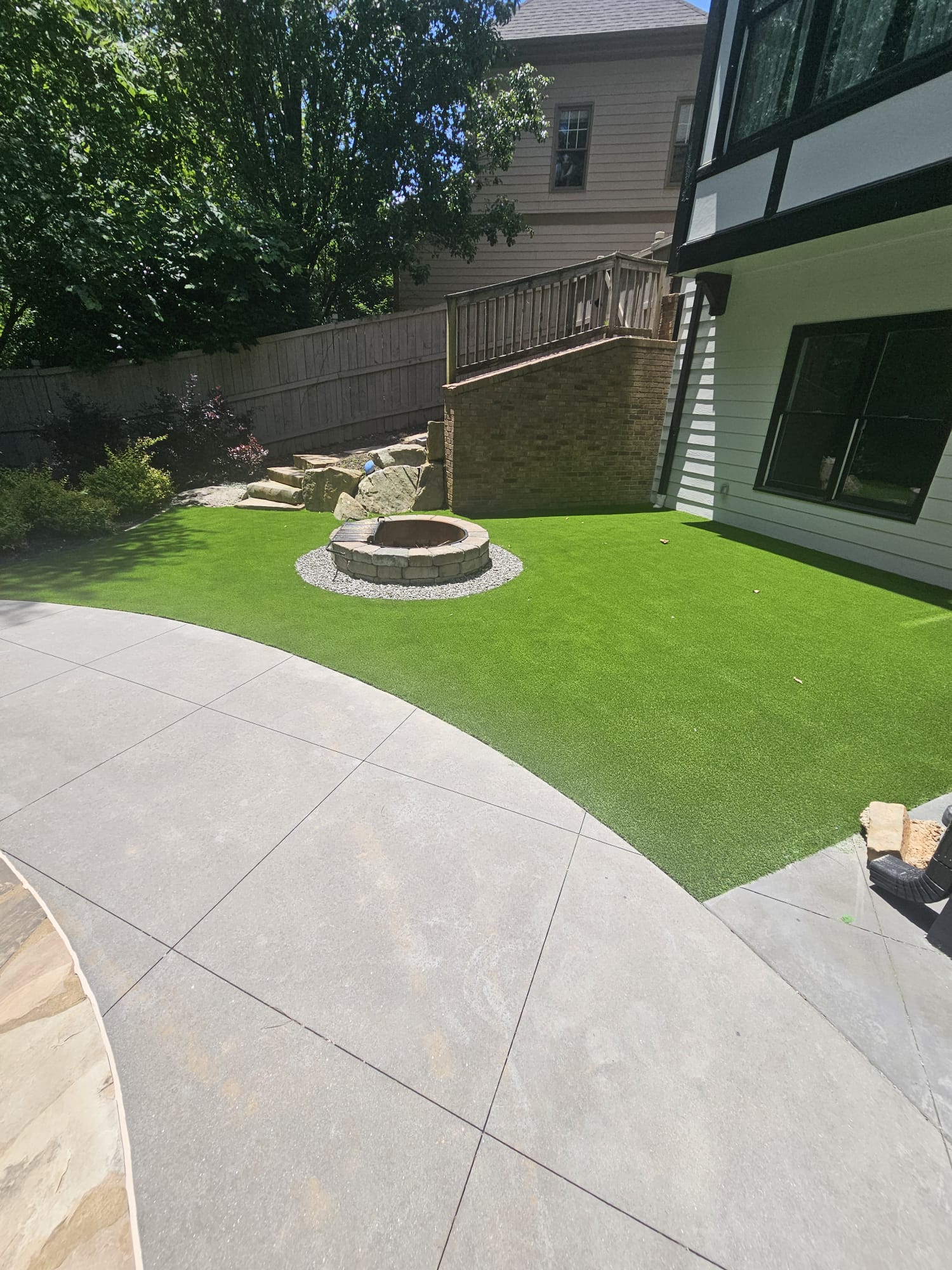
Artificial turf installation in Cherokee County — installed on a shaded backyard where natural grass had been replaced three times in four years before the homeowner made the switch.
Artificial turf installation quality differences are significant and directly affect longevity. A properly prepared base — compacted crushed aggregate at sufficient depth, weed barrier, perforated drainage layer — is what separates an artificial turf installation that looks excellent after ten years from one that develops soft spots, drainage problems, and seam failures within three. The edges must be anchored securely to prevent lifting, seams must be glued and nailed on a pattern that prevents separation, and infill must be applied at the correct rate and brushed in properly to support blade recovery. Kaizen Scapes approaches artificial turf installation with the same attention to base preparation that we apply to hardscape projects — because in both cases, the surface is only as good as what's under it.
Kaizen Scapes proudly serves homeowners across Canton, GA, Woodstock, GA, and the surrounding North Georgia communities including Holly Springs, Ball Ground, Acworth, Kennesaw, Marietta, Alpharetta, Milton, Roswell, Cumming, Johns Creek, and East Cobb. If you're looking for hardscaping and landscaping craftsmanship within 35 miles of Canton or Woodstock, our team is ready to transform your outdoor space.
Whether you're in Canton, Ball Ground, Holly Springs, or anywhere across Cherokee County, Kaizen Scapes brings the same relentless standard to every project. We don't do cookie-cutter. We do custom — built to last. See our full hardscaping services or call for a free consultation.
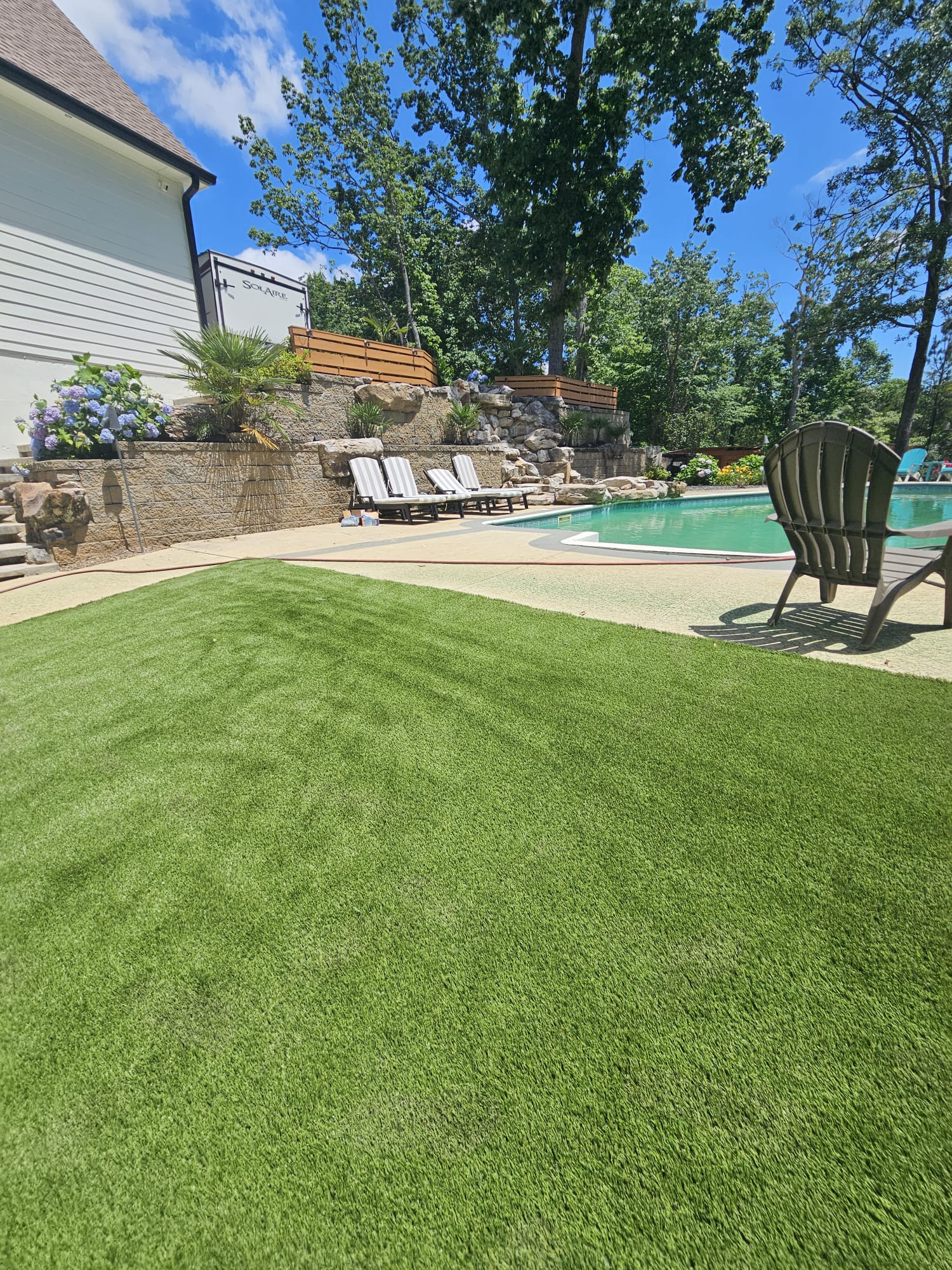
The finished backyard — consistent appearance year-round, no irrigation cost, and a surface that handles pet traffic and shade without intervention.
Free consultations across Canton, Woodstock, and Cherokee County. We'll give you an honest assessment of which solution fits your property.
(470) 535-0252 Get a Free Estimate