

Tree removal and landscape grading are two decisions that most Woodstock homeowners treat as separate conversations. They’re not. What you do with a tree — and what you do with the ground after it’s gone — determines what you can build on that site. The sequence matters, the method matters, and the soil behavior that follows is something every Woodstock homeowner planning a patio, retaining wall, or new planting area needs to understand before a single cut is made.
Cherokee County’s tree canopy is dense and the properties are often sloped, which means tree removal in Woodstock frequently happens in the same context as a significant grading or hardscape project. When those two scopes aren’t planned together, the grading that follows tree removal produces a site condition that’s incompatible with what was planned for it. Here’s what that relationship looks like in practice, and what a properly sequenced project accounts for.
Stump Grinding vs. Full Removal
Stump grinding removes the visible stump to a depth of eight to twelve inches below grade — it does not remove the root system. The roots remain in the soil, and they will decompose over the next three to seven years depending on the species, soil moisture, and size. During that decomposition period, the soil above and around those roots is structurally unreliable for certain applications. A poured concrete pad, a block retaining wall, or any hardscape requiring a compacted aggregate base installed directly over a substantial root mass is at risk of uneven settling as those roots break down and the soil above them loses support.
Full root removal — mechanical excavation of the root ball and primary root structure — costs significantly more and takes more time, but it produces a clean, buildable site condition that can support hardscape installation within one growing season after proper fill and compaction. The decision between stump grinding and full root removal is not a cost preference — it is a site engineering decision that should be made based on what you intend to build and where. A contractor who recommends stump grinding on a site where you’ve told them you want a patio built in the same zone hasn’t done that evaluation honestly.
“The removal method you choose today determines what the ground will support three years from now. That’s not a landscaping detail — it’s a structural decision.”
Root system mapping matters before any retaining wall or patio project that shares a site with existing or recently removed trees. Large hardwood species — oak, hickory, tulip poplar — common throughout Woodstock’s older neighborhoods extend root systems significantly beyond the drip line. Those root zones affect compaction behavior, drainage patterns, and the long-term performance of any structure built within them. A site assessment that identifies those zones before project design prevents costly redesigns — or worse, structural failures — after installation.
Georgia Clay After Tree Removal
Georgia clay is a notoriously reactive soil — it expands when saturated and contracts when dry, and those cycles are amplified in the zone directly affected by tree removal. A mature tree extracts significant moisture from the surrounding soil. When that tree is removed, the moisture equilibrium in that zone shifts — soil that was being constantly dried by root water uptake becomes wetter during rain events, and the clay in that zone begins its expansion/contraction cycles at a different amplitude than the surrounding undisturbed soil.
The practical consequence for Woodstock homeowners is this: the soil around a recently removed tree in Cherokee County clay is not dimensionally stable for at least one full seasonal cycle after removal. Building hardscape directly on that zone — even with a gravel base — without allowing for full compaction and settlement, or without proper geotechnical fill, produces a surface that moves. Concrete cracks. Block shifts. Edging heaves. These failures are not random — they are the predictable result of building on a soil profile that hasn’t stabilized.
Re-grading after tree removal in Woodstock typically runs $1,500 to $6,000 depending on the size of the removal zone, the amount of fill required, and what the finished grade needs to accomplish. The range is wide because the scope varies significantly: a single small tree removal might require only cleanup grading, while removing several mature trees from a slope to create a flat patio zone requires engineered fill, compaction in lifts, and in some cases a retaining structure at the downhill edge to hold the new grade. What re-grading enables is equally variable — it can unlock a useless slope for a patio, eliminate a drainage problem that’s been directing water toward the foundation, or create a flat lawn zone where only a root-disrupted mess existed before.
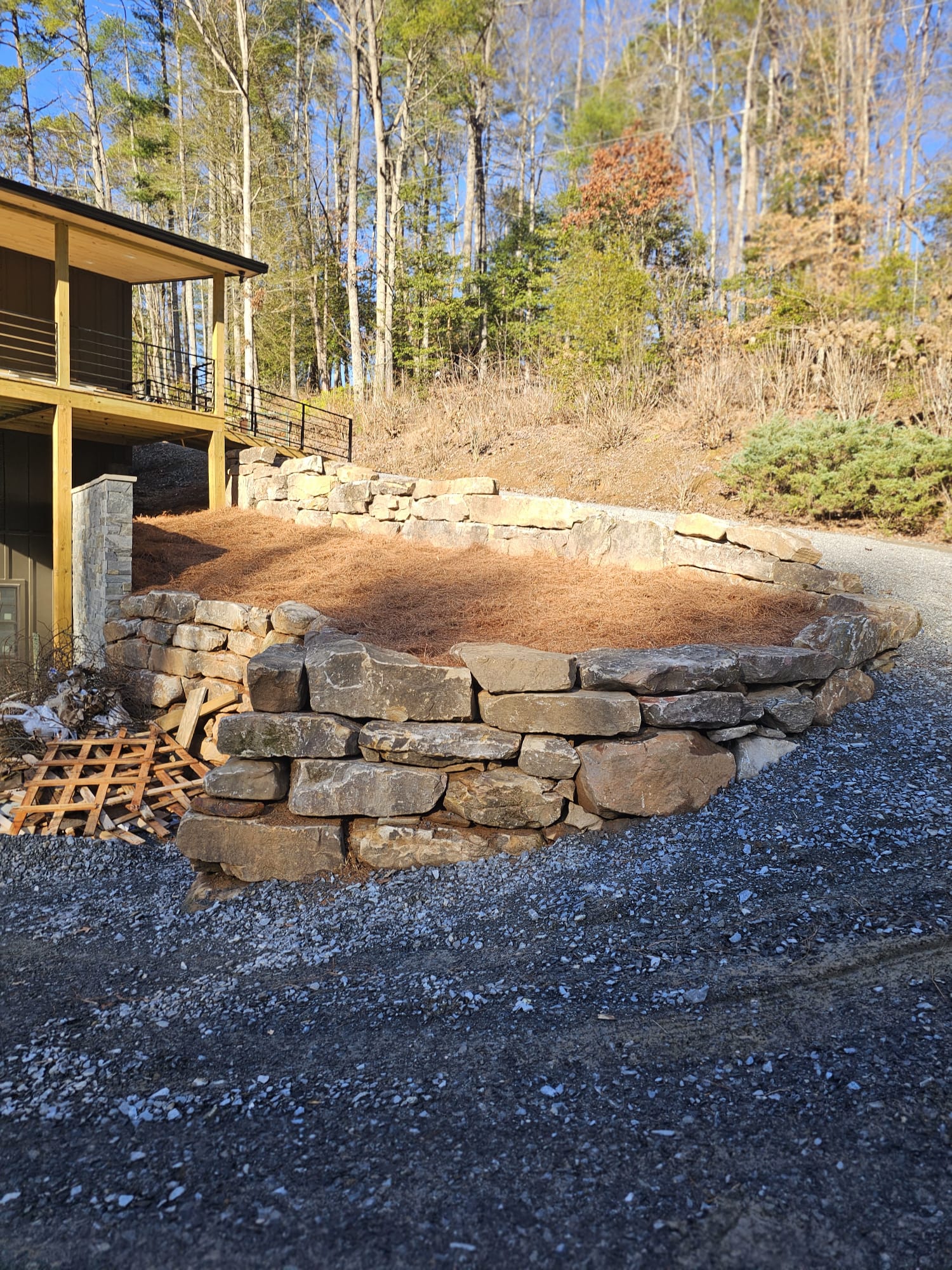
Grading and retaining wall construction in Woodstock after tree removal — the site prepared correctly for hardscape installation over Cherokee County clay.
The correct sequence for a Woodstock project that involves both tree removal and landscape or hardscape installation is: assess, remove, remediate, wait (if needed), then build. The assessment identifies which trees must come out, what removal method is appropriate for each based on what will be built in that zone, and what re-grading or fill work is required afterward. Skipping the assessment and sequencing intuitively is the most expensive mistake Woodstock homeowners make on this type of project — it results in either a removal method that prevents the intended hardscape, or a hardscape installation that fails because the soil condition wasn’t properly prepared.
If your Woodstock project includes a retaining wall, a patio, a new planting bed layout, or significant lawn re-establishment, tree removal planning should be the first item on the scope — not the last. The decisions made at that stage cascade into every other scope item. A contractor who doesn’t ask about existing trees or recent removals before designing your landscape project hasn’t mapped the full picture of what your site requires.
Kaizen Scapes proudly serves homeowners across Canton, GA, Woodstock, GA, and the surrounding North Georgia communities including Holly Springs, Ball Ground, Acworth, Kennesaw, Marietta, Alpharetta, Milton, Roswell, Cumming, Johns Creek, and East Cobb. If you’re looking for hardscaping and landscaping craftsmanship within 35 miles of Canton or Woodstock, our team is ready to transform your outdoor space.
Whether you’re in Canton, Woodstock, Alpharetta, Milton, or anywhere across Cherokee County and the greater North Atlanta suburbs, Kaizen Scapes brings the same relentless standard to every project. We don’t do cookie-cutter. We do custom — built to last.
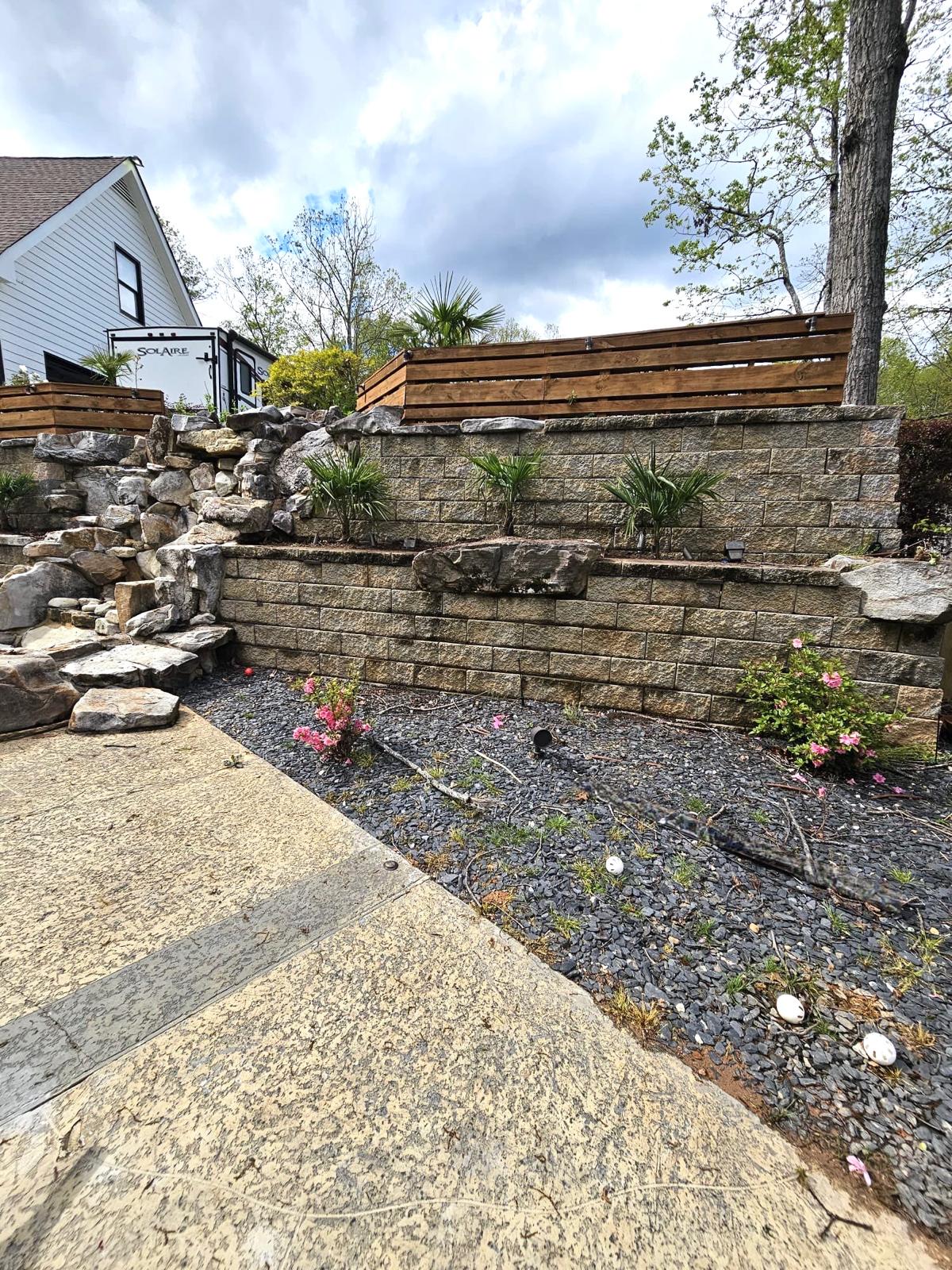
A completed Woodstock site — tree removal, re-grading, and retaining wall construction sequenced correctly for a stable, buildable landscape.
We assess the full site before any scope is set. Free evaluations across Woodstock, Canton, and all of Cherokee County.
Kaizen Scapes is based in Canton, Georgia and serves the greater North Atlanta region within 35 miles: