

A retaining wall that looked solid when it was built rarely announces its failure all at once. In Canton, Georgia, the more common story is a wall that passes the eye test for eight or nine years — then begins showing signs that something is quietly wrong underneath. By the time most homeowners call us, the problem has been developing for two or three seasons. Understanding why walls fail here, and what repair actually entails, saves you from patching symptoms rather than solving the cause.
Cherokee County’s soil profile is the central variable in almost every retaining wall failure we diagnose. North Georgia red clay expands dramatically when wet and contracts when dry, cycling through lateral pressure swings that manufactured block systems and mortar joints weren’t designed to absorb indefinitely. Add ten-plus years of freeze-thaw cycles, root intrusion from mature hardwoods, and — most critically — drainage systems that have silted up or were never installed correctly, and you have the conditions that produce most of the failing walls we’re called to assess in Canton.
The Failure Mechanisms
Most homeowners interpret wall movement as a structural problem with the wall itself. Sometimes that’s true. More often, the wall is a symptom and the drainage system — or lack of one — is the actual problem. Here is how the failure progression typically works on Canton residential properties:
Water infiltrates the backfill zone behind the wall. On properties with gravel drainage aggregate and functioning perforated pipe, that water moves through and exits at the base. On properties where the drainage layer has silted in, where no drainage was installed at all, or where the exit point has become blocked by sediment, water builds up in the soil column behind the wall face. That accumulated water weight — called hydrostatic pressure — adds lateral force to the already significant earth pressure the wall was designed to resist. Segmental block walls are not waterproof. The pressure finds paths through the joints, accelerating erosion of the fines in the backfill and beginning the cycle of movement.
“In Canton, GA, we find that roughly 70% of retaining wall failures have a correctable drainage component. The wall didn’t fail — the drainage failed the wall.”
Once movement begins — even minor tipping or bulging at the face — the interlock between block courses degrades. Block walls rely on the tight contact between units to distribute load across the face. When a section begins to tip forward, that contact loosens, concentrating stress on fewer blocks. The rate of movement typically accelerates once this starts. A wall that showed a half-inch of lean in spring may show two inches by fall. That is why early diagnosis matters: a wall repaired at the first signs of movement costs a fraction of a wall rebuilt after progressive failure has widened the damage zone.
Signs to Diagnose
Not all wall problems are equal, and the visible signs tell an experienced contractor a great deal about what’s happening underground. Reading the pattern correctly determines whether repair is viable or whether rebuilding is the more economical path.
Homeowners often ask for a repair estimate without realizing that repair almost always requires dismantling the affected section to correct what’s behind the face. This surprises people — but it’s unavoidable. You cannot fix a drainage problem, re-compact a base, or add geogrid reinforcement without removing the wall material above. A contractor who quotes a retaining wall repair in Canton without dismantling is either patching the face (not a repair) or hasn’t evaluated the drainage situation.
A genuine repair sequence for a bowing block wall section in Canton looks like this: excavate and remove the affected block courses, clean and sort the salvageable block, excavate the backfill zone to expose the drainage aggregate or lack thereof, re-grade and compact the base, install or replace the perforated drain pipe with proper outlet, place clean gravel drainage aggregate, rebuild the block courses with geogrid reinforcement at code-required intervals, and backfill with compactable material in lifts. That’s a real repair. It addresses the cause, not just the appearance.
For smaller sections — under 20 linear feet — repair timelines are typically one to two days. Larger repairs or those requiring full drainage system replacement run two to four days depending on site access and the extent of backfill excavation needed. Most block salvaged from a properly dismantled wall can be reused if the blocks are in good condition, which reduces material cost meaningfully on repair jobs.
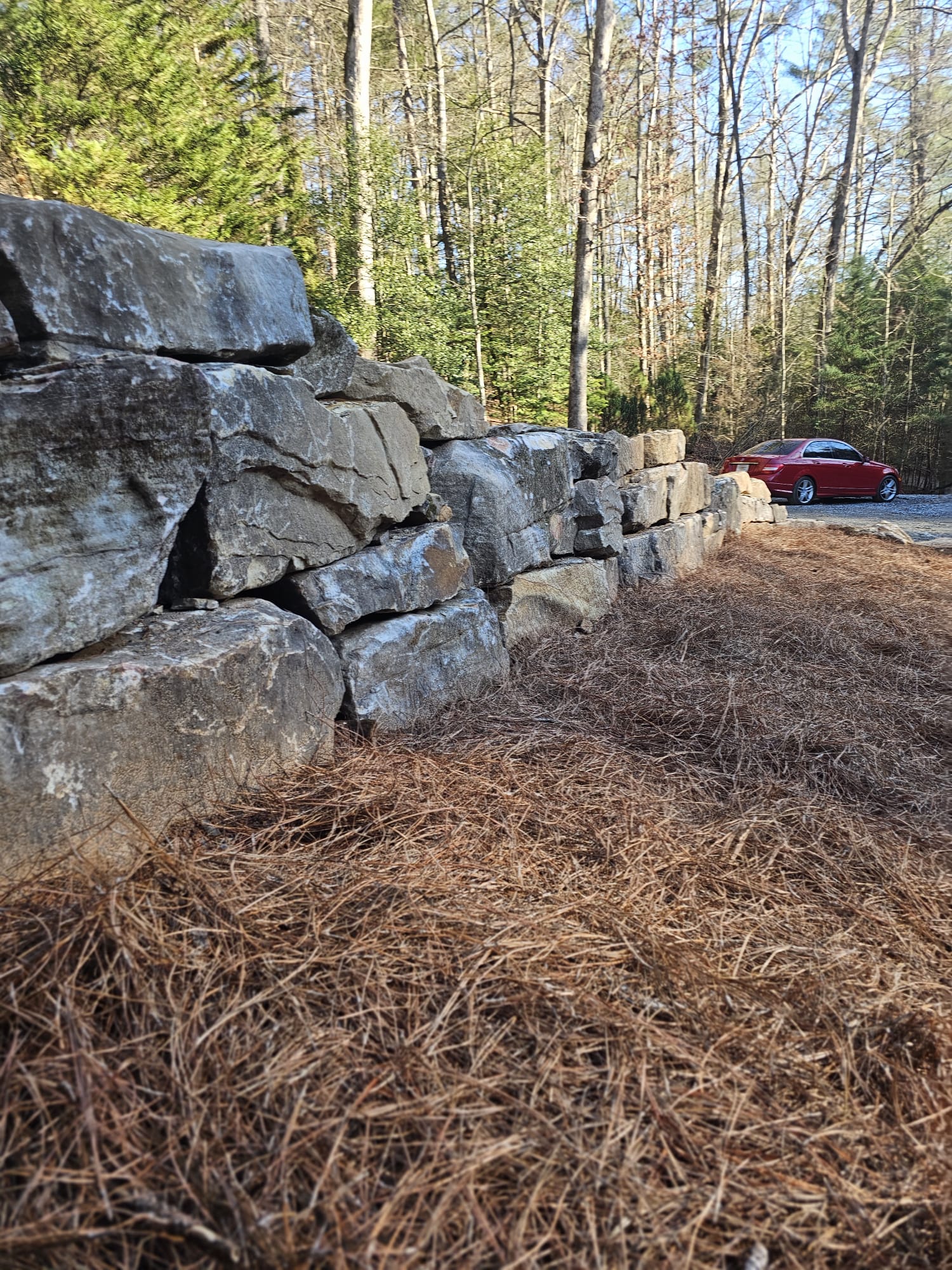
Retaining wall repair in Canton, GA — dismantled section revealing failed drainage aggregate, prior to rebuild with corrected drainage and geogrid reinforcement.
Repair vs. Rebuild
The repair-or-rebuild decision comes down to three variables: the percentage of the wall that has failed, the condition of the original base, and whether the failure is isolated or systemic. A wall where 20% of a run is showing movement but the base is solid and the failure is localized — typically a section where drainage was undersized — is a strong candidate for targeted repair. A wall where 60% is bowing, the original base was never properly compacted, and the drainage system was entirely absent is a rebuild. Throwing repair dollars at a systemically failed wall is the single most common mistake Canton homeowners make — and the reason we see walls that have been “fixed” three times in ten years.
Cost comparison on a typical Canton residential wall: a targeted repair of a 20-foot bowing section runs $2,800 to $5,500 depending on height and drainage work required. A full rebuild of that same section runs $4,500 to $9,000. The repair is cheaper — but only if the cause is actually corrected and the rest of the wall is structurally sound. If adjacent sections are marginal and will fail within two to three years, the incremental cost of rebuilding the full run during the same mobilization is almost always a better investment. We’ll tell you exactly where the line is on your wall during the estimate — including the sections that are currently fine and the sections we’d flag as watch items.
Kaizen Scapes proudly serves homeowners across Canton, GA, Woodstock, GA, and the surrounding North Georgia communities including Holly Springs, Ball Ground, Acworth, Kennesaw, Marietta, Alpharetta, Milton, Roswell, Cumming, Johns Creek, and East Cobb. If you’re looking for hardscaping and landscaping craftsmanship within 35 miles of Canton or Woodstock, our team is ready to transform your outdoor space.
Whether you’re in Canton, Woodstock, Alpharetta, Milton, or anywhere across Cherokee County and the greater North Atlanta suburbs, Kaizen Scapes brings the same relentless standard to every project. We don’t do cookie-cutter. We do custom — built to last.
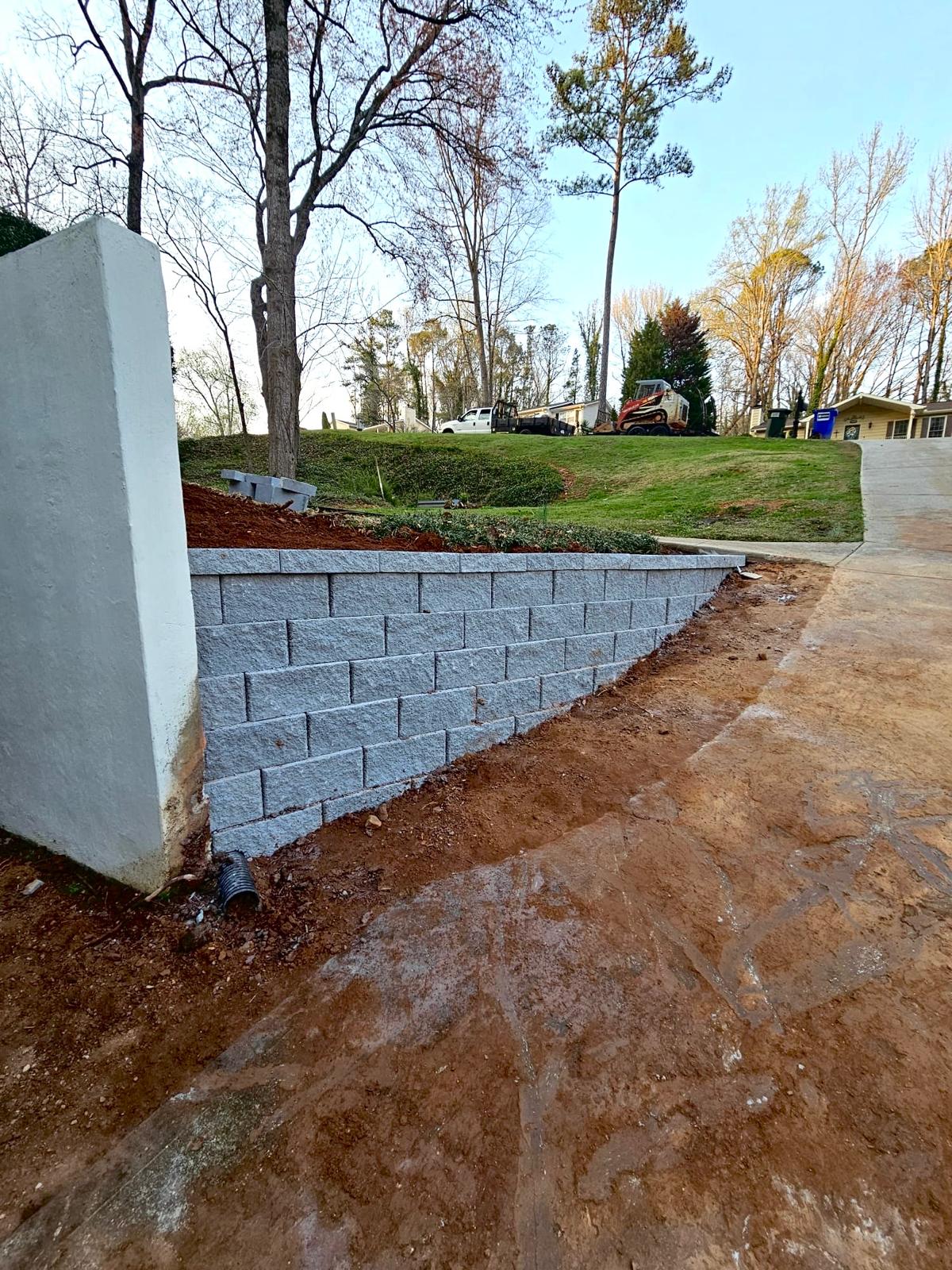
A completed retaining wall repair in Canton — block rebuilt with proper drainage aggregate and geogrid reinforcement, grade restored and stabilized.
We diagnose the cause before we quote the fix. Free retaining wall assessments across Canton and Cherokee County.