

Every retaining wall discussion focuses on the wall — the block, the stone, the height, the face finish. But in Milton, Georgia, where properties sit on the rolling terrain of North Fulton County and experience some of the highest annual rainfall in Metro Atlanta, the drainage system behind the wall is the structure that actually keeps the wall standing. Get the drainage wrong and no amount of engineering in the wall face will prevent failure. Get it right and a modest wall can hold for decades without incident.
Homeowners in Milton frequently call us about walls that are cracking, bowing, or leaning — and in the majority of those calls, the wall itself is structurally intact. The blocks are sound. The geogrid, where it was installed, is functioning. The failure is entirely in the drainage layer behind the face. Water that should be exiting the system is instead accumulating, saturating the clay backfill, expanding against the wall, and producing exactly the forces the drainage was supposed to prevent. Understanding why this happens — and what a properly installed or retrofit drainage system looks like — is the most useful thing a Milton homeowner can know about their retaining wall.
The Physics of Hydrostatic Pressure
Hydrostatic pressure is the force exerted by water that has accumulated in the soil or drainage zone behind a wall. Water weighs approximately 62 pounds per cubic foot. When drainage fails and water begins to accumulate in the backfill zone of a retaining wall, that weight is added directly to the lateral force the wall must resist. For a wall that was designed to hold back dry or moist clay with a known lateral pressure coefficient, a saturated backfill can increase lateral forces by 30 to 50 percent or more — far beyond the wall’s design capacity.
Milton averages approximately 55 inches of rainfall annually, with intense storm events becoming more frequent in recent years. A single heavy rain event — 3 inches in 24 hours — delivers roughly 1,870 gallons of water per 1,000 square feet of drainage area. On a typical Milton residential slope, that volume moving through a failing drainage system in a matter of hours can build hydrostatic pressure almost instantaneously. The walls that fail suddenly after a storm event aren’t failing because of the storm — they’re failing because the drainage system was already compromised and the storm provided the triggering pressure spike.
“The storm gets blamed. But the drainage system had been failing for years. The storm just applied the final force that exceeded what the compromised wall could resist.”
How Drainage Systems Fail
Not all drainage failures look the same, and the correction strategy depends on understanding which failure mode is present. In Milton, we consistently see four patterns:
Retrofitting a drainage system behind an existing retaining wall is one of the most cost-effective interventions available to Milton homeowners with failing walls. In cases where the wall face is structurally sound — no lean, no significant bowing, face blocks intact — adding a drainage system behind the wall can extend the wall’s functional life significantly without a rebuild. The question is whether the retrofit is achievable without dismantling the wall face.
For shorter walls (under 4 feet), a drainage retrofit can sometimes be accomplished from the top of the wall — excavating the backfill vertically, removing the contaminated material, installing filter fabric and clean aggregate with a perforated pipe at the base of the excavation, and backfilling in compacted lifts. This avoids touching the wall face entirely and is significantly less expensive than a partial rebuild.
For taller walls or situations where the pipe outlet needs to be established from below, the work requires dismantling the lower courses of the wall face to install the drainage pipe at the correct elevation relative to the footer course, then rebuilding those courses. This is more invasive but still far less expensive than rebuilding the full wall. On a typical 40-foot run with a drainage retrofit plus lower course rebuild, expect costs in the $3,500 to $7,500 range — versus $10,000 to $18,000 for a full wall rebuild if the drainage failure is allowed to continue until the wall fails structurally.
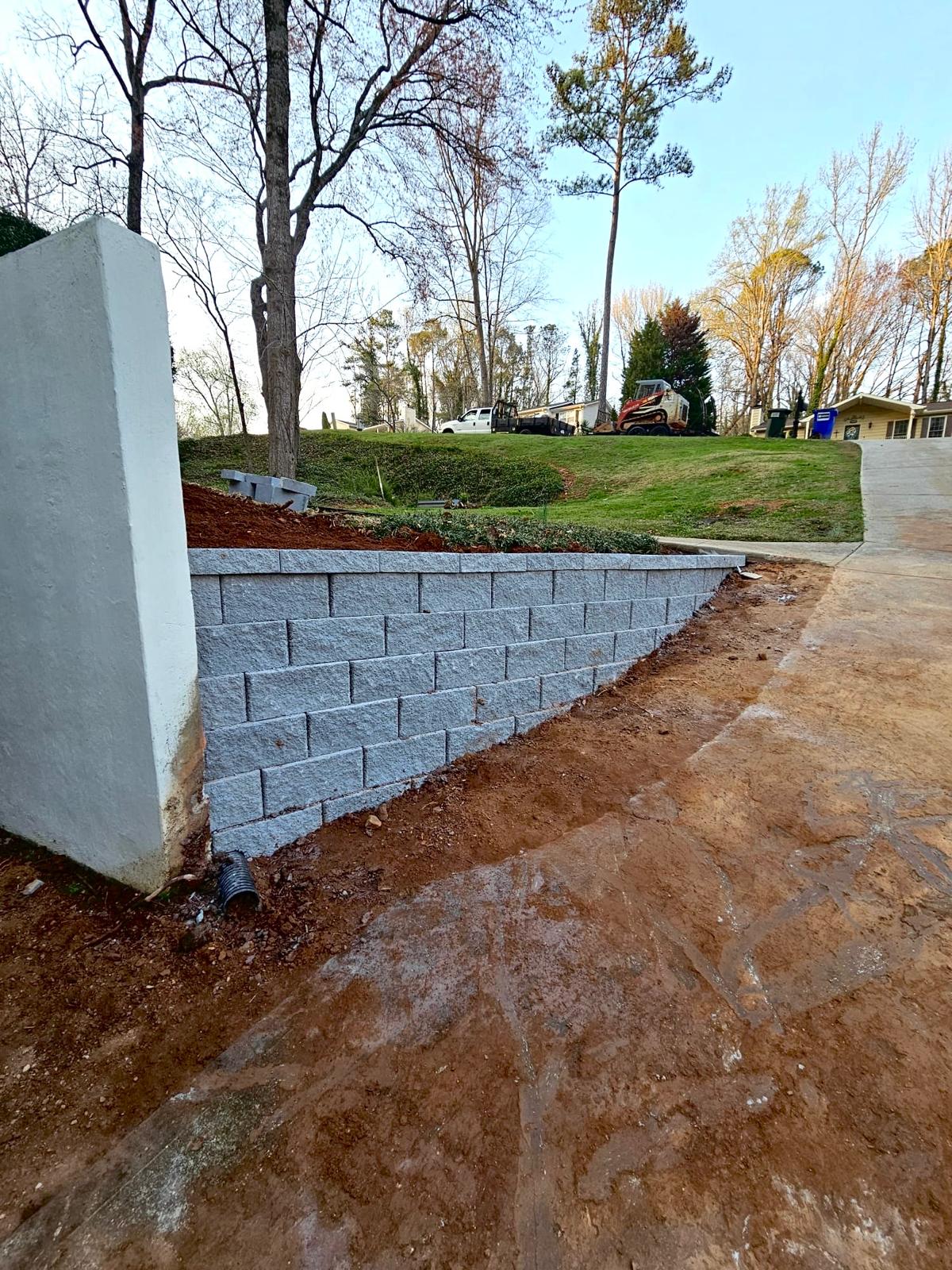
Retaining wall drainage work in Milton, GA — filter fabric and clean drainage aggregate installed behind the wall face, perforated pipe set to proper grade with daylight outlet.
What Proper Drainage Design Includes
When Kaizen Scapes builds or repairs a retaining wall drainage system in Milton, the design addresses every component in the drainage chain. Each component serves a specific function, and omitting any one of them compromises the whole system.
Kaizen Scapes proudly serves homeowners across Canton, GA, Woodstock, GA, and the surrounding North Georgia communities including Holly Springs, Ball Ground, Acworth, Kennesaw, Marietta, Alpharetta, Milton, Roswell, Cumming, Johns Creek, and East Cobb. If you’re looking for hardscaping and landscaping craftsmanship within 35 miles of Canton or Woodstock, our team is ready to transform your outdoor space.
Whether you’re in Canton, Woodstock, Alpharetta, Milton, or anywhere across Cherokee County and the greater North Atlanta suburbs, Kaizen Scapes brings the same relentless standard to every project. We don’t do cookie-cutter. We do custom — built to last.
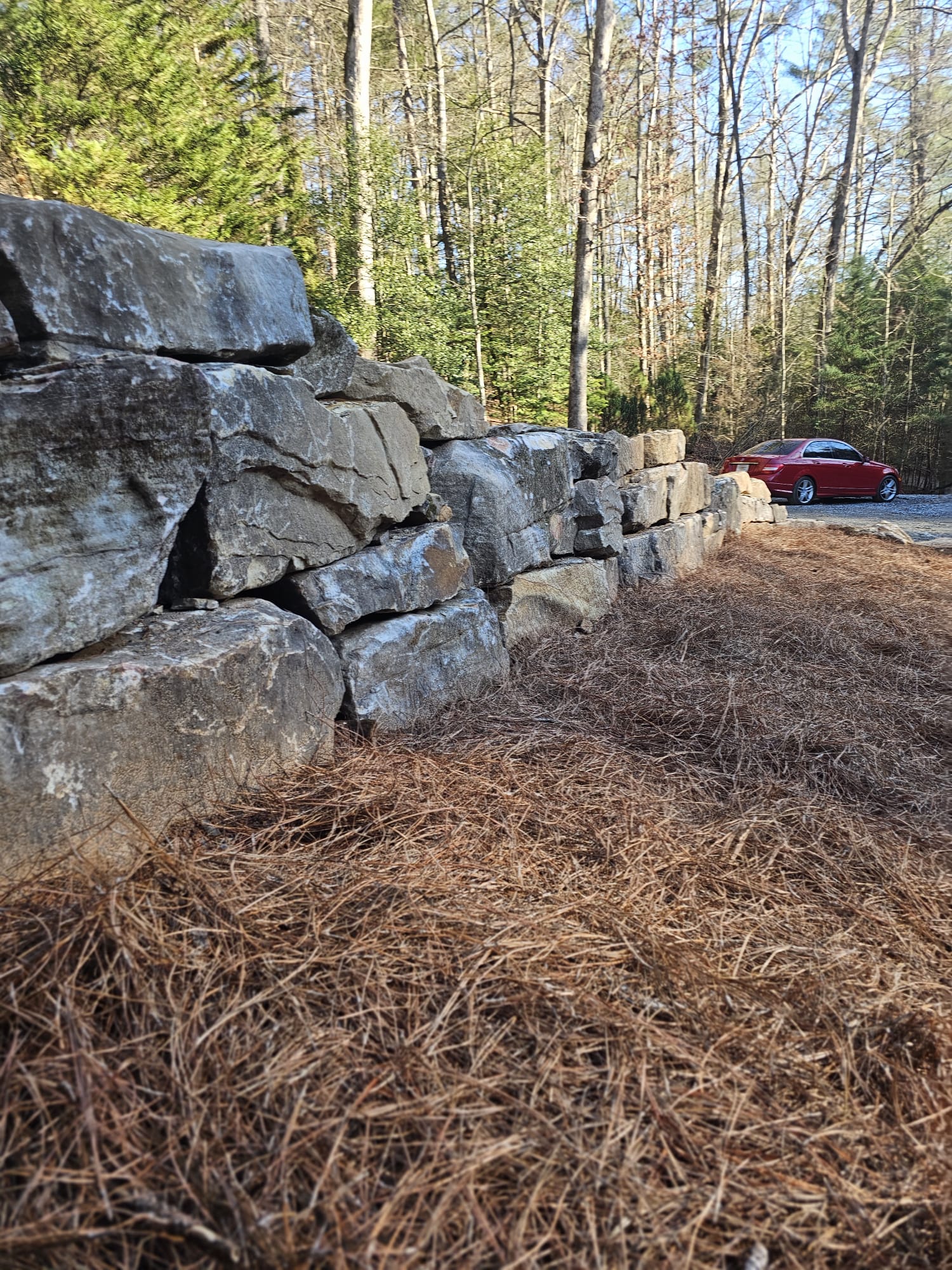
Completed retaining wall drainage restoration in Milton — filter fabric, clean aggregate, and properly graded collection pipe installed before backfill is replaced.
We diagnose drainage problems before they become rebuild bills. Free assessments across Milton and North Fulton County.