

Woodstock’s new construction boom has pushed development into land that was never flat — heavily graded lots in the foothills of Cherokee County where builders clear, cut, and fill to create a buildable pad, hand off the keys, and leave the homeowner with exposed cut banks, filled slopes, and a drainage system that was designed to satisfy minimum code requirements, not to perform for twenty years under seasonal Georgia rainfall.
The grade change problem in Woodstock new construction is not subtle. Many new-build lots in the Route 92 corridor and the newer subdivisions off Arnold Mill Road deliver homes with four to twelve feet of grade change across the rear yard — sometimes more. Without retaining walls, terracing, and proper drainage infrastructure, that grade is actively eroding from the first rain after the builder’s straw and seed cover fails to establish. What looks like a landscaping project is actually a structural and drainage project that needs to be resolved before any landscaping can succeed.
What Builders Leave Behind
Builder grading is engineered to one standard: establish positive drainage away from the foundation and pass the county inspection. It is not engineered to create a usable outdoor environment, stabilize long-term slope performance, or account for the erosion patterns that develop on Cherokee County clay once the disturbed surface is exposed to rainfall. The straw and seed package that builders apply to disturbed slopes has a limited establishment window — typically 60 to 90 days in ideal conditions. In a Woodstock winter or a dry late summer, that window narrows significantly.
What this means for new Woodstock homeowners is that the slope they close on in February may look acceptable in March and look like an active erosion channel by June. Cherokee County’s red clay, once disturbed and exposed, loses four to six inches of surface depth per season of unprotected exposure. By the time a homeowner calls for a retaining wall assessment 12 months after closing, the grade they are working with is not the grade the builder left — it has shifted, eroded, and in some cases created drainage channels that have begun directing water toward the foundation.
“Builder grading passes the inspection. It is not designed to hold a slope in Cherokee County clay through a full erosion season. That distinction costs homeowners months and thousands if they miss it.”
The Stabilization Sequence
Stabilizing a graded new-build lot in Woodstock is a sequencing problem before it is a design problem. The sequence that works — and that delivers a structurally sound, developable outdoor environment — follows the same logic as any engineered earthwork: address the structural hold first, then drainage, then surface development.
Step one is retaining wall design and permitting. In Cherokee County, retaining walls over four feet require a permit and — in most jurisdictions — a stamped engineering plan. The engineering phase is where the actual soil bearing conditions of your specific Woodstock lot are assessed: soil type, subsoil composition, groundwater presence, and slope loading. This is not a catalog selection process — it is a site-specific structural analysis. Walls designed off a catalog without a site assessment fail. We see the evidence regularly on assessments in Woodstock.
Step two is base preparation and drainage infrastructure. A retaining wall without a drainage package is a pressure vessel waiting to fail. Hydrostatic pressure — the weight of saturated soil behind an impermeable wall — is the leading cause of retaining wall failure in Cherokee County. A proper installation includes a perforated drain pipe behind the wall footing, drainage aggregate fill, and filter fabric to prevent soil migration into the drain system. These elements are not optional — they are the structural components that make the wall perform for twenty years rather than five.
The honest cost range for stabilizing a graded new-build lot in Woodstock depends almost entirely on the severity of grade change and the linear footage of retaining wall required. A moderate-slope lot with 4 to 6 feet of grade change and 60 to 80 linear feet of retaining wall typically runs $15,000 to $28,000, including drainage, geogrid, and finish grading. A severe-grade lot with 8 to 12 feet of change, multiple wall tiers, and engineered specifications can reach $35,000 to $45,000 or more.
What homeowners should be aware of is the cost of delay. Every season of unprotected erosion adds regrading costs to the project before the wall can go in. A slope that costs $18,000 to stabilize at rough-grade handoff may cost $24,000 after two seasons of erosion have shifted the grade and require correction before the wall base can be set. The wall itself costs the same. The correction work that precedes it is the avoidable expense.
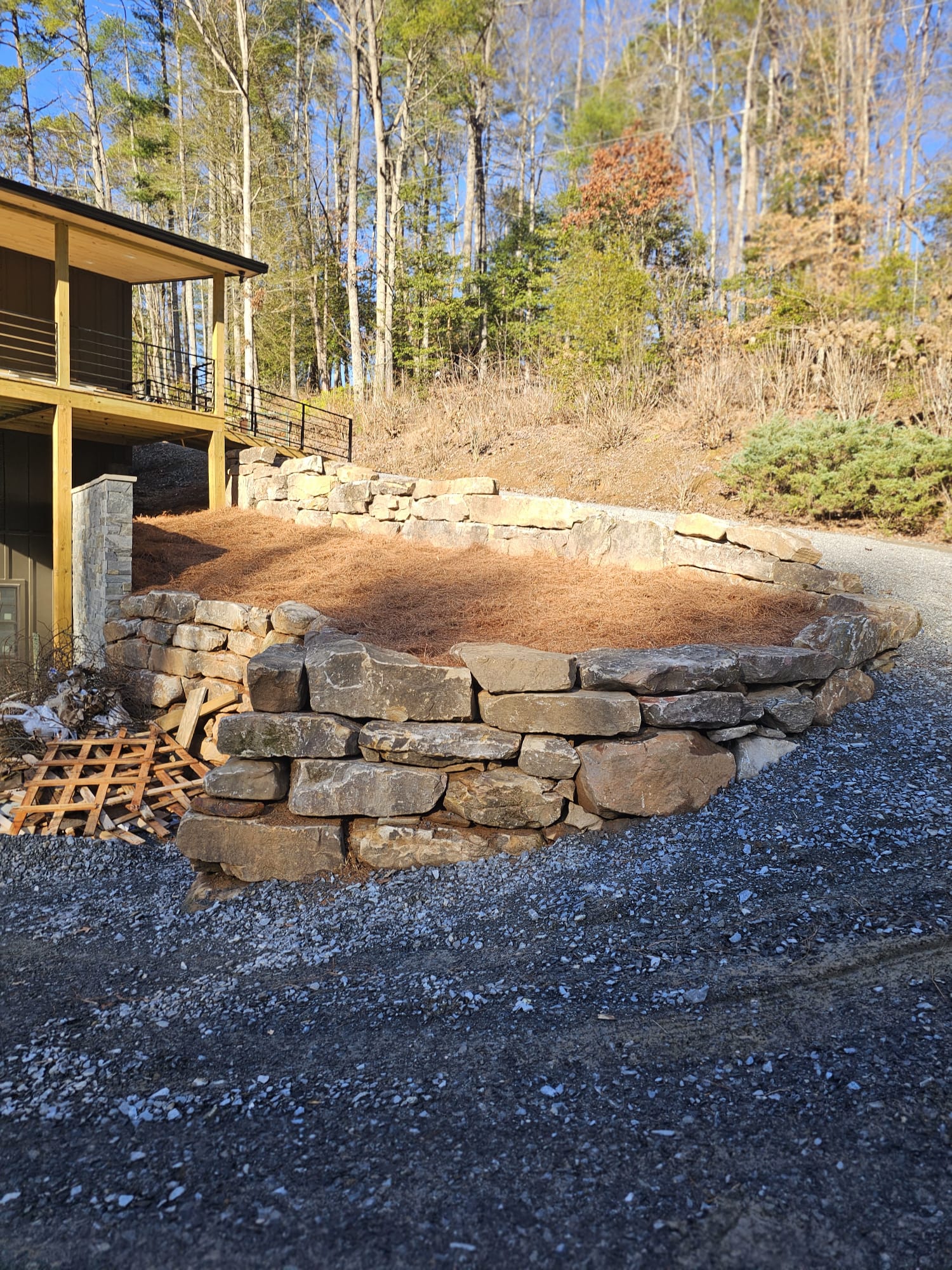
Retaining wall and terracing installation on a new-build Woodstock lot — geogrid reinforced, drainage engineered for Cherokee County clay, grade stabilized before sod.
We assess Woodstock grade change projects with an engineering-first approach. Before we design anything, we look at the actual slope conditions — the soil composition, the drainage patterns that have established since the builder’s grading, and the load conditions that the wall will need to manage. We coordinate the permitting process for walls over four feet and work with Cherokee County’s requirements so the project moves without delays that cost the homeowner more erosion time.
We also do the site work that allows the outdoor space to actually develop after the walls are in. Finish grading, drainage swale establishment, and surface preparation for sod, pavers, or planting beds are part of the scope — not add-ons quoted separately after the wall is done. A retaining wall without a finished outdoor environment behind it is a structural solution to half the problem.
Kaizen Scapes proudly serves homeowners across Canton, GA, Woodstock, GA, and the surrounding North Georgia communities including Holly Springs, Ball Ground, Acworth, Kennesaw, Marietta, Alpharetta, Milton, Roswell, Cumming, Johns Creek, and East Cobb. If you’re looking for hardscaping and landscaping craftsmanship within 35 miles of Canton or Woodstock, our team is ready to transform your outdoor space.
Whether you’re in Canton, Woodstock, Alpharetta, Milton, or anywhere across Cherokee County and the greater North Atlanta suburbs, Kaizen Scapes brings the same relentless standard to every project. We don’t do cookie-cutter. We do custom — built to last.

Finished outdoor living space on a stabilized new-build lot in Woodstock — retaining walls complete, grade development underway, outdoor fireplace anchoring the patio.
Free site assessment for grade change and retaining wall projects across Woodstock and Cherokee County. The sooner we assess, the less erosion correction costs you.
Kaizen Scapes is based in Canton, Georgia and serves the greater North Atlanta region within 35 miles: