

A retaining wall that moves in its first two years isn’t settling. It’s failing. And in Canton, GA, where Cherokee County’s clay-heavy soils hold water for days after a rain event, that failure almost always traces back to the same three fixable decisions that were made wrong before the first block was ever placed.
The homeowners who call us to rebuild walls that were just installed two or three years ago are not dealing with bad luck. They are dealing with a quote that didn’t include a drainage plan, a footing that wasn’t engineered for the load, or a material that was chosen for its price rather than its structural rating. Any one of those three decisions made wrong is enough to produce a wall that will need to come down. All three made wrong at once is just a matter of how quickly it shows.
Why It Happens
The first is drainage. Georgia clay absorbs water slowly and holds it — which means the soil behind a retaining wall stays saturated for extended periods after a storm. Hydrostatic pressure builds behind a wall that has no drainage outlet, and a wall engineered to hold the weight of the earth above it is not simultaneously engineered to resist that pressure. Something moves. Once movement starts, it accelerates — a wall that leans two degrees this year will lean four next year.
The second decision is footing depth and base preparation. A retaining wall built on uncompacted, shallow, or unstable ground will settle unevenly as that ground moves beneath it. Cherokee County’s clay soils are particularly susceptible to volumetric change with moisture — they expand when wet, contract when dry. A footing that isn’t excavated to stable bearing depth, with proper compaction and base aggregate, will track every moisture cycle in the soil. Over time, that tracking becomes visible lean, joint separation, and eventually wall failure.
“The wall doesn’t fail at year three because of bad weather. It fails because of a decision made on day one — before a single block was placed.”
The third is material selection. Decorative landscape block and structural segmental retaining wall block look nearly identical on a job site or in a product photo. Under lateral load, they perform completely differently. Decorative block is rated for low-height borders and ornamental applications. Structural SRW block is engineered for specific height ranges, load conditions, and drainage configurations. The right material for a twelve-foot slope in Cherokee County and the right material for a six-inch garden border are not the same product — but they are routinely quoted as though they are.
What Good Looks Like
Every retaining wall project we build in Canton starts before the quote. The site assessment comes first: slope angle, soil type, drainage patterns uphill and downhill, the load above the wall, and the proximity to structures. These variables determine the footing requirement, the drainage system behind the wall, whether geogrid reinforcement is needed, and which material system fits the application. Skip any one of those assessments and the quote that follows is incomplete — regardless of the number on the page.
For Cherokee County properties with significant grade change — and many Canton and Woodstock lots have exactly that — a tiered retaining system that steps the grade into two or three shorter walls typically outperforms a single tall wall on every metric: structural performance, drainage management, long-term maintenance, and visual integration with the landscape. The material cost is higher. The performance advantage is measurable across the life of the installation.
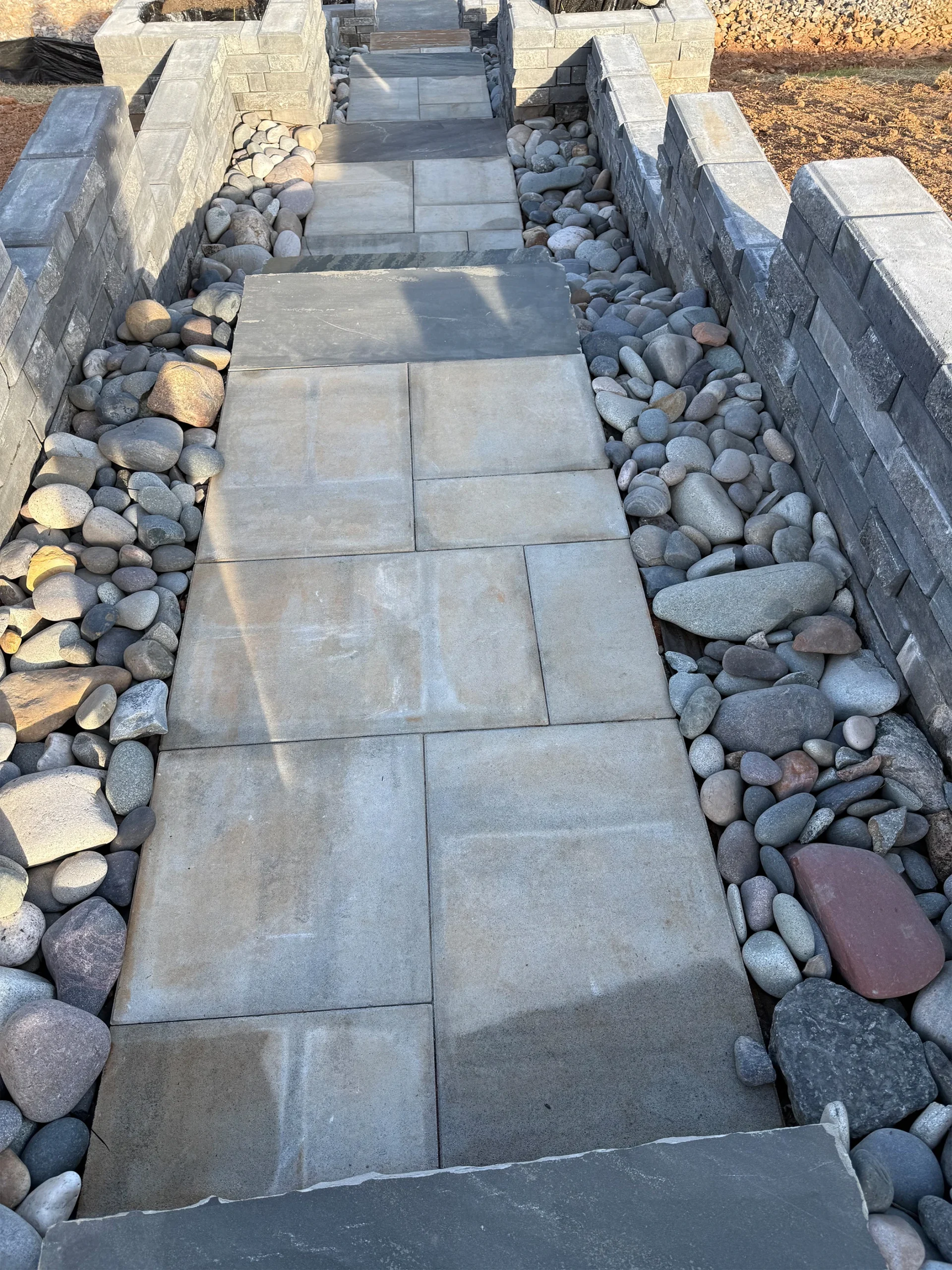
An engineered retaining wall system in Canton — drainage behind every course, footing depth set by soil conditions, material selected for the actual structural load.
Retaining wall projects in Cherokee County typically range from $6,000 for a straightforward single-tier segmental wall to $28,000 or more for engineered multi-tier systems with natural stone, geogrid, and full drainage infrastructure. The range is wide because the variables are wide: wall height, length, slope conditions, soil type, material selection, and drainage complexity all affect the final number.
A quote that doesn’t account for those variables isn’t a lower-cost option — it’s a quote for a different, shorter-lived project. The wall that lasts twenty years and the wall that needs rebuilding in three often look identical in the first year after installation. The difference is in the drainage pipe buried behind it, the base depth it sits on, and the structural rating of the blocks it’s built from. Those are not visible from the street. They are visible in the contractor’s site assessment process and in the line items on their quote.
When homeowners in Canton are comparing three retaining wall quotes, the lowest number is the one that deserves the most scrutiny — not the most consideration. Ask what drainage system is included. Ask what the footing specification is. Ask what block system is being used and whether it’s rated for the wall height being quoted. A contractor who can answer those questions with specifics is quoting a different wall than a contractor who can’t. The price difference between them is real. So is the performance difference.
Why Kaizen Scapes
The most common question we hear when homeowners are evaluating retaining wall quotes in Canton is why ours is higher than others. Because the others are quoting a different wall. A wall without a drainage plan. A wall with a shallow footing. A wall built from decorative block where structural SRW belongs. We’re quoting the wall that will still be level, intact, and maintenance-free when you’re ready to sell your home. That’s a materially different project, and it costs a materially different amount.
Kaizen Scapes proudly serves homeowners across Canton, GA, Woodstock, GA, and the surrounding North Georgia communities including Holly Springs, Ball Ground, Acworth, Kennesaw, Marietta, Alpharetta, Milton, Roswell, Cumming, Johns Creek, and East Cobb. If you’re looking for hardscaping craftsmanship within 35 miles of Canton or Woodstock, our team is ready to transform your outdoor space.
Whether you’re in Canton, Woodstock, Alpharetta, Milton, or anywhere across Cherokee County and the greater North Atlanta suburbs, Kaizen Scapes brings the same relentless standard to every project. We don’t do cookie-cutter. We do custom — built to last. Explore our full hardscaping services or schedule a free site evaluation today.
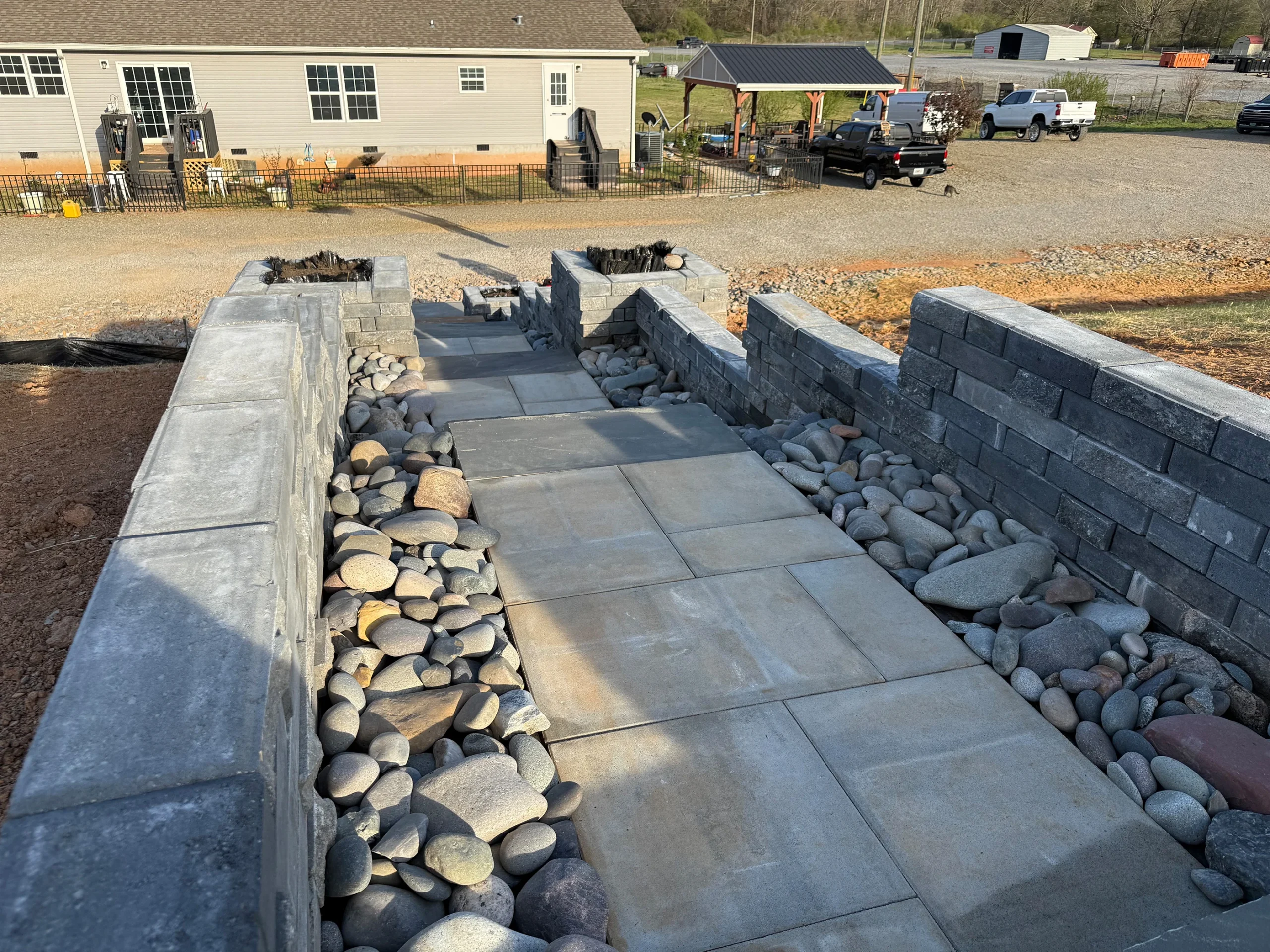
The finished wall — engineered for this slope, built for Cherokee County soil conditions, designed to hold without a repair call for decades.
Free retaining wall assessments across Canton, Woodstock, and all of Cherokee County. We look at drainage, soil, and load before quoting anything.
Kaizen Scapes is based in Canton, Georgia and serves the greater North Atlanta region within 35 miles: