

A natural stone pool deck in Roswell is not an aesthetic upgrade — it is a performance decision. When Georgia summer surface temperatures hit the mid-90s and a concrete pool deck pushes 120–130°F underfoot, the material around your pool stops being decorative and starts being a liability. Natural stone changes that equation in ways that are measurable, lasting, and — in Roswell’s luxury real estate market — increasingly expected.
The conversation around pool deck materials almost always starts with appearance and ends with cost, which means most homeowners never get to the part that actually matters: what the material does at year five, year ten, and year fifteen. Concrete looks acceptable at year one. Natural stone improves with age. That gap is where the real value argument lives — and it is an argument that Roswell’s property market rewards.
The Material Options
Travertine is the dominant natural stone pool deck choice in the Southeast for a reason that has nothing to do with taste: its thermal mass and porous surface structure keep it 15 to 20 degrees cooler than poured concrete under direct Georgia sun. The same porosity that makes travertine feel comfortable barefoot also means it requires filling at installation to prevent pooling — a step some contractors skip, which becomes obvious within two seasons. For Roswell properties with south-facing pool environments, travertine is the most functional choice in the natural stone category. Expect $18–$30 per square foot installed, depending on slab thickness and pattern complexity.
Bluestone delivers the formal, refined aesthetic that suits Roswell’s architectural vernacular — particularly on properties with traditional or transitional architecture where the clean cleft surface reads as deliberate craftsmanship rather than rustic material. Thermal performance sits between travertine and concrete: cooler than poured or brushed concrete, but warmer than travertine’s filled surface under sustained sun exposure. Bluestone pools are maintenance-conscious investments — the material seals well, holds its color exceptionally over time, and photographs with a depth that concrete simply cannot replicate. Installed cost runs $22–$38 per square foot for standard cleft or thermal-finish bluestone.
“Natural stone doesn’t just look better at year ten — it performs better. Concrete cracks, spalls, and retains heat. Stone weathers into something more refined than the day it was installed.”
Crab orchard sandstone — quarried in Tennessee — is the warm-toned, earth-colored option that bridges natural and organic aesthetics with genuine hardscape durability. Its slip resistance in wet conditions is among the highest of any natural stone pool deck material, which matters on pool surrounds where safety and surface texture are functional requirements. The orange-brown-grey palette pairs well with wooded Roswell lots and properties with warm-tone exteriors. Installed cost: $16–$28 per square foot for standard irregular flagging.
Granite pool coping and deck sections are the highest-durability natural stone option — and the heaviest. Granite resists staining, chlorine exposure, and freeze-thaw cycles at a level no other natural stone matches, making it the correct choice for pool surrounds where chemical exposure and long-term maintenance reduction are the priority. The tradeoff is thermal: granite heats up and retains heat closer to concrete than travertine does. Most Roswell projects use granite selectively — as coping, step treads, or feature sections — rather than as primary deck field material. Coping-only installation runs $35–$70 per linear foot.
Seal or Don’t Seal
The seal-or-don’t-seal question depends entirely on the stone type and the pool chemistry environment, not on a blanket recommendation. Travertine filled with grout or epoxy requires sealing annually in pool environments — the sealer protects the fill material from chlorine degradation and prevents the pitting that makes unfilled, unsealed travertine look neglected within three to four years. Skip the annual seal on travertine and you’re not looking at a maintenance issue — you’re looking at a replacement timeline.
Bluestone and crab orchard sandstone benefit from sealing but are not as immediately punished by a missed cycle. A penetrating sealer applied every two to three years maintains color saturation and prevents chlorine staining on flagging joints. Granite — particularly thermal-finish or flamed-finish granite — is the most maintenance-forgiving natural stone in a pool environment. Its low porosity means sealing is optional on coping sections and becomes a preference rather than a structural maintenance requirement.
A well-installed, properly sealed natural stone pool deck at year ten in Roswell looks like a maturing investment. Travertine develops a subtle patina that reads as aged luxury — the same effect that makes European stone courtyards look better at fifty years than they did at five. Bluestone holds its slate-grey tones with a depth that photographs better under landscape lighting than it does in daylight. Crab orchard sandstone weathers toward a quieter, more refined version of its original palette.
Compare that trajectory to a brushed concrete pool deck at year ten: surface cracks from seasonal temperature cycling, spalling at the aggregate level from freeze-thaw and chemical exposure, and a maintenance cost profile that includes crack injection, resurfacing, or full replacement on a ten-to-fifteen year cycle. The material cost premium of natural stone over concrete is typically recovered in the reduced maintenance and replacement cycle alone — before the resale premium is factored in.
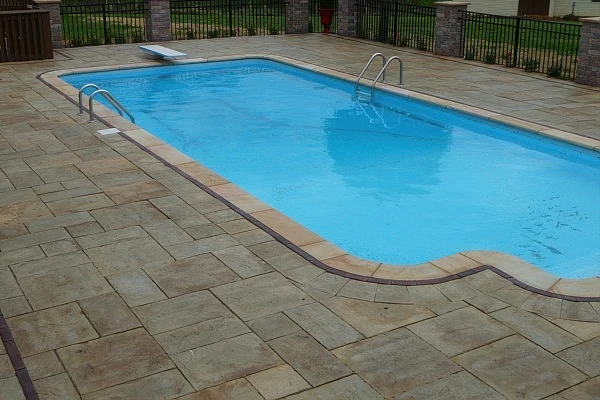
Natural stone pool deck work in the North Atlanta area — material selected and installed to perform in Georgia’s climate conditions.
Roswell sits in a real estate market where the outdoor environment is a purchase driver, not an afterthought. Buyers at the $700K–$1.5M price points that characterize Roswell’s residential market have seen natural stone pool environments — they know what travertine looks like versus brushed concrete, and the visual delta at the pool surround reads in listing photography before a buyer ever visits the property. A natural stone pool deck doesn’t just add value at resale — it compresses days on market by qualifying the property for buyers who would otherwise pass on the listing.
The cost premium for natural stone over concrete in a Roswell pool deck context typically ranges from $8,000 to $22,000 on a standard pool surround — a range that depends on pool size, stone selection, coping detail, and drainage infrastructure. That premium, amortized against a fifteen-to-twenty year material life versus a concrete deck’s ten-to-twelve year cycle before meaningful resurfacing, is a different financial argument than the upfront number suggests.
Kaizen Scapes proudly serves homeowners across Canton, GA, Woodstock, GA, and the surrounding North Georgia communities including Holly Springs, Ball Ground, Acworth, Kennesaw, Marietta, Alpharetta, Milton, Roswell, Cumming, Johns Creek, and East Cobb. If you’re looking for hardscaping and landscaping craftsmanship within 35 miles of Canton or Woodstock, our team is ready to transform your outdoor space.
Whether you’re in Canton, Woodstock, Alpharetta, Milton, or anywhere across Cherokee County and the greater North Atlanta suburbs, Kaizen Scapes brings the same relentless standard to every project. We don’t do cookie-cutter. We do custom — built to last.

Landscape lighting integrated with a pool hardscape environment — how the investment reads after dark in Roswell.
We’ll assess your pool surround, recommend the right stone for your conditions, and give you an honest number. Free estimates across Roswell and all of North Atlanta.
Kaizen Scapes is based in Canton, Georgia and serves the greater North Atlanta region within 35 miles: