

The most expensive pool deck mistake in Cumming, GA is rarely the material choice. It is the drainage decision — or the absence of one. Forsyth County’s clay-dominant soil profile does not absorb water efficiently, and a pool deck that routes water toward its own perimeter without a defined outlet path is creating the conditions for soil erosion, coping edge undercutting, and deck surface heave that will be visible within a few seasons. These are not low-probability outcomes. They are what happens when drainage is treated as an afterthought rather than an engineering discipline.
What makes this particularly costly for Cumming homeowners is that drainage failures in pool deck applications are almost always invisible until they cause damage that requires partial or complete deck replacement. The water is moving underground, carrying soil particles, creating voids beneath the surface substrate. The deck looks fine until one section begins to sink, or the coping pulls away from the pool shell, or a crack traces directly back to a drainage void that has been expanding for three years. By the time the symptom appears, the repair cost frequently exceeds what a proper drainage system would have cost at installation.
Why Cumming Is Different
The soil profile across Cumming and central Forsyth County is predominantly Cecil clay loam — a red clay-dominant soil with a saturated hydraulic conductivity so low that water cannot percolate into the ground quickly enough to manage even a moderate rain event. In practical terms: when a pool deck sheds water to its perimeter, that water has nowhere to go except laterally across the soil surface or vertically under the deck substrate if the edge restraint is compromised. Both paths lead to erosion and base destabilization.
The problem compounds in Forsyth County because the terrain varies significantly. Properties in the Lake Lanier watershed area have elevation relief that creates significant runoff velocity — meaning a pool deck that routes water toward a downhill slope can generate erosion forces that a flat-property system would never experience. The drainage specification for a pool deck on a Cumming lot with 8 feet of grade relief is fundamentally different from the same square footage on a flat lot in the same subdivision. A contractor who quotes the same drainage approach for both sites has not site-assessed the drainage problem.
“Drainage must be designed before the material is selected. The surface choice is aesthetic; the drainage system is structural. Get the order wrong and you pay for it twice.”
Drainage System Comparison
Channel drains — linear drainage runs installed flush with the deck surface, typically at the pool coping line or at a perpendicular run across the deck field — are the most common drainage specification for residential pool decks in Cumming. A properly specified channel drain collects water at the lowest elevation of the deck surface slope and routes it to a defined outlet — a catch basin, drywell, or piped discharge to a downhill outlet point. The grate profile must be rated for pedestrian traffic and specified in a material compatible with pool chemicals; stainless steel grates are the standard for pool environments. The channel body and connecting pipe must be sized for the watershed area of the deck — a common undersizing error that results in the drain surcharging during heavy rain events.
Trench drains function similarly to channel drains but are designed for higher-volume applications — typically at the transition from the pool deck to an adjacent structure, driveway, or at the base of a grade change where surface runoff from above the deck adds to the pool deck’s own drainage load. For Cumming properties where the pool deck sits downhill of a lawn or landscape area, a trench drain at the upper deck perimeter is the correct specification — it intercepts inbound surface runoff before it reaches the deck zone rather than attempting to manage it after it arrives. This is a distinction that many pool deck contractors miss because it requires understanding the drainage context beyond the deck perimeter, not just within it.
Perimeter drain systems — a continuous drainage run at the deck edge, typically at the coping line — address the specific failure mode of water infiltrating beneath the deck surface through the joint between coping and deck field. In Forsyth County’s clay soil conditions, this infiltration path is the primary driver of coping edge erosion and sub-base undercutting. A properly detailed perimeter drain at the coping line, with filter fabric, aggregate fill, and a piped outlet, intercepts this water before it contacts the sub-base. It is the most underspecified drainage element in residential pool deck construction and one of the most consequential omissions when left out.
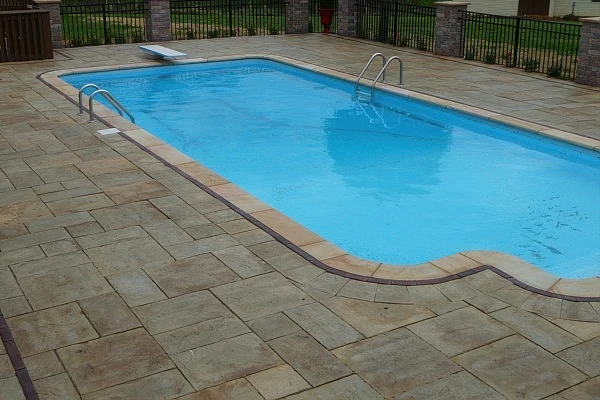
A Kaizen Scapes pool deck drainage installation in the Cumming area — channel drain at coping line, perimeter drain at edge, outlet piped to a defined discharge point.
The sequence matters in Cumming pool deck projects because the drainage system determines the sub-base specification, which determines the surface elevation, which determines the coping height relationship, which determines the accessible transition at the pool entry — all of which must be resolved before a single paver, stone, or tile is selected. If a homeowner selects travertine and then asks about drainage, the travertine choice may need to be revisited — because travertine’s thinner profile with a dry-set installation requires a different sub-base depth than a wet-set large-format tile, and that sub-base depth may change the finished elevation relative to the pool coping in ways that affect the drainage slope.
This is why the contractors who do pool deck drainage well always start with the drainage assessment. They walk the site, note the grade, identify inbound runoff sources, and design the drainage system before the material conversation begins. The homeowners who end up with drainage failures are almost always the ones who chose the material first — because they were working with a contractor who led with the catalog instead of the site.
Why Kaizen Scapes
Our Cumming pool deck proposals always include a drainage design section that specifies: drain type and placement, outlet pipe size and route, outlet termination point, and sub-base specification that responds to Forsyth County’s clay soil conditions. We don’t leave drainage to the installation phase. By the time we quote it, the drainage system is already designed — because we walked the site and the design happened before the number did.
Kaizen Scapes proudly serves homeowners across Canton, GA, Woodstock, GA, and the surrounding North Georgia communities including Holly Springs, Ball Ground, Acworth, Kennesaw, Marietta, Alpharetta, Milton, Roswell, Cumming, Johns Creek, and East Cobb. If you’re looking for hardscaping and landscaping craftsmanship within 35 miles of Canton or Woodstock, our team is ready to transform your outdoor space.
Whether you’re in Canton, Woodstock, Alpharetta, Milton, or anywhere across Cherokee County and the greater North Atlanta suburbs, Kaizen Scapes brings the same relentless standard to every project. We don’t do cookie-cutter. We do custom — built to last.
Call (470) 535-0252 to schedule a Cumming pool deck drainage consultation, or request a free estimate online. We’ll assess your site and give you a drainage design before any material decision is made.
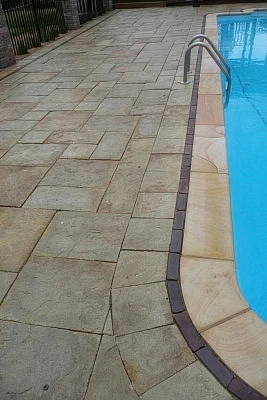
A completed pool deck in the Cumming area — drainage engineered before material selection, channel drain and perimeter system installed for Forsyth County clay soil conditions.
Free site evaluations and drainage assessments across Cumming, Johns Creek, Suwanee, and all of Forsyth County.
Kaizen Scapes is based in Canton, Georgia and serves the greater North Atlanta region within 35 miles: