

A privacy wall that does only one thing — block a sightline — is a missed opportunity. A raised masonry planter wall does everything a privacy wall does, and then it does more: it adds growing depth for plant material, elevates plantings to eye level for layered screening, creates definition between outdoor zones, and contributes seasonal color and texture that a solid wall alone can never provide.
In Alpharetta, where outdoor living spaces are a serious design investment and neighborhoods tend to have HOA architectural standards worth respecting, the planter wall approach solves the privacy problem in a way that reads as a garden feature rather than a fortification. It’s the privacy solution that the neighborhood architectural review committee tends to approve without friction — because it looks like landscaping done well, not a boundary dispute made permanent.
The Mechanics of Privacy
The privacy arithmetic behind a planter wall is straightforward and powerful. A masonry planter wall at 30 to 36 inches raises the base elevation of whatever grows in it by 30 to 36 inches. An arborvitae planted at grade in Alpharetta’s clay-heavy soil takes three to four years to reach 6 feet. The same arborvitae planted in a raised masonry planter with properly amended, well-draining soil mix reaches 6 feet of visible height (wall plus plant) within one to two growing seasons — because the plant starts from an elevated base and grows in conditions better suited to its root system than compacted native soil.
Effective privacy height = wall height + plant height above the wall rim. A 36-inch planter wall with arborvitae that grows to 4 feet above the rim delivers 7 feet of total privacy height — well above the standing sightline — while the masonry structure itself stays under 3 feet and avoids height restriction triggers in most Alpharetta HOA covenants. This is how a planter wall achieves standing-height privacy with a structure that reads as a garden feature, not a privacy barrier.
“The best privacy solution on an Alpharetta patio is the one that your neighbors admire rather than object to. A well-designed planter wall with thoughtful plant selection achieves both outcomes simultaneously.”
The soil volume inside the planter is the variable that most directly determines plant health and growth rate. Most ornamental planting in residential landscapes happens in beds with 6 to 12 inches of amended soil over compacted subgrade. A masonry planter wall at 30 to 36 inches typically contains 24 to 30 inches of planting depth — two to three times the soil volume available in a grade-level bed. For screening plants like arborvitae, skip laurel, or holly, that additional root volume translates directly into faster establishment, more vigorous growth, and better drought tolerance during Alpharetta’s summer dry periods.
Planter Wall Design
A planter wall built for privacy has different dimensional requirements than a planter wall built purely for ornamental use. For screening purposes, a minimum interior width of 24 inches is needed to accommodate the root system of columnar evergreen screening plants. Narrower planters — 12 to 18 inches — work for ornamental annuals and perennials but restrict the root development of any plant expected to grow above 3 to 4 feet. For arborvitae, skip laurel, and similar screening plants, a 30 to 36-inch interior width is the professional standard — it provides adequate root zone, allows for proper irrigation, and gives the plant the lateral stability it needs as it gains height.
Alpharetta’s residential architecture spans traditional brick colonials, craftsman homes, and contemporary designs — the planter wall stone selection needs to respond to the house rather than follow a generic formula. For traditional brick homes, a running-bond brick planter wall with a bluestone or limestone cap creates visual continuity with the architecture. For craftsman and transitional homes, stacked natural fieldstone or a dry-laid granite pattern integrates well with the informal character of those styles. For contemporary homes, a clean-faced CMU (concrete masonry unit) with a smooth stucco finish and a flush-profile concrete cap reads as intentionally modern and pairs well with the clean lines those properties typically feature. Material selection is not aesthetic preference — it is architectural response.

Hardscape detail in the Alpharetta area — stone work that integrates with the property’s architectural character.
The plant selection for a privacy planter wall needs to accomplish three things: provide year-round screening (evergreen, not deciduous), reach adequate height within a reasonable establishment period (2 to 4 years), and perform reliably in Alpharetta’s USDA Hardiness Zone 7b climate. The following options are what we recommend based on consistent performance in Fulton County’s soil and climate conditions.
Green Giant Arborvitae is the most reliable choice for elevated planter situations. It grows 3 to 5 feet per year once established, maintains dense evergreen foliage from base to tip, and tolerates both the amended planter soil conditions and Alpharetta’s occasional cold snaps. In a 36-inch planter, Green Giants reach 6 feet of total privacy height (plant height above wall rim) within two growing seasons. For screening applications with a 2-year timeline, Green Giant arborvitae is the professional default.
Skip Laurel (Prunus laurocerasus ‘Schipkaensis’) is the preferred option when a softer, more broadleaf appearance is desired. It grows 12 to 24 inches per year, tolerates the shade created by taller structures and fencing, and handles Alpharetta’s clay-heavy native soils better than most screening plants — though in a planter with amended soil it will significantly outperform its grade-level rate. Skip laurel’s broad leaves and dense branching create a more naturalistic screen texture than the columnar geometry of arborvitae.
Nellie Stevens Holly is the choice for properties where seasonal berries and dense year-round screening are both desirable. It is one of the best-performing evergreen screens in North Georgia’s climate, tolerates a wide range of soil conditions, and provides wildlife habitat value that some Alpharetta HOAs specifically encourage in landscape design. In a raised planter with excellent drainage, Nellie Stevens performs significantly better than in compacted grade-level soil.
Why This Approach
The planter wall approach to privacy solves a problem that a plain masonry wall cannot: the visual weight of a solid wall at 6 feet in a residential backyard. A 6-foot solid masonry wall provides excellent privacy and is structurally sound — but it can feel oppressive in a residential space, particularly in smaller Alpharetta rear yards where the wall to space ratio becomes significant. A 36-inch planter wall with 5-foot plantings achieves comparable total privacy height while keeping the masonry portion at a scale that feels proportional to the space. The plants above the wall rim are visually porous — they soften the boundary, move in the wind, change with the seasons, and contribute a layer of life and texture that a solid wall cannot replicate.
Kaizen Scapes proudly serves homeowners across Canton, GA, Woodstock, GA, and the surrounding North Georgia communities including Holly Springs, Ball Ground, Acworth, Kennesaw, Marietta, Alpharetta, Milton, Roswell, Cumming, Johns Creek, and East Cobb. If you’re looking for hardscaping and landscaping craftsmanship within 35 miles of Canton or Woodstock, our team is ready to transform your outdoor space.
Whether you’re in Canton, Woodstock, Alpharetta, Milton, or anywhere across Cherokee County and the greater North Atlanta suburbs, Kaizen Scapes brings the same relentless standard to every project. We don’t do cookie-cutter. We do custom — built to last.
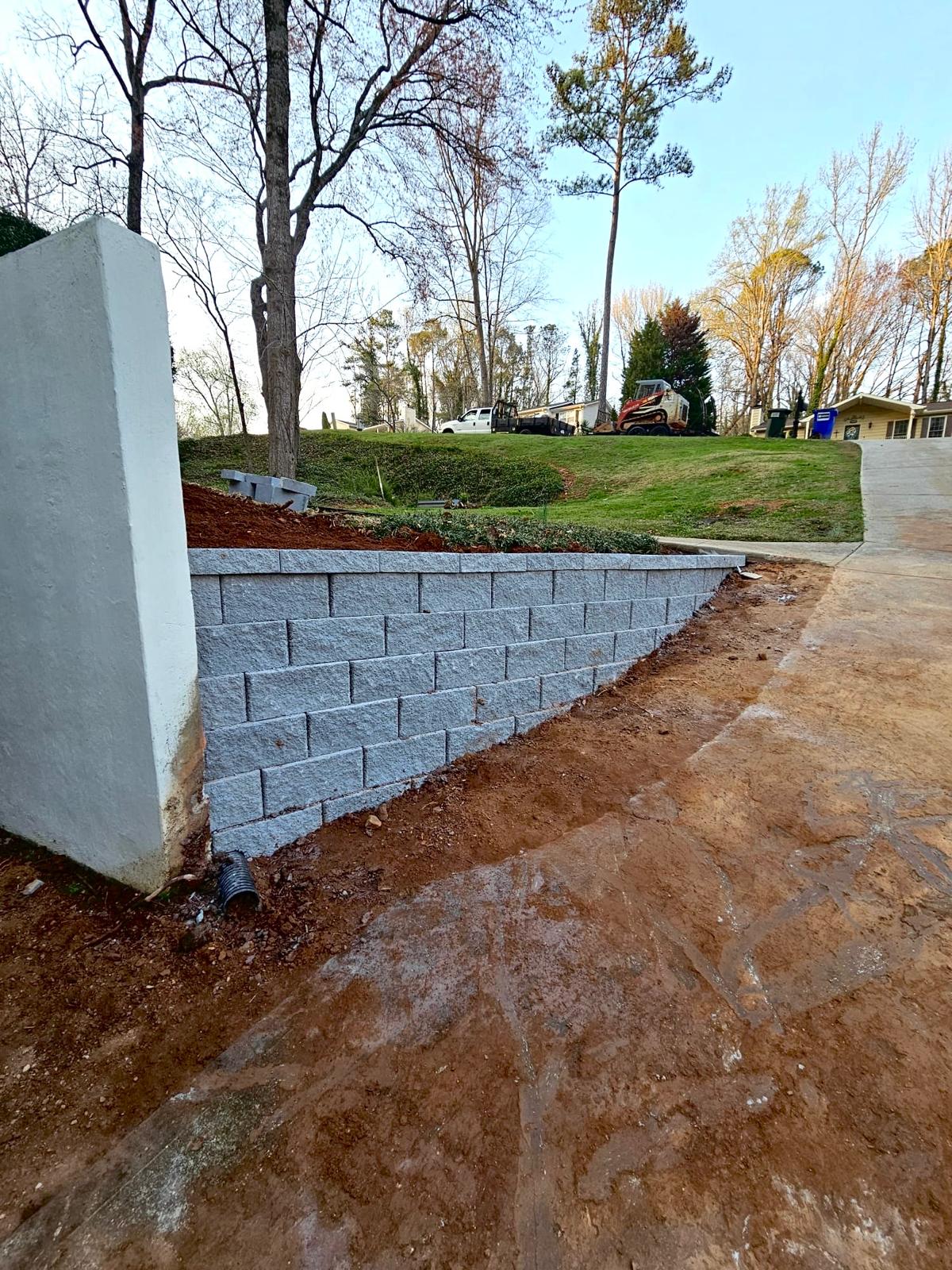
Masonry craftsmanship in the Alpharetta area — built to architectural standards, designed to perform for decades.
We design planter walls that solve the sightline problem and add living texture to the patio. Free estimates across Alpharetta, Milton, and North Atlanta.
Kaizen Scapes is based in Canton, Georgia and serves the greater North Atlanta region within 35 miles: