

The hardscaping contractor market in North Georgia is not self-regulating. There is no license requirement in Georgia specifically for hardscaping, no governing body that certifies a contractor as competent to build a retaining wall or install a paver patio. What that means for a Cherokee County homeowner is that the company quoting $9,000 for your patio may employ master craftsmen with twenty years of structural hardscaping experience — or it may employ a lawn crew who learned to lay pavers last spring. The quotes look identical from the outside. The outcomes do not.
These seven questions are not a gotcha test. They are the diagnostic framework that separates contractors who understand what they’re building from contractors who are pricing it from a catalog. A legitimate hardscaping contractor answers all seven without hesitation. Evasion, vagueness, or irritation at the questions tells you something important before a single dollar changes hands.
Question 1
This is the most important question you can ask a hardscaping contractor in North Georgia, and most homeowners never ask it. Cherokee County’s clay soils do not drain — they redirect water. Every hardscaping installation changes the drainage pattern of a site: a patio redirects sheet flow, a retaining wall intercepts hillside drainage, a driveway creates impervious surface that concentrates runoff. A contractor who hasn’t thought about where your water goes during a heavy rain hasn’t designed a complete project — they’ve designed a structure that will undermine itself over time.
What a good answer sounds like: specific — slope percentages, where drainage outlets, whether French drain or catch basin is required, what happens during a 2-inch rainfall event. A bad answer: “We’ll slope it away from the house” with no further detail. That’s not drainage planning. That’s guessing out loud.
Question 2
Paver patios, retaining walls, and steps are only as permanent as the base they sit on. The industry standard for a paver patio in Georgia is a minimum 4-inch compacted aggregate base, properly graded, with a 1-inch bedding sand layer above. For a retaining wall, the standard calls for a base course buried at or below grade, compacted gravel backfill, perforated drain pipe, and geogrid reinforcement for walls over three feet. Driveways require 8 to 10 inches of compacted base. These are not optional upgrades — they are the engineering minimum for a structure that performs over time in Georgia’s clay soil and freeze-thaw conditions.
A contractor who quotes a shallower base is not giving you a deal. They’re giving you a structure that will shift, crack, or fail within three to seven years — which is exactly the timeline when many homeowners discover that their “lifetime” patio was built on a four-week base.
“The gap between a $9,000 patio and a $13,000 patio is usually not markup — it’s base depth, drainage infrastructure, and the crew who knows the difference.”
Question 3
Several major hardscaping material manufacturers — Techo-Bloc, Unilock, and EP Henry among them — maintain installer certification programs that require training in proper installation techniques, base preparation, and structural applications. A certified installer has been through a curriculum that covers the specific performance characteristics of the material system, including how it handles Georgia’s clay soil behavior, what pattern restrictions apply under load, and what warranty implications attach to the installation method. Certification doesn’t guarantee excellence, but its absence is informative — particularly when a contractor is proposing a premium material system for a structural application like a pool deck or a driveway.
Question 4
This question is not about whether subcontractors are inherently inferior — they are not. It is about accountability, consistency, and quality control throughout your project. A contractor who employs their own dedicated hardscaping crew has direct oversight of every decision made on your site. A contractor who subcontracts hardscaping work to whoever is available that week has limited visibility into what’s actually happening on your property — and limited leverage when something is done incorrectly. Ask who specifically will be on your site, how long they’ve worked with the company, and whether the project manager visits the job daily.

A hardscaping installation in North Georgia — outdoor fireplace, patio surround, and masonry work by Kaizen Scapes’ own crew, not subcontracted.
Generic references don’t tell you much. A contractor who has installed dozens of small garden patios is not necessarily qualified to build a tiered retaining wall system on a sloped lot — and the references you want are from homeowners who had your specific challenge, not your contractor’s most impressive showcase project. Ask for three references from the past eighteen months on comparable projects. Then call them — and specifically ask about what happened when something went wrong, because something always does on any significant outdoor construction project. How a contractor handles problems is more revealing than their performance when everything goes smoothly.
Question 6
A legitimate hardscaping contractor produces a written scope of work that specifies: exact materials (product name, manufacturer, size, color), base depth and aggregate specification, drainage infrastructure components, geogrid specification (if applicable), grade and slope specification, and what is and is not included in the contract price. If your quote is a single-page document with a total price and a general description of “patio installation,” you don’t have a contract — you have a handshake with a price attached. Disputes about what was included are almost always disputes about what was never written down. A detailed scope of work protects both parties equally.
Question 7
In Cherokee County and the surrounding North Georgia municipalities, retaining walls above a certain height, structures attached to the home, and work near utility easements or setback lines typically require permits. A contractor who dismisses permits as unnecessary bureaucracy is either uninformed or is protecting a margin that disappears when inspections are required. Permitted work is inspected work — which means a third-party verification that the structural standards were met. Unpermitted hardscaping can complicate home sales, void insurance claims, and result in mandatory demolition of non-compliant structures. Ask whether permits are required for your specific project and verify the answer independently with your local municipality if you have any doubt.
Kaizen Scapes proudly serves homeowners across Canton, GA, Woodstock, GA, and the surrounding North Georgia communities including Holly Springs, Ball Ground, Acworth, Kennesaw, Marietta, Alpharetta, Milton, Roswell, Cumming, Johns Creek, and East Cobb. If you’re looking for hardscaping and landscaping craftsmanship within 35 miles of Canton or Woodstock, our team is ready to transform your outdoor space.
Whether you’re in Canton, Woodstock, Alpharetta, Milton, or anywhere across Cherokee County and the greater North Atlanta suburbs, Kaizen Scapes brings the same relentless standard to every project. We don’t do cookie-cutter. We do custom — built to last.
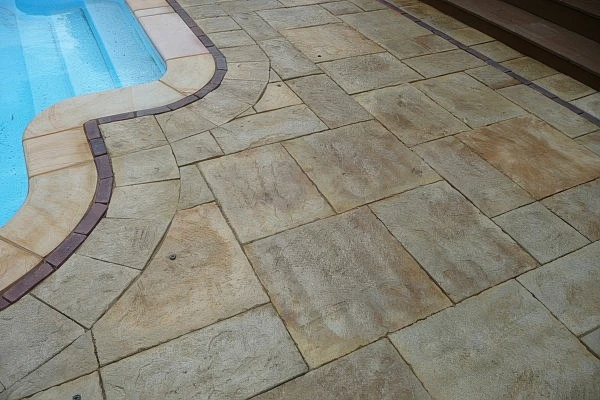
A completed pool deck and outdoor living project in Canton — built by a crew that answered all seven questions before breaking ground.
We welcome the scrutiny. Walk your site with us — our site evaluation process is the conversation these questions are designed to start. Call (470) 535-0252.
Kaizen Scapes is based in Canton, Georgia and serves the greater North Atlanta region within 35 miles: