

North Georgia is not a forgiving climate for outdoor materials. The combination of high summer heat, humidity that rarely drops below 60%, episodic freeze-thaw cycles in winter, and one of the most active red clay soil profiles in the Southeast puts every hardscaping material through a stress test that doesn’t stop when the project is complete. The question isn’t which material looks best on day one. It’s which material still performs on year fifteen.
The honest answer — the one most salespeople won’t give you — is that longevity is almost never determined by the material alone. It’s determined by whether the installation met the structural requirements of the material. A concrete paver patio installed over a 4-inch compacted base on Georgia red clay will fail in 8 years. The same paver over a proper 6 to 8-inch compacted aggregate base with edge restraint and adequate drainage will outlast your mortgage. The material is just the top layer. The base is the product.
The 20-Year Material Breakdown
Concrete pavers — the dominant material for patios, pool decks, and walkways across Canton and Woodstock — have a well-documented lifespan of 30 or more years when properly installed. The key phrase is “properly installed.” Concrete pavers don’t fail on their own; they fail because the base moved. Georgia’s red clay expands and contracts with moisture content changes, and a base that isn’t deep enough or adequately compacted translates that movement directly into surface-level shifting and separation. Properly sealed concrete pavers resist staining and freeze-thaw spalling; unsealed pavers in the North Georgia climate will show visible deterioration within 5 to 8 years at the joint lines.
Natural stone — granite, bluestone, travertine, flagstone — is the longest-lasting hardscaping material available for residential applications, with a realistic lifespan of 50 or more years for well-installed mortared systems and indefinitely for dry-laid systems that can be releveled without demolition. Natural stone is also the most forgiving of Georgia soil movement precisely because it can be adjusted without replacement. The failure mode for natural stone isn’t the stone itself — it’s the mortar joints in mortared applications, which need repointing every 10 to 15 years in high-moisture environments, and the base preparation in dry-laid applications.
“In North Georgia’s climate, the installation standard matters more than the material choice. A well-installed paver patio outlasts a poorly installed natural stone project every time.”
Poured concrete slabs are the most common hardscaping material in North Georgia by volume — and the one with the most predictable failure timeline in expansive clay soil conditions. Expect surface cracking to begin within 5 to 10 years in most Cherokee County applications, and structural slab movement and heaving within 15 to 25 years depending on drainage and tree root proximity. Poured concrete is difficult to repair invisibly — patches are always visible. Replacement requires full demolition. The low upfront cost rarely accounts for the total cost of ownership over 20 years when removal and replacement are factored in.
Asphalt driveways carry a realistic lifespan of 15 to 20 years in North Georgia with proper sealcoating every 3 to 5 years. Without sealcoating, UV degradation and moisture penetration accelerate surface oxidation, and cracks begin forming within 5 to 7 years. Asphalt performs well on properly graded and compacted bases but is highly susceptible to softening and rutting during Georgia’s sustained high-heat summers — particularly in areas with heavy vehicle traffic or tight turning loads.
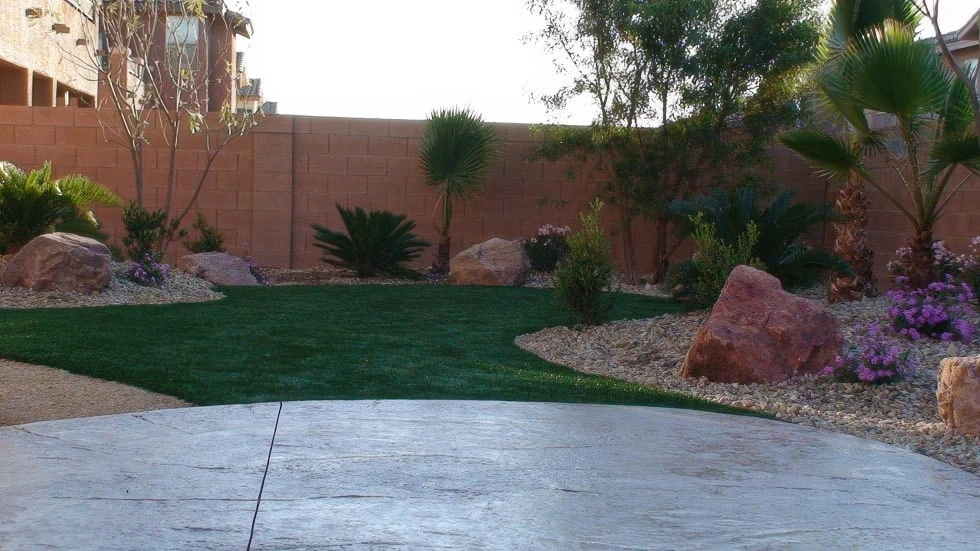
A properly baselined paver pool deck in Canton — when the base is built right, the surface holds for thirty years through Georgia’s freeze-thaw cycles and clay movement.
Georgia’s red clay is the single biggest accelerant of hardscaping failure in our service area. Unmodified red clay can hold up to 40% of its weight in water, expanding significantly when saturated and contracting as it dries. Any hardscaping surface installed directly on or immediately above red clay without proper aggregate base and drainage separation will eventually reflect that movement at the surface. This is not a material failure — it is a base failure — but the symptom shows up in the surface.
Tree root proximity is the second most common failure accelerant for poured concrete and paver surfaces. A single mature oak root growing under a patio slab will produce more heaving force than Georgia’s freeze-thaw cycles produce in a decade. Proper installation accounts for root proximity in the base design — either by routing drainage away from root zones or specifying a sand-set paver system that can be releveled as roots grow rather than a rigid poured system that cracks under uplift pressure.
Surface drainage is the third factor. Any hardscaping surface that allows water to pool rather than drain away will degrade faster regardless of material. This is why slope specification matters in every Kaizen Scapes proposal — we design for a minimum 1% grade away from all structures, and for pool decks and high-water-volume surfaces, we specify channel drains or French drain systems that actively move water away from the installation rather than relying on surface runoff alone.
For concrete pavers: annual cleaning, biannual sealcoating, and immediate re-sanding of joint lines when sand loss is visible. For natural stone: annual cleaning and joint inspection; repoint mortar joints at the first sign of cracking rather than waiting for joint failure. For wood structures: annual cleaning and staining or sealing on the specified cycle; inspect fasteners for corrosion annually in Georgia’s high-humidity environment. For masonry: inspect mortar joints every three years and repoint before water infiltration begins — once water gets behind masonry, freeze-thaw cycles do exponential damage to even well-built structures.
A qualified hardscaping contractor in Canton, GA will tell you what maintenance cycle your specific materials require before the project begins — not after you call them because something is failing.
Kaizen Scapes proudly serves homeowners across Canton, GA, Woodstock, GA, and the surrounding North Georgia communities including Holly Springs, Ball Ground, Acworth, Kennesaw, Marietta, Alpharetta, Milton, Roswell, Cumming, Johns Creek, and East Cobb. If you’re looking for hardscaping and landscaping craftsmanship within 35 miles of Canton or Woodstock, our team is ready to transform your outdoor space.
Whether you’re in Canton, Woodstock, Alpharetta, Milton, or anywhere across Cherokee County and the greater North Atlanta suburbs, Kaizen Scapes brings the same relentless standard to every project. We don’t do cookie-cutter. We do custom — built to last.

Every Kaizen Scapes installation is engineered for North Georgia’s specific climate — not just built to look good on the day it’s finished.
We’ll match the right material to your site conditions, your budget, and the way you actually use your outdoor space.
Kaizen Scapes is based in Canton, Georgia and serves the greater North Atlanta region within 35 miles: