

Segmental concrete retaining wall block has a reputation problem. Homeowners who want stone aesthetics sometimes dismiss it as the cheap option. Contractors who prefer to upsell sometimes skip the specification details that make it perform. The result is that the most reliably engineered residential retaining wall system available — properly specced and properly installed — gets underestimated by the people paying for it and underdone by the people building it.
For most Woodstock properties with grade changes between three and eight feet, a correctly engineered segmental concrete block wall is not the default option — it is often the best option. Understanding what separates structural retaining block from decorative garden block, and what a geogrid-reinforced installation actually involves, is the information that will help you evaluate any quote you receive for retaining wall work in Cherokee County.
Structural vs. Decorative Block
The home improvement retail landscape has blurred a distinction that matters structurally: there is a significant engineering difference between the $4-per-block decorative wall stone sold at big-box stores and the structural segmental retaining wall block manufactured by companies like Allan Block, Versa-Lok, and Anchor Diamond for engineered retaining wall applications. Both are concrete. They are not the same product.
Structural retaining wall block is manufactured to precise compressive strength specifications — typically 3,500 to 5,500 PSI — with dimensional tolerances that allow consistent interlock and predictable load performance. The geometry of the block creates a setback that provides natural batter (the backward lean that improves stability). Many structural block systems include a pin or clip connection that mechanically links courses under load. Decorative garden block is designed for low-height visual borders, typically under 18 to 24 inches, and is not engineered for the lateral earth pressure that builds behind a wall retaining a meaningful grade change.
“A wall built with decorative garden block on a four-foot grade change is not an inexpensive retaining wall. It is a wall that has not been built yet — it’s still being postponed until it fails.”
This distinction matters in Woodstock because many homeowners receive quotes that don’t specify block type. A quote that says “concrete block retaining wall” without naming the block manufacturer and block series is not a complete specification. You cannot meaningfully compare two quotes that don’t specify whether the block being used is a structural SRW block or decorative garden wall stone.
How Geogrid Works
Segmental retaining wall block relies on mechanical interlock and block mass for short walls. Once a wall exceeds approximately four feet of exposed height, the lateral earth pressure behind the wall exceeds what block mass and interlock alone can resist in Cherokee County’s clay-heavy soils. At that threshold, geogrid reinforcement becomes a structural requirement — not an upgrade.
Geogrid is a high-density polyethylene grid material embedded horizontally in the compacted gravel backfill behind the wall at specified intervals as the wall rises. It works by anchoring into the backfill soil to create what engineers call a mechanically stabilized earth zone — a composite structure of grid and compacted fill that resists lateral pressure across a broad plane rather than at the wall face alone. The grid extends back into the hillside by a distance typically equal to 60–80% of the total wall height. A six-foot wall requires geogrid runs extending roughly four feet behind the wall face.
A segmental block wall built without geogrid on a grade change that required it doesn’t fail immediately. It leans. The process is gradual: seasonal freeze-thaw cycles and moisture expansion in Cherokee County clay exert lateral pressure against the wall face. Without the mechanically stabilized earth zone, the wall begins to bow outward at mid-height — typically becoming visible within three to five years of installation. By year seven or eight, the wall is structurally compromised and requires full removal and rebuild. The rebuild cost typically exceeds the original installation cost because the failed wall must first be demolished and hauled away.
This is the single most common retaining wall failure pattern we assess in Woodstock and Canton. It is also entirely preventable. The difference between a wall that bows and a wall that stands for 25 years is often $800 to $1,500 in geogrid material and the labor to install it correctly — a cost that disappears from a quote when a contractor is competing on price rather than on outcome.
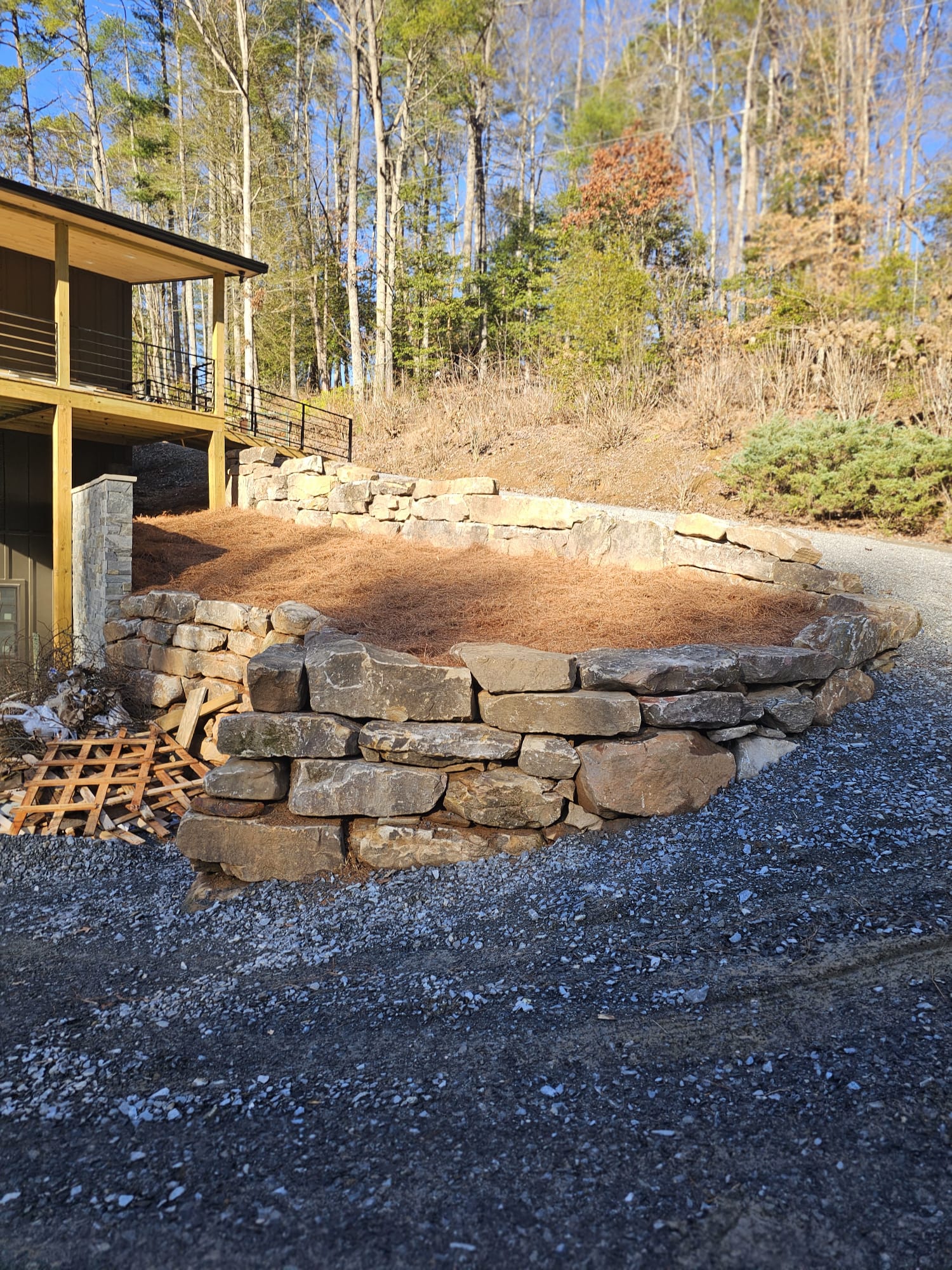
An engineered segmental block retaining wall in Woodstock — geogrid layers embedded at every specified course, full drainage package, Allan Block structural specification.
The most useful thing a Woodstock homeowner can do when receiving retaining wall quotes is ask each contractor to itemize the specification. A complete quote for a concrete block retaining wall should include: block manufacturer and series name, PSI specification or compliance with ASTM C1372, base excavation depth and compaction method, drainage aggregate type and quantity, perforated drain pipe specification, filter fabric, geogrid manufacturer and installation intervals (if wall exceeds 4 feet), and finish grading.
Concrete block retaining walls in Woodstock typically run $22 to $45 per square foot of wall face for a properly engineered installation. A 40-foot wall at five feet of exposed height — 200 square feet of wall face — runs approximately $4,400 to $9,000 for a straightforward site and $8,000 to $16,000 for a more complex installation with geogrid, drainage infrastructure, steps, and caps. The range within those estimates reflects site conditions: access, existing grade, soil type, and drainage outlet requirements vary significantly across Woodstock’s neighborhoods.
This is the honest conversation: for the majority of Woodstock properties with standard grade changes, properly engineered segmental block delivers the same structural outcome as natural stone at 40–60% of the cost — with cleaner geometry, faster installation, and a broader range of finishes. The cases where natural stone genuinely outperforms engineered block are real but narrower than the premium suggests: properties with significant aesthetic requirements, wooded lots where manufactured block looks out of place, or sites where the boulder wall’s mass gravity system offers a practical engineering advantage over geogrid installation. For a rear utility slope on a standard Woodstock subdivision lot, the $12,000 stone wall and the $7,500 engineered block wall will both stand for 25 years — but one of those quotes leaves $4,500 in your account.
Why Kaizen Scapes
We do not have a preferred product that maximizes our margin. We have a site evaluation process that determines which block system and which drainage specification your specific Woodstock slope requires — and then we quote that, itemized, with manufacturer names and installation specs. If the honest answer is that standard engineered block with geogrid solves your problem at a fraction of the stone cost, that is the conversation we will have with you. Call us at (470) 535-0252 to discuss your project or request a free site evaluation through our contact page.
Kaizen Scapes proudly serves homeowners across Canton, GA, Woodstock, GA, and the surrounding North Georgia communities including Holly Springs, Ball Ground, Acworth, Kennesaw, Marietta, Alpharetta, Milton, Roswell, Cumming, Johns Creek, and East Cobb. If you’re looking for hardscaping and landscaping craftsmanship within 35 miles of Canton or Woodstock, our team is ready to transform your outdoor space.
Whether you’re in Canton, Woodstock, Alpharetta, Milton, or anywhere across Cherokee County and the greater North Atlanta suburbs, Kaizen Scapes brings the same relentless standard to every project. We don’t do cookie-cutter. We do custom — built to last.
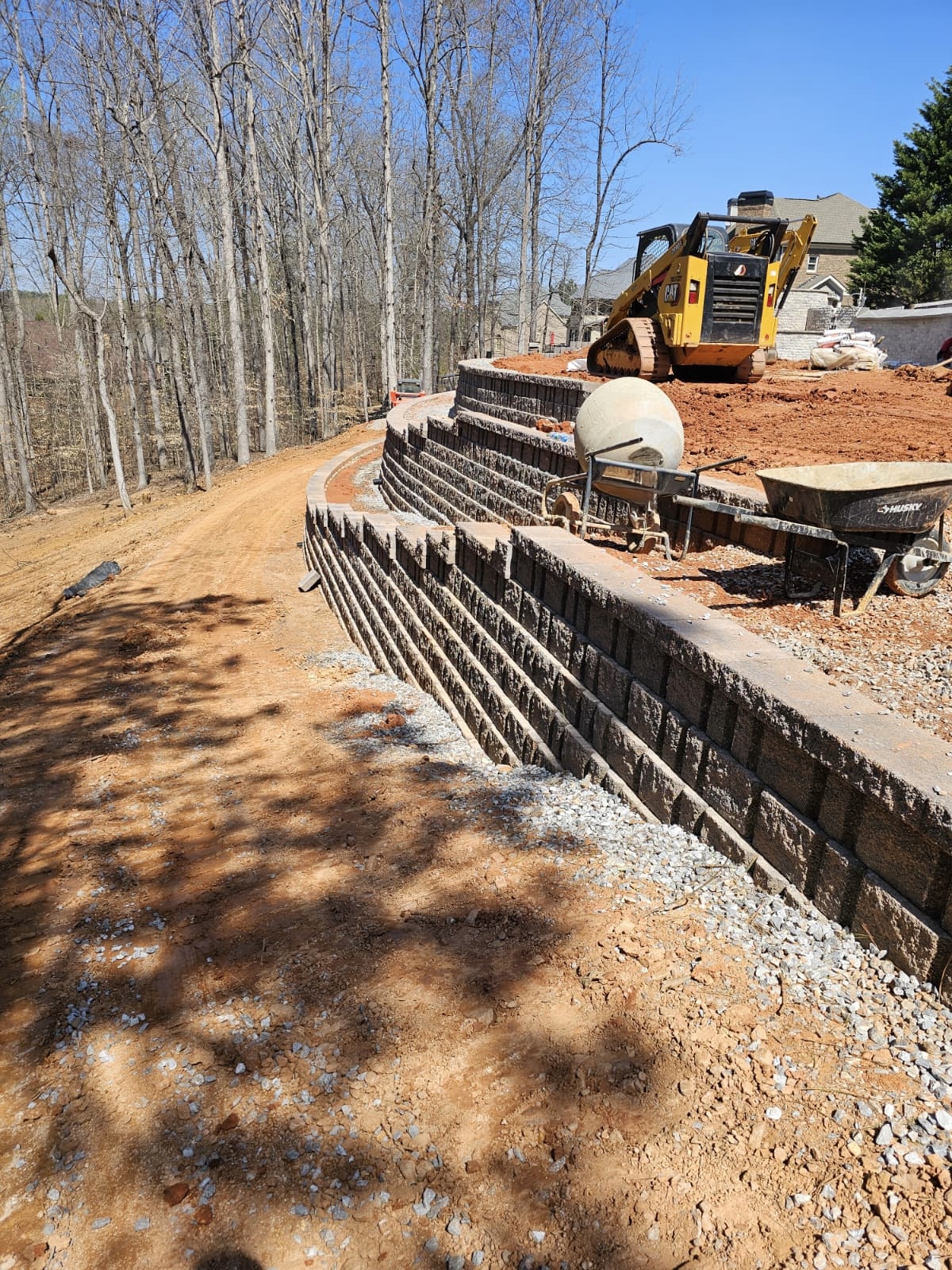
A completed engineered block retaining wall in Woodstock — structural specification, geogrid reinforced, drainage infrastructure matched to the site’s clay soil conditions.
We specify the block, the geogrid, and the drainage package before we quote. Free site evaluations across Woodstock, Canton, and Cherokee County.
Kaizen Scapes is based in Canton, Georgia and serves the greater North Atlanta region within 35 miles: