

Every spring, a significant number of Canton homeowners spend a weekend buying mulch, spreading it on slopes and around retaining walls, and watching it wash down the hill with the first heavy rain. Then they do it again the following spring. This isn't a landscaping problem — it's a design problem. And it has a permanent solution that most contractors never suggest because it doesn't require an annual service call.
Mixed aggregate drainage — a combination of structural rip-rap and decorative river rock — is what replaces that cycle. It solves the water management problem that mulch creates the illusion of solving, it looks better than bare mulch, and it requires exactly zero maintenance from the day it's installed. Here's how it works and why it matters on a property with any grade change at all.
Organic mulch has real benefits in the right application — moisture retention around plantings, temperature moderation in root zones, weed suppression in flat beds. What it doesn't do is manage water. On a slope, mulch is essentially a temporary surface covering that holds together until the first hard rain, then redistributes itself to wherever the water went. That might be over the concrete landing, into the wall joints, down the driveway, or into the foundation drainage area around the house.
Every time that happens, two things occur: the mulch is displaced from where it was supposed to be, and the exposed soil it was covering begins to erode. In Georgia's climate — significant summer thunderstorms, clay-heavy soils that shed water rather than absorbing it quickly — this isn't an occasional problem. It's a recurring one that compounds over time as the underlying soil profile degrades and the slope loses its stability.
"Mulch treats the symptom. Rock and aggregate address the cause. Water moves through stone — it moves soil with it when there's nothing permanent to stop it."
In this Canton retaining wall project, three distinct aggregate types serve three distinct functions, and they work together as a drainage system rather than just a surface covering. The large jagged rip-rap in the foreground acts as armor stone — it's heavy enough that water velocity can't move it, and its irregular surface creates friction that slows water flow and forces it to permeate into the ground rather than run across the surface.
The smooth river pebbles along the path edges serve a transition function — they're visually lighter than rip-rap, which creates a border definition that helps the eye read the path as a distinct space. But they also allow water to flow between rounded surfaces easily, preventing pooling along the path edge. The combination of the two materials — angular rock that holds position under water pressure, and rounded rock that allows drainage between pieces — is what makes this a functional system rather than just a decorative one.
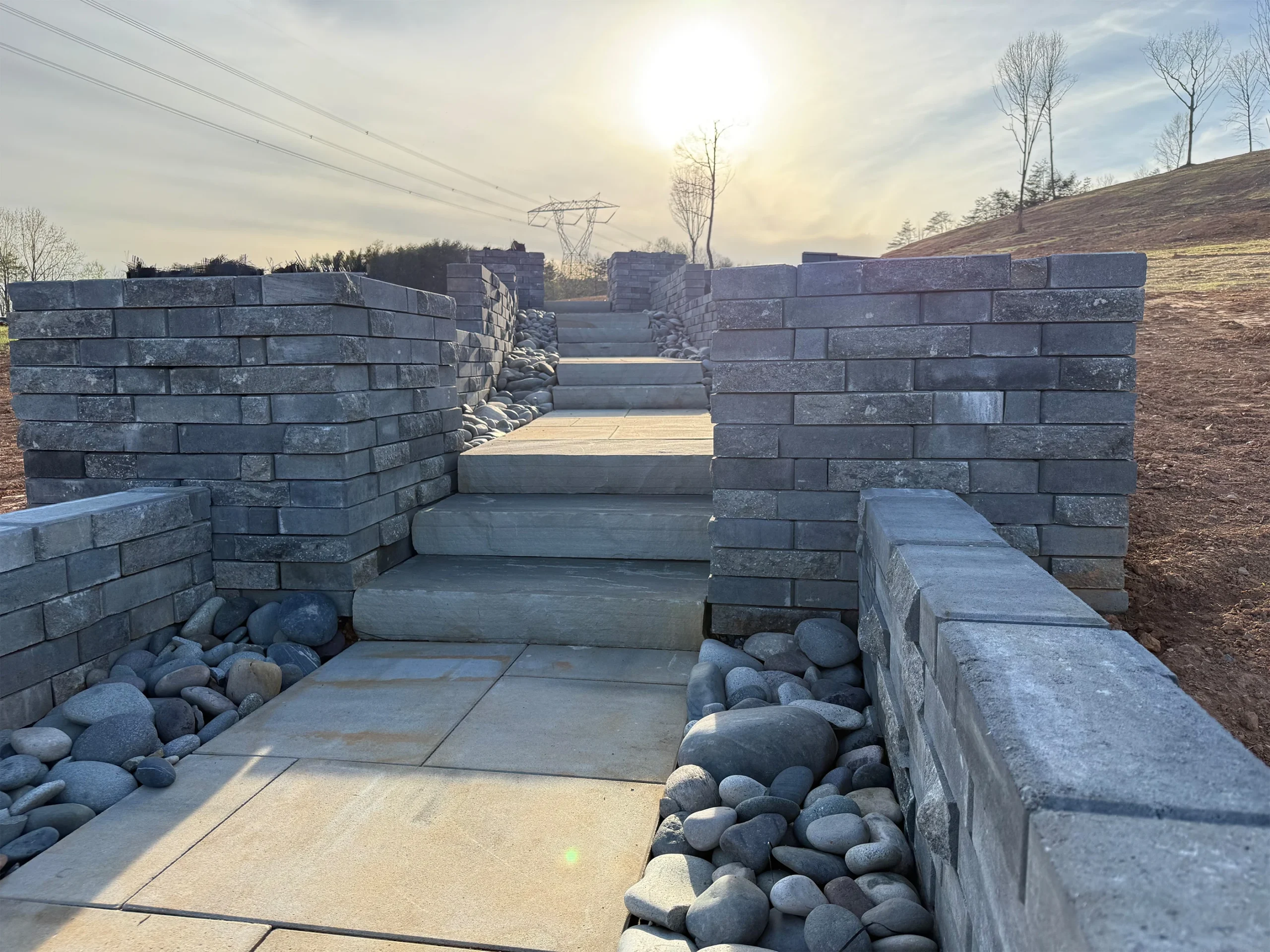
Three aggregate types in one drainage system — rip-rap for armor, river rock for border definition, and the wall block itself. Each material chosen for its function, not just its appearance.
The comparison that most homeowners don't make is the total cost of mulch over ten years versus the one-time cost of a properly installed rock drainage system. At $100–200 per application, annual or biannual remulching on a significant slope adds up to a number that starts to look embarrassing when compared against a permanent installation. The permanent installation doesn't wash away, doesn't attract termites or fungus the way organic material does, and doesn't leave the soil exposed between applications.
There's also a maintenance behavior argument. A slope with organic mulch requires periodic attention to stay looking right. A slope with rip-rap and river rock looks exactly the same on the day you install it as it does in year five and year fifteen. The homeowner gets their time back, their money back on an annual basis, and a landscape that stops demanding upkeep and starts delivering it instead.
When this drainage approach is combined with a properly engineered retaining wall and integrated stone steps — as in this Canton project — the result is a slope that is fully managed, permanently stabilized, and completely self-maintaining. That's the goal of good hardscaping design. To see the complete system in context, explore our hardscaping services page or call us for a free site evaluation.
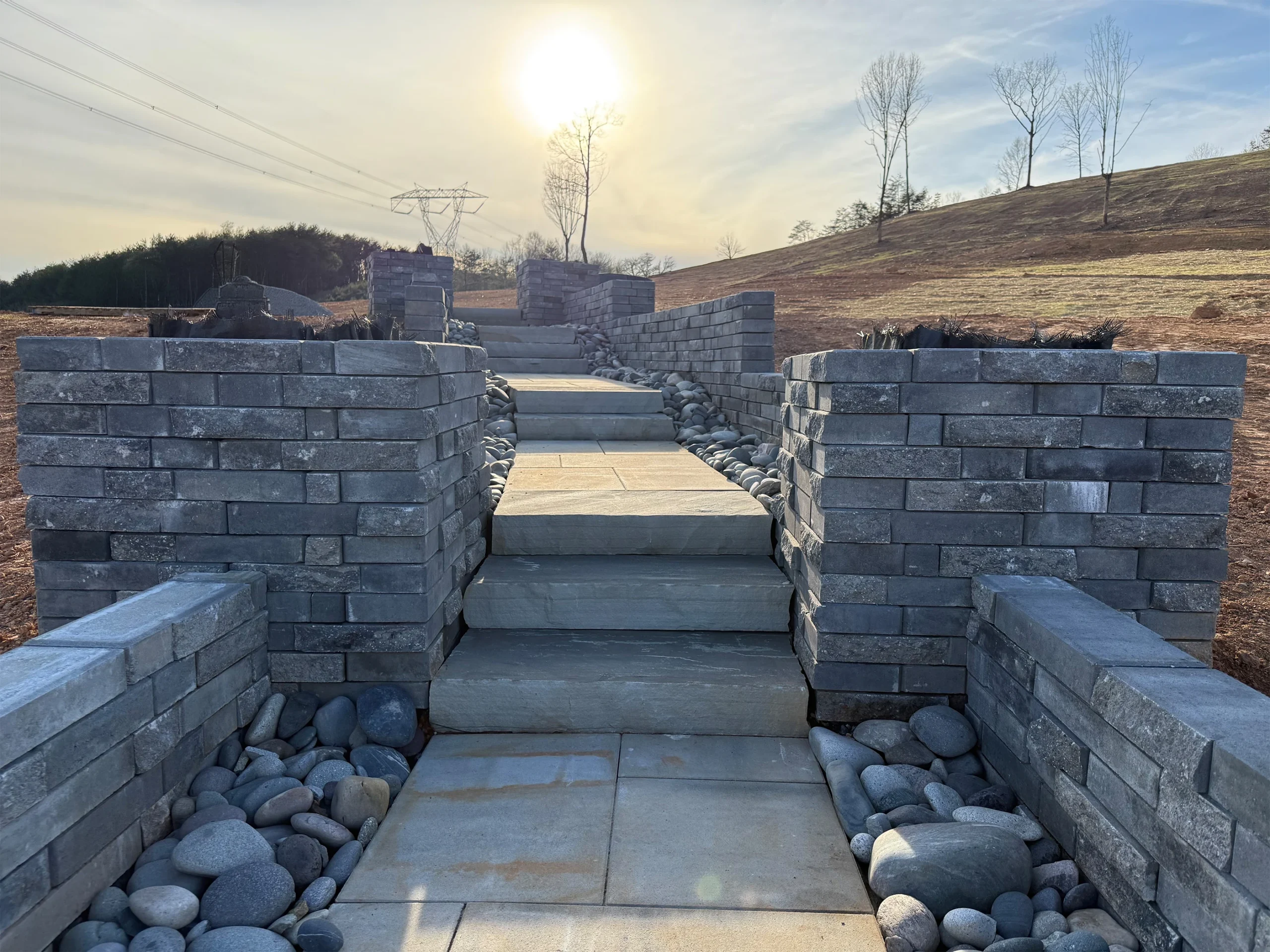
River rock borders define the path while managing drainage — the rounded profile lets water pass through instead of pooling, and the visual edge keeps the space looking intentional.
The question isn't whether your slope needs drainage management — any slope in Cherokee County does. The question is whether you want to solve it once with permanent materials, or partially solve it every year with materials that are gone before the next storm.
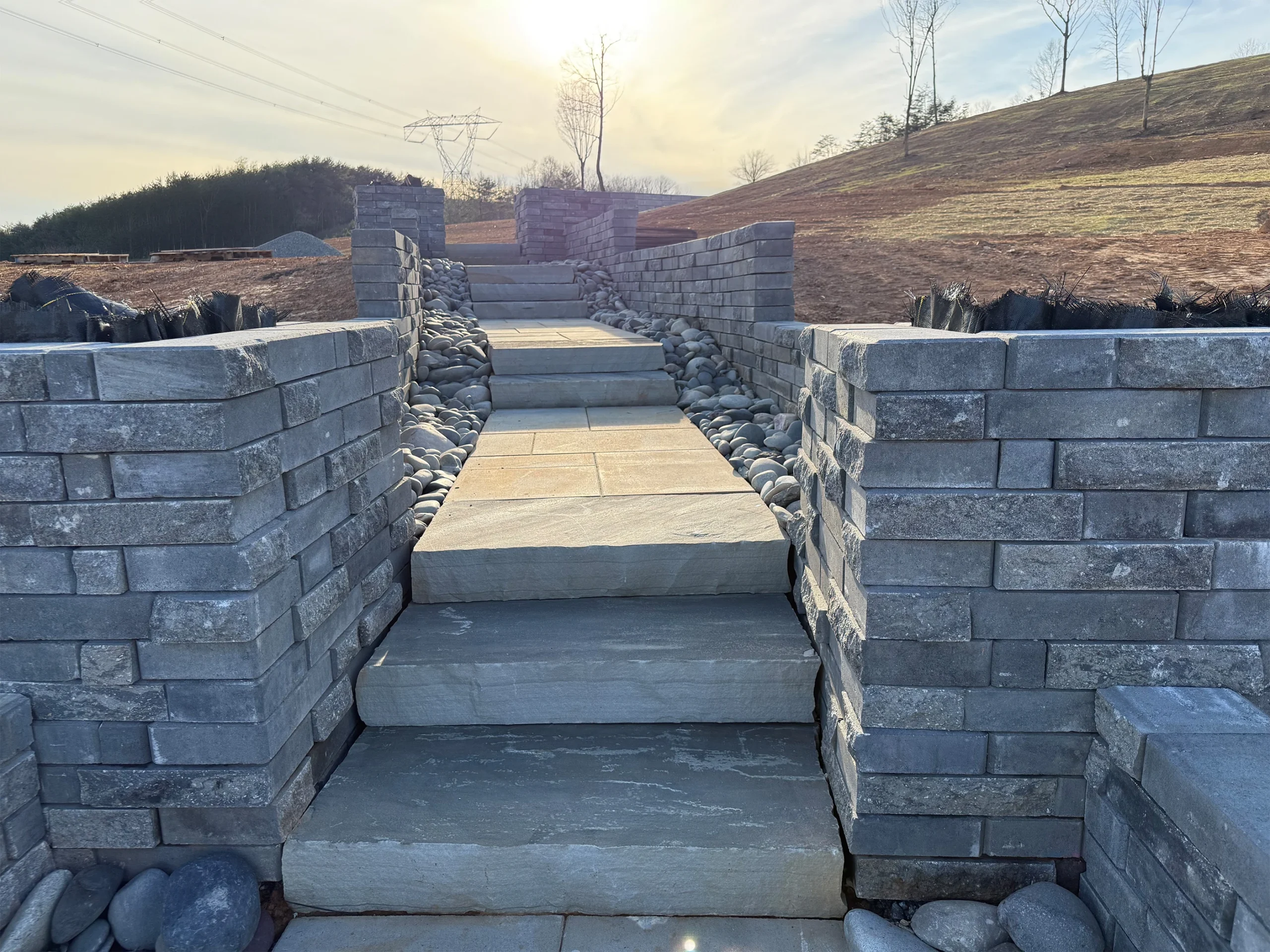
The finished drainage system — rip-rap, river rock, and stone steps working together to manage water permanently. No mulch. No annual maintenance. No erosion.
We install permanent drainage rock systems that solve the problem once. Free site evaluation across Canton and Cherokee County.
(470) 535-0252 Get a Free Estimate