

One of the first questions Milton, GA homeowners ask when starting a landscape lighting project is which fixture type to use. Path lights, uplights, and downlights are the three primary categories, and each one does something fundamentally different from the others. The confusion arises because they're often discussed interchangeably in home improvement contexts, as if choosing one is simply a matter of preference. In reality, each fixture type performs a specific function in a well-designed lighting system — and the best landscape lighting contractor installations use all three in combination, with each type deployed where it's functionally suited rather than substituted for one of the others.
The clearest way to understand the three types is to think about what they illuminate and where the light source is positioned relative to the illuminated object. Path lights are positioned at ground level and emit light downward and outward, illuminating the walking surface and the immediate area around a path or driveway. Uplights are positioned at or near ground level and emit light upward, projecting onto trees, architectural features, columns, or wall surfaces above. Downlights are mounted at height — on eaves, in tree canopies, on pergola beams — and emit light downward over a wide area, providing the ambient fill that makes a space feel like a room. Each position creates a completely different visual effect on the landscape, and the three together create the layered result that makes professional lighting work look dramatically different from a collection of individual fixtures.
Path lights are the most practical fixture in any landscape lighting system: they guide movement, define edges, and provide the ground-level illumination that makes walkways and steps safe to navigate after dark. But they're frequently misused in ways that undermine the rest of the design. The most common error is treating path lights as the primary ambient light source — positioning them densely enough that the path-light field produces most of the visible illumination in a given area. Path lights are not ambient fixtures; they're directional fixtures that illuminate a surface. When they're used to provide ambient light, the result is an uneven, bottom-lit effect that produces unflattering shadows upward on any vertical surfaces nearby.
Correct path light spacing depends on the fixture's beam spread and lumen output. A fixture with a 120-degree spread and 100 lumens output illuminates a circle of approximately 4–5 feet in diameter at useful intensity. Spacing fixtures at 8-foot intervals creates a dotted-line effect with visible dark gaps between each pool of light. Spacing at 6 feet produces an overlapping pattern where the illuminated zones connect — which reads as a continuous lit edge rather than a series of individual fixtures. Fixture height matters too: path lights mounted between 12 and 18 inches above grade produce the most useful combination of surface illumination and visual presence without creating upward glare at eye level for someone walking the path.
"Path lights guide movement. Uplights create drama on architectural features and trees. Downlights simulate moonlight and make a space feel inhabited. You usually need all three."
Uplights are the fixture type responsible for most of the visual drama in landscape lighting. Positioned at the base of trees, architectural columns, or wall surfaces, they throw light upward at angles that create shadow patterns, texture reveal, and visual focal points that are visible both from within the property and from the street. The choice between above-ground uplights (stake-mounted or surface-mounted) and well lights (recessed flush into the ground) is primarily aesthetic: well lights are invisible during daylight and produce a cleaner composition, but they require more precise placement and more complex installation. Above-ground uplights are easier to reposition but are visible during daylight as hardware. For Milton's larger properties with mature tree canopies, well lights positioned at the base of signature trees produce some of the most dramatic lighting effects available in residential landscape work — the light passing through the canopy creates dappled patterns on the ground below that shift with the wind.
Downlighting — sometimes called moonlighting when the fixture is mounted high in a tree canopy — is the fixture type that most directly affects how a space feels from inside the house after dark. A landscape lit only from below, with no overhead light source, reads as theatrical from inside but not as a habitable space. Adding a downlight source — whether from an eave-mounted fixture, a high beam-mounted fixture, or a tree canopy-mounted fixture — creates the overhead light plane that makes the outdoor space feel like a room with a ceiling rather than a stage set. The effect is subtle but immediately noticeable when compared side by side: the same space with and without overhead light sources reads as fundamentally different in quality and comfort.
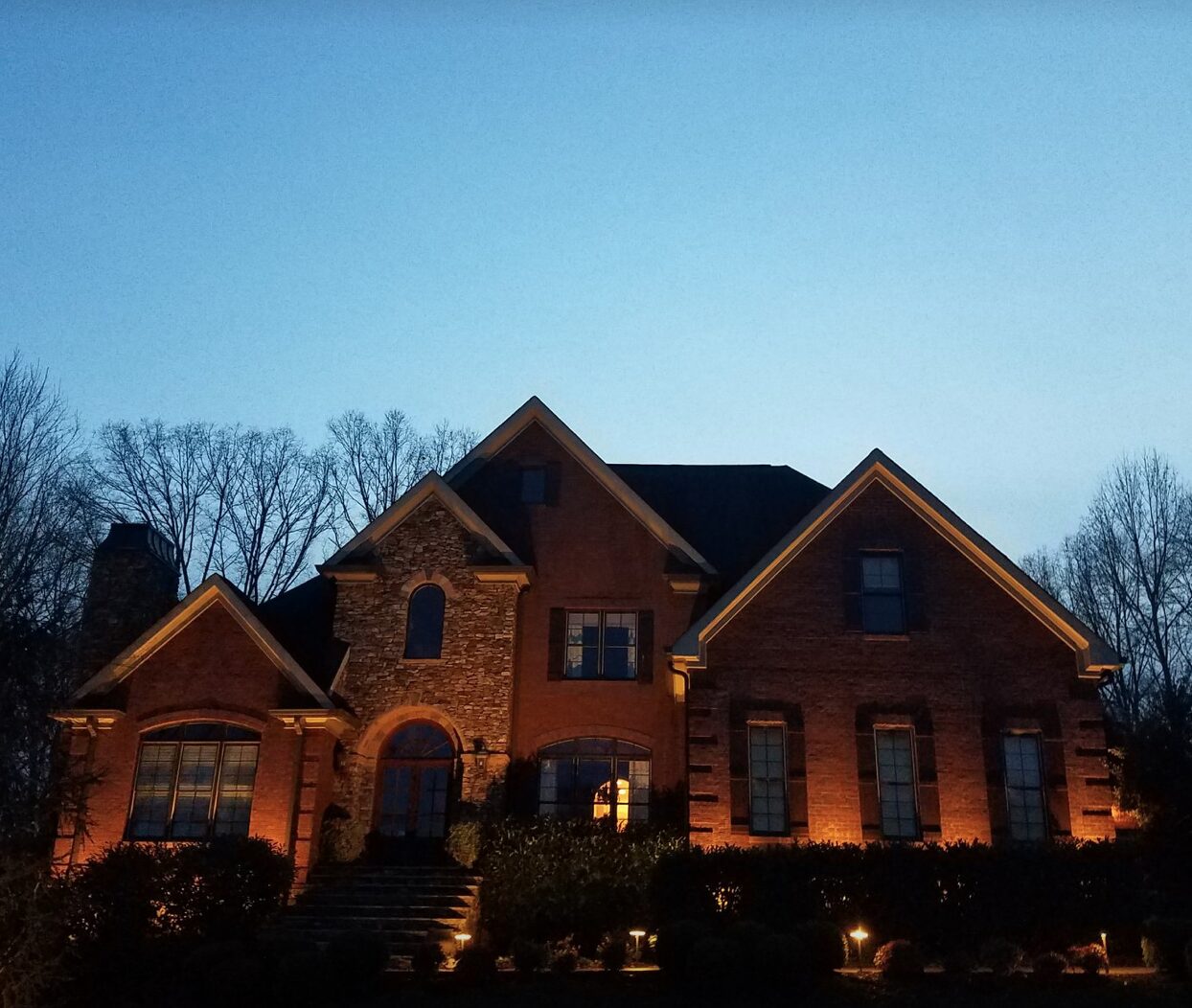
Path lights, uplights, and downlights working together in Milton, GA — each fixture type performing its specific function in a layered system that creates atmosphere rather than just illumination.
Milton's larger residential properties with mature tree canopies and significant architectural investment deserve lighting designs that use all three fixture categories deliberately. Kaizen Scapes doesn't substitute one fixture type for another based on cost — path lights go where paths are, uplights go where there are features worth illuminating from below, and downlights go where the space needs an overhead ambient source. The composition of the three types is what produces the result that looks designed rather than assembled. That approach takes more planning and more precise installation, but it produces a system that performs the same way it looks in a design rendering — every night, without adjustment.
Kaizen Scapes proudly serves homeowners across Canton, GA, Woodstock, GA, and the surrounding North Georgia communities including Holly Springs, Ball Ground, Acworth, Kennesaw, Marietta, Alpharetta, Milton, Roswell, Cumming, Johns Creek, and East Cobb. If you're looking for hardscaping and landscaping craftsmanship within 35 miles of Canton or Woodstock, our team is ready to transform your outdoor space.
Whether you're in Milton, Alpharetta, Cumming, or anywhere across North Georgia, Kaizen Scapes brings the same relentless standard to every project. We don't do cookie-cutter. We do custom — built to last. See our full hardscaping services or call for a free consultation.
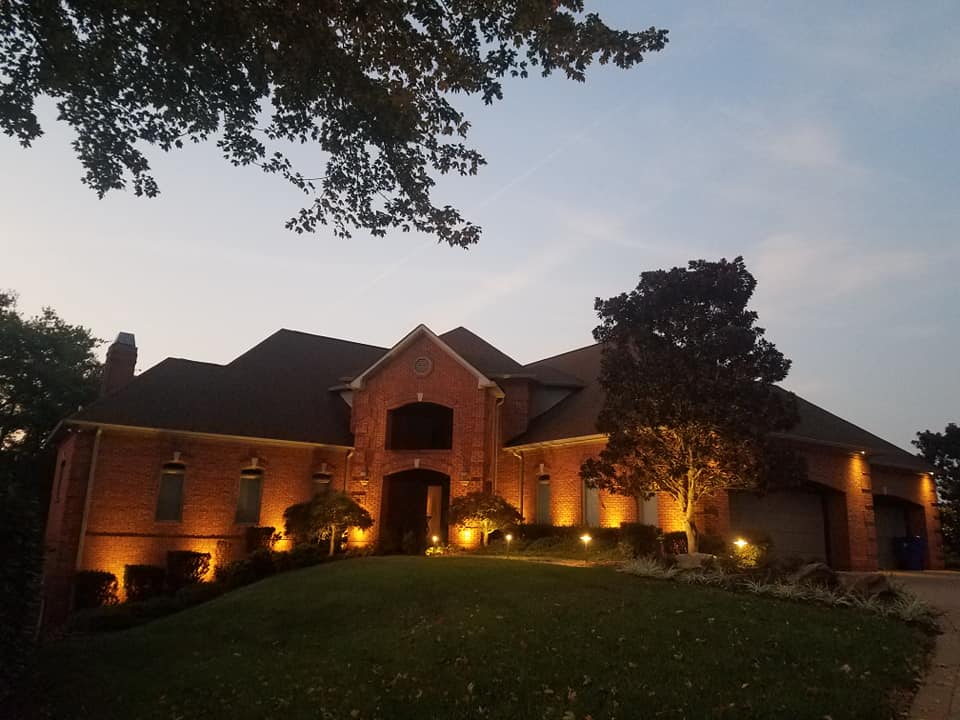
Finished lighting system in Milton, GA — path lights, uplights, and downlights each deployed where they're functionally suited, producing a layered result that looks intentional from every angle.
Free consultations across Milton, Alpharetta, Canton, and North Georgia. Professional landscape lighting designed with all three fixture layers.
(470) 535-0252 Get a Free Estimate