

Erosion control landscaping in Georgia starts with a fundamental that homeowners rarely think about until they have standing water against their foundation, a washed-out garden bed, or sod that dies every time it rains hard: grading and drainage are not separate systems. They are the same system. Grade determines where water flows on the surface. Drainage infrastructure — whether French drains, surface swales, catch basins, or channel drains — determines where that water goes once it's collected. Getting one right without the other produces a yard that almost works but develops specific, recurrent problems that frustrate homeowners for years because the root cause is invisible from the surface.
Kennesaw and Cobb County properties face the same drainage challenges that characterize most of North Georgia's developed landscape: red clay subsoil with limited infiltration capacity, rolling topography that concentrates water in low spots, and residential grading done during construction that prioritized building pad elevation over comprehensive drainage design. The result is a significant proportion of Cobb County backyards where water either doesn't drain away from the foundation properly, pools in the middle of the lawn after moderate rainfall, or moves across the surface in concentrated flow patterns that erode topsoil and kill sod. All three problems are addressable — but only when the grading and drainage strategy accounts for both surface flow and subsurface collection together.
Georgia's red clay is notoriously dense and has an infiltration rate that makes it effectively impermeable during moderate to heavy rainfall events. When rain falls faster than the clay can absorb it — which is most of the time in a Georgia summer storm — it runs off the surface. The direction and velocity of that runoff is entirely determined by grade. A properly graded residential yard directs surface runoff away from the structure and toward drainage infrastructure or a legitimate discharge point at the property boundary. An improperly graded yard channels water wherever the existing low spots happen to be, which is often directly against the foundation wall or into the basement window wells.
The standard grading requirement for positive drainage away from a residential foundation is a minimum six-inch drop in the first ten feet from the structure. This minimum slope ensures that water moves away from the foundation at a rate sufficient to prevent pooling against the sill or the foundation wall. In practice, many Kennesaw properties were graded to meet this minimum at construction time but have settled over subsequent years, reducing the slope and creating drainage problems that didn't exist when the home was new. Annual inspection of the grade immediately adjacent to the foundation — particularly in areas where soil has been disturbed by landscaping, tree roots, or utility work — is one of the most cost-effective maintenance activities a homeowner can perform.
"Water always finds a path. Grading determines whether that path goes away from your foundation or toward it — and once the yard is established, correcting it is expensive."
French drains and surface swales solve the same fundamental problem — collecting and moving water away from problem areas — but they do it through different mechanisms and are appropriate for different conditions. A French drain is a subsurface system: a trench filled with drainage aggregate around a perforated pipe, covered with filter fabric and backfilled. It collects groundwater and shallow surface water through infiltration and moves it to a discharge point. French drains are the right solution for areas where surface water needs to be intercepted and moved underground — particularly at the base of slopes, along property lines receiving sheet flow from adjacent properties, and at the transition between lawn and foundation.
A surface swale is a designed shallow channel — typically grass-lined or planted — that moves surface runoff from a collection area to a discharge point through the same gravity mechanism as natural watercourses. Swales are appropriate where the drainage volume is significant enough that a subsurface system would be undersized, where the grade naturally supports a surface flow path, and where the visual impact of a designed drainage channel is acceptable in the landscape design. For Kennesaw properties with significant elevation change from the rear of the yard to the street or drainage easement, a combination of French drain at the base of the slope and a swale along the property perimeter typically provides the most robust drainage solution.
New sod installed on improperly graded ground is set up to fail in a specific way: irrigation water and rainfall pool in the low spots, creating saturated conditions that prevent root development and promote crown rot, while the high spots dry out too quickly and develop heat stress. The result is an uneven sod installation with patches of failure that don't respond to watering adjustments because the root cause is grade, not irrigation frequency. Grading correction before sod installation — not after, not as a remediation — is the step that determines whether the sod survives long-term. Sod laid on a properly graded, amended surface with adequate topsoil depth establishes uniformly. Sod laid on whatever grade the yard happened to have is a maintenance project from day one.
The grading-before-vs.-after-hardscape question is often answered by project scope rather than preference. If the hardscape project includes significant cut-and-fill work that will change the yard's drainage pattern, grading must happen as part of the hardscape project — not before or after. A retaining wall project that changes the relationship between the upper yard level and the lower yard level changes the drainage dynamics of both areas simultaneously, and the drainage infrastructure for both needs to be designed as part of the wall project. Installing drainage infrastructure before a major grading change and then having the grading work undo it is wasted money.
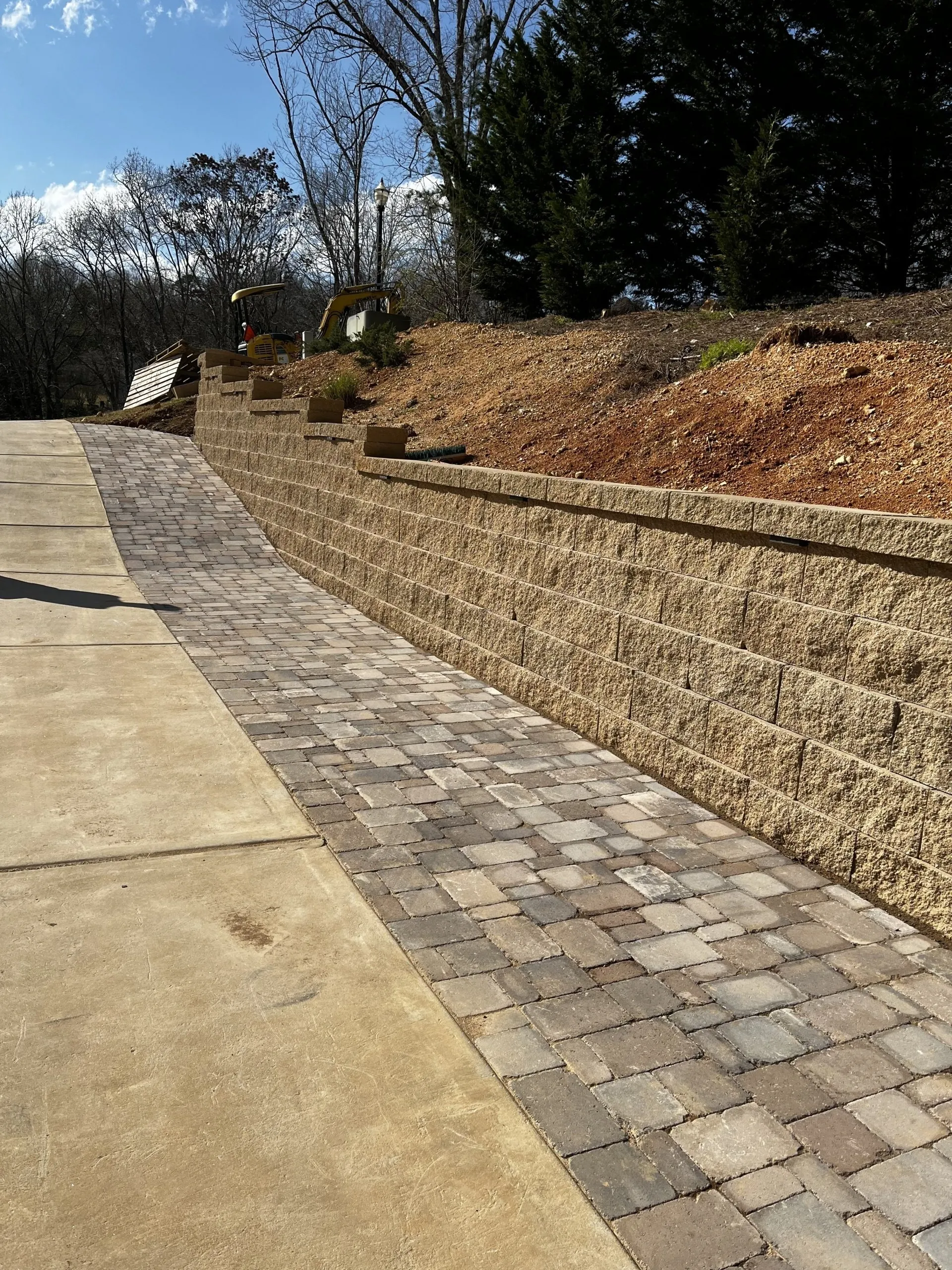
Grading and drainage work in Kennesaw, GA — surface swale and French drain integration designed to move water predictably away from the structure and off the property.
Freshly graded slopes in North Georgia are vulnerable to erosion immediately after disturbance. Georgia's rainfall intensity — heavy thunderstorms that can deliver two inches or more in an hour — strips exposed topsoil faster than in most regions. Erosion blanket (also called erosion control blanket or ECB) is a biodegradable fiber mat that protects the soil surface and holds seed in place while ground cover establishes. It should be installed within 24 to 48 hours of grading completion on any slope that will be seeded rather than sodded. Waiting for a convenient time or leaving slopes exposed over a weekend during spring rain season is the choice that creates a gully erosion problem that requires significant rework to correct. The erosion blanket installation is not the expensive part. The repair is.
Kaizen Scapes proudly serves homeowners across Canton, GA, Woodstock, GA, and the surrounding North Georgia communities including Holly Springs, Ball Ground, Acworth, Kennesaw, Marietta, Alpharetta, Milton, Roswell, Cumming, Johns Creek, and East Cobb. If you're looking for hardscaping and landscaping craftsmanship within 35 miles of Canton or Woodstock, our team is ready to transform your outdoor space.
Whether you're in Kennesaw, Marietta, Acworth, or anywhere across Cobb County, Kaizen Scapes brings the same relentless standard to every project. We don't do cookie-cutter. We do custom — built to last. See our full hardscaping services or call for a free consultation.
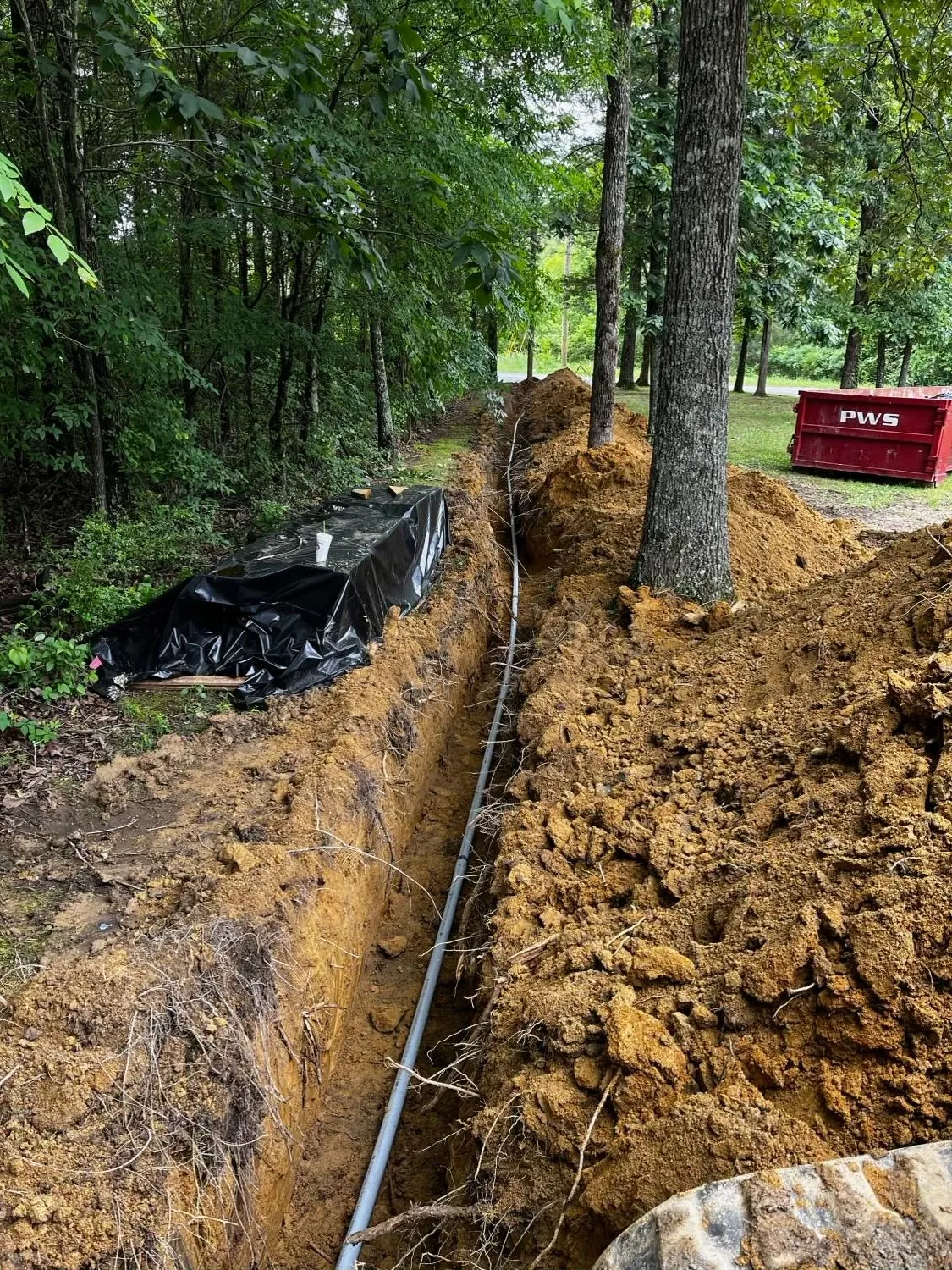
Finished grading and erosion control installation in Cobb County — drainage designed to move water predictably, slopes protected, and the yard set up correctly for sod establishment.
Free consultations across Kennesaw, Marietta, and Cobb County. We diagnose the drainage problem and fix it once, correctly.
(470) 535-0252 Get a Free Estimate